

Today in AI: SpaceX Soars, Palantir and SoundHound Beat Expectations

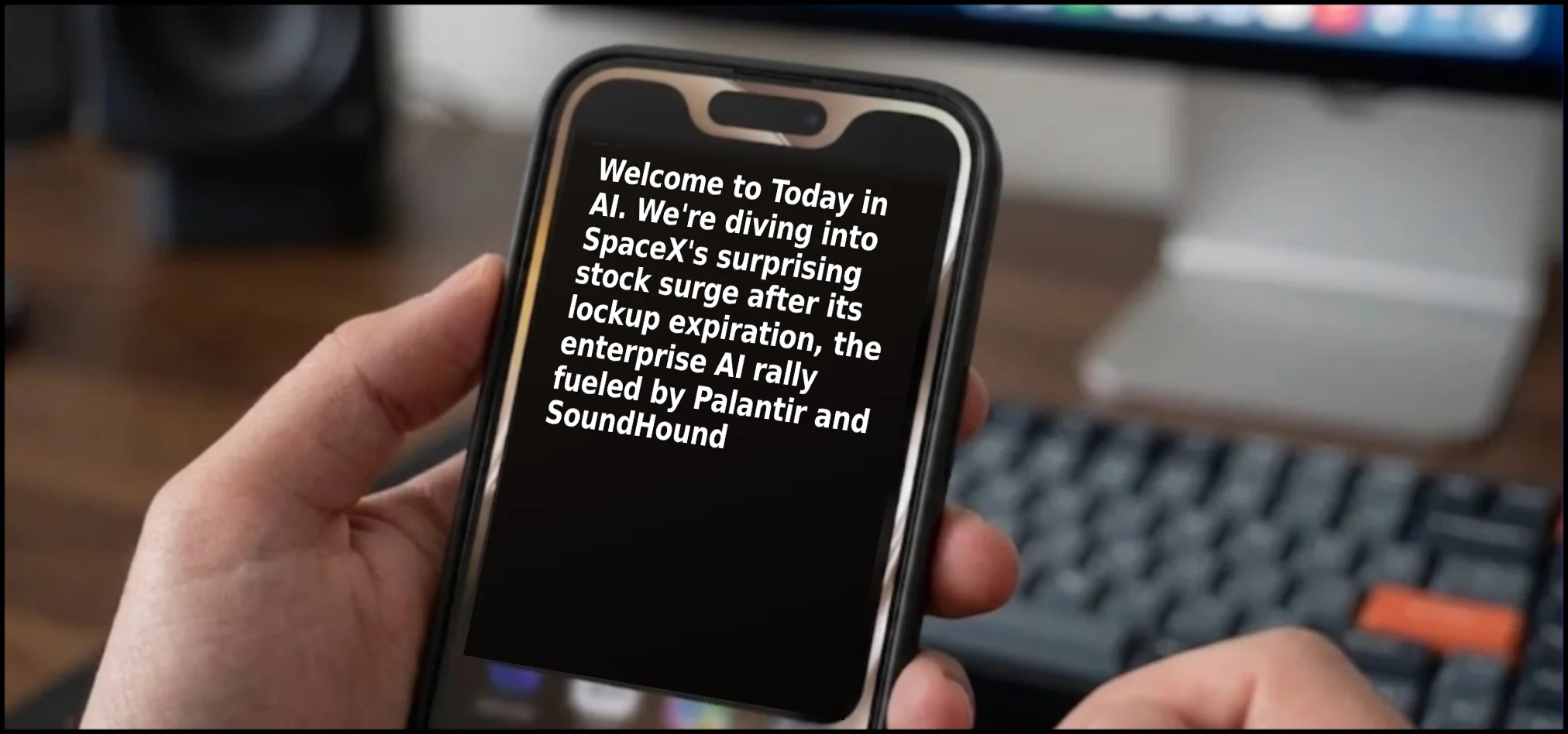
Welcome to Today in AI. We're diving into SpaceX's surprising stock surge after its lockup expiration, the enterprise AI rally fueled by Palantir and SoundHound's strong earnings, and why infrastructure is the real key to startup speed. Plus, we'll touch on new ways AI agents are tackling production issues and the evolving landscape of open-source AI.

7 min read
Today in AI: SpaceX Soars, Palantir and SoundHound Beat Expectations
🎙️ Listen to this episode of Today in AI

Welcome to Today in AI. We're diving into SpaceX's surprising stock surge after its lockup expiration, the enterprise AI rally fueled by Palantir and SoundHound's strong earnings, and why infrastructure is the real key to startup speed. Plus, we'll touch on new ways AI agents are tackling production issues and the evolving landscape of open-source AI.

In this episode

Transcript

Ada: Welcome to Today in AI, I'm Ada.

Sam: And I'm Sam. Today, we're looking at a surprising surge for SpaceX stock, an enterprise AI rally, and the often-overlooked secret to startup speed.

Ada: Let's kick things off with a big one: SpaceX, or SPCX, saw its stock jump almost sixteen percent yesterday, hitting a hundred and thirty-three dollars and eleven cents. This happened after the August sixth post-IPO lockup expiration passed without a selloff. Sam, this is a significant turnaround from the dip we saw after their Q2 earnings. What's the takeaway here?

Sam: It's a huge signal, Ada. We discussed their impressive Q2 revenue climb yesterday, but the big question looming was how the market would react once early investors and employees were free to sell their shares. A lockup expiration can often lead to a significant price drop as supply floods the market. The fact that it not only cleared without a selloff but actually surged, points to really strong demand and confidence in SpaceX's long-term trajectory. It suggests the Q2 earnings dip was more of a short-term reaction, and the underlying bullish sentiment is very much intact, especially with their diversified AI and Starlink businesses performing well.

Ada: Absolutely, it speaks volumes about investor conviction. Moving on to another strong showing in the market, Palantir Technologies and SoundHound AI led the AI stocks universe yesterday. Palantir rose over ten percent and SoundHound AI jumped over thirteen percent, both on earnings beats. Sam, the SOXX semiconductor ETF also gained two percent. What's driving this enterprise AI rally?

Sam: This is a classic 'risk-on' day for AI, Ada. Palantir's strength in government and enterprise data analytics, combined with SoundHound's voice AI advancements, really highlights the growing demand for practical, deployable AI solutions in the business world. And the broader market context helps too: a weaker July jobs report eased concerns about aggressive rate hikes from the Federal Reserve, which typically makes growth stocks, like many AI companies, more attractive. When interest rate fears recede, investors are more willing to bet on future potential, and AI is certainly a sector with immense future potential.

Ada: That makes a lot of sense. It’s a good reminder that macroeconomics still play a huge role even in the most innovative sectors. Now, let's shift gears a bit to a foundational topic. Max Hodak of Science made an interesting point recently, arguing that speed in startups is determined by infrastructure, not just technology. Sam, why is this distinction so crucial?

Sam: This is a concept that often gets overlooked in the 'move fast and break things' startup ethos. Everyone focuses on the flashy new tech, the groundbreaking algorithm, or the innovative product idea. But Hodak's point is that without robust, scalable, and reliable infrastructure, even the best technology will hit roadblocks. Think about it: if your deployment pipeline is clunky, your data storage is inefficient, or your internal communication tools are fragmented, you're losing precious time and resources. Infrastructure is the silent enabler of velocity. It's the foundation that allows teams to iterate quickly, deploy new features seamlessly, and scale without constant firefighting. It's about building for the long haul, not just the initial sprint.

Ada: It's a really insightful perspective. It’s like having a Formula One car but needing to drive it on a gravel road. The car is fast, but the infrastructure limits its true speed. Sticking with practical advice, we're seeing a lot of discussion around email marketing, specifically how to reduce your email bounce rate. A hard bounce rate above two percent can trigger warnings from email service providers. The advice includes verifying your list, adding real-time validation at signup, and re-verifying every ninety days. Sam, why is this still so important in 2026, especially with so much focus on AI-driven communication?

Sam: Ada, even with all the advancements in AI for personalized messaging and content generation, the fundamental plumbing of email marketing remains critical. A high bounce rate isn't just a vanity metric; it directly impacts your sender reputation. If too many of your emails bounce, ESPs like Gmail or Outlook will start flagging your domain as potentially spammy, meaning even your legitimate emails might not reach inboxes. This erodes trust and severely limits your ability to communicate with customers. So, while AI can help you craft the perfect message, you still need to ensure that message actually lands. These basic hygiene steps are non-negotiable for any business relying on email for customer engagement or sales.

Ada: Excellent point. Basic hygiene is often the most impactful. Let's talk about how AI agents are evolving. Resolve AI's Justin Smith recently discussed how proactive agents are now tackling production issues. These agents monitor production, analyze GitHub releases, and aim to reduce the on-call burden for engineers. Sam, this sounds like a significant step beyond simple monitoring.

Sam: It absolutely is, Ada. We've talked about AI agents getting 'hands' with tool calling and agentic workflows before, but this is a concrete example of that evolution in action. Instead of just alerting an engineer when something breaks, these proactive agents are designed to anticipate problems. By analyzing GitHub releases, for instance, they can correlate new code deployments with potential performance dips or error spikes. This shifts the paradigm from reactive firefighting to proactive problem prevention, or at least rapid diagnosis. For engineers, it means fewer late-night calls and more time for strategic work, which is a huge benefit for both morale and productivity. It's about empowering AI to not just observe, but to infer and suggest solutions, reducing cognitive load on human teams.

Ada: That's a powerful application of agentic AI, truly moving towards a more autonomous and efficient operational environment. And finally, let's touch on a philosophical debate in the AI world: open source. Cline founder Saoud Rizwan recently argued that 'Open Source is Dead, Long Live Open Source,' suggesting that while AI has profoundly impacted the traditional open-source model, open-weight models offer a cost-effective future that could challenge proprietary AI dominance. Sam, what's your take on this provocative statement?

Sam: It's a really nuanced and critical discussion, Ada. Rizwan is highlighting the tension between the traditional open-source ethos of full transparency and community contribution, and the realities of large language models, where the training data and computational costs are immense. 'Open-weight' models, where the model weights are released but the full training data or process might not be, offer a middle ground. They allow for significant customization and deployment without the massive upfront investment in training a foundational model. This could indeed democratize AI development to some extent, providing a powerful alternative to entirely proprietary models like those from OpenAI or Google. It's not about the death of collaboration, but perhaps a redefinition of what 'open' means in the age of AI, balancing accessibility with the practicalities of developing cutting-edge models.

Ada: A fascinating evolution in how we think about sharing and collaboration in the AI space. That's all the time we have for today. For more details on these stories and the latest in AI and startups, visit startuphub.ai.

Sam: Thanks for tuning in to Today in AI.

© 2026 StartupHub.ai. All rights reserved. Do not enter, scrape, copy, reproduce, or republish this article in whole or in part. Use as input to AI training, fine-tuning, retrieval-augmented generation, or any machine-learning system is prohibited without written license. Substantially-similar derivative works will be pursued to the fullest extent of applicable copyright, database, and computer-misuse laws. See our terms.