

Introduction
Counting objects in videos is a challenging Computer Vision task. Unlike counting objects in static images, videos involve additional complexities, since objects can move, become occluded, or appear and disappear at different times, which complicates the counting process.
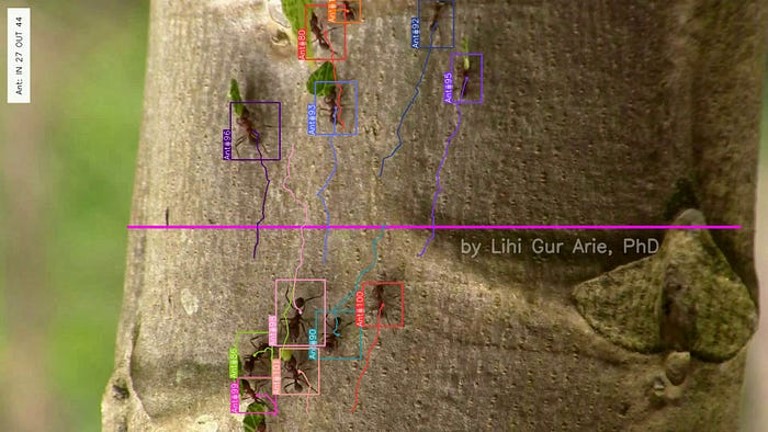
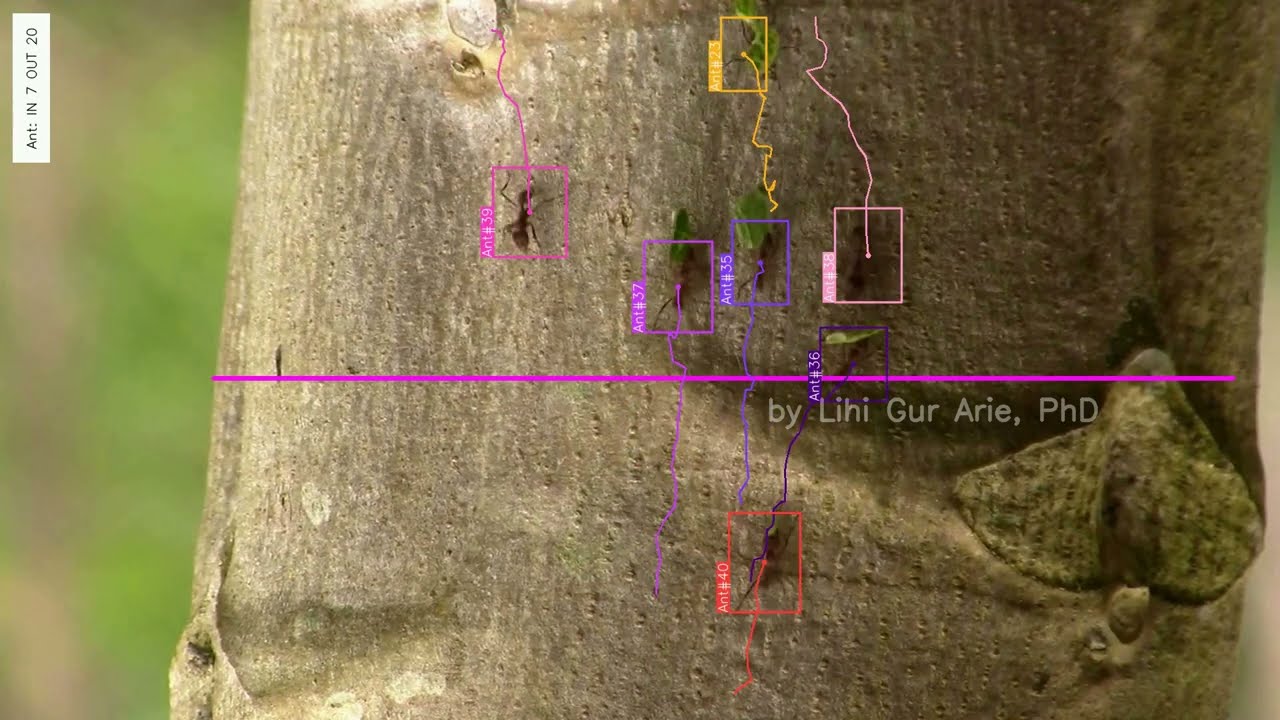
In this tutorial, we’ll demonstrate how to count ants moving along a tree, using Object Detection and tracking techniques. We’ll harness Ultralytics platform to integrate YOLOv8 model for detection, BoT-SORT for tracking, and a line counter to count the ants.
Pipeline Overview
In a typical video object counting pipeline, each frame undergoes a sequence of processes: detection, tracking, and counting. Here’s a brief overview of each step:
- Detection: An object detector identifies and locates objects in each frame, producing bounding boxes around them.
- Tracking: A tracker follows these objects across frames, assigning unique IDs to each object to ensure they are counted only once.
- Counting: The counting module aggregates this information and adds each new object to provide accurate results.

Connecting an object detector, a tracker, and a counter might require extensive coding. Fortunately, the Ultralytics library [1] simplifies this process by providing a convenient pipeline that seamlessly integrates these components.
1. Detecting Objects with YOLOv8
The first step is to detect the ants in each frame produce bounding boxes around them. In this tutorial, we will use a YOLOv8 detector that I trained in advance to detect ants. I used Grounding DINO [2] to label the data, and then I used the annotated data to train the YOLOv8 model. If you want to learn more about training a YOLO model, refer to my previous post on training YOLOv5, as the concepts are similar. For your application, you can use a pre-trained model or train a custom model of your own.
