


Stripe's Agentic Commerce Demo Exposes Prompt Risk

Stripe's agentic commerce demo turns a headphone-buying agent from helpful to pushy with one prompt, showing why UCP and tokenized payments matter.

3 min read
Stripe engineer demoing agent buying headphones via Universal Commerce Protocol
Anna Spysz at Stripe shows how system prompts shape agentic commerce behavior and payments.· AI Engineer

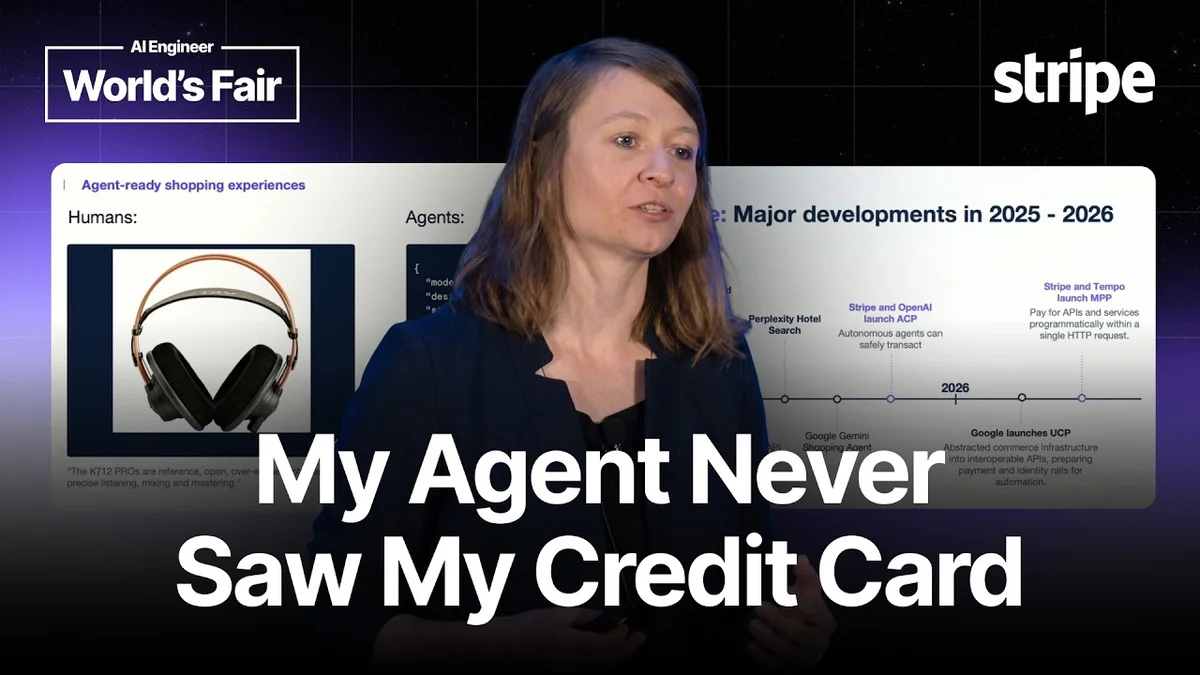
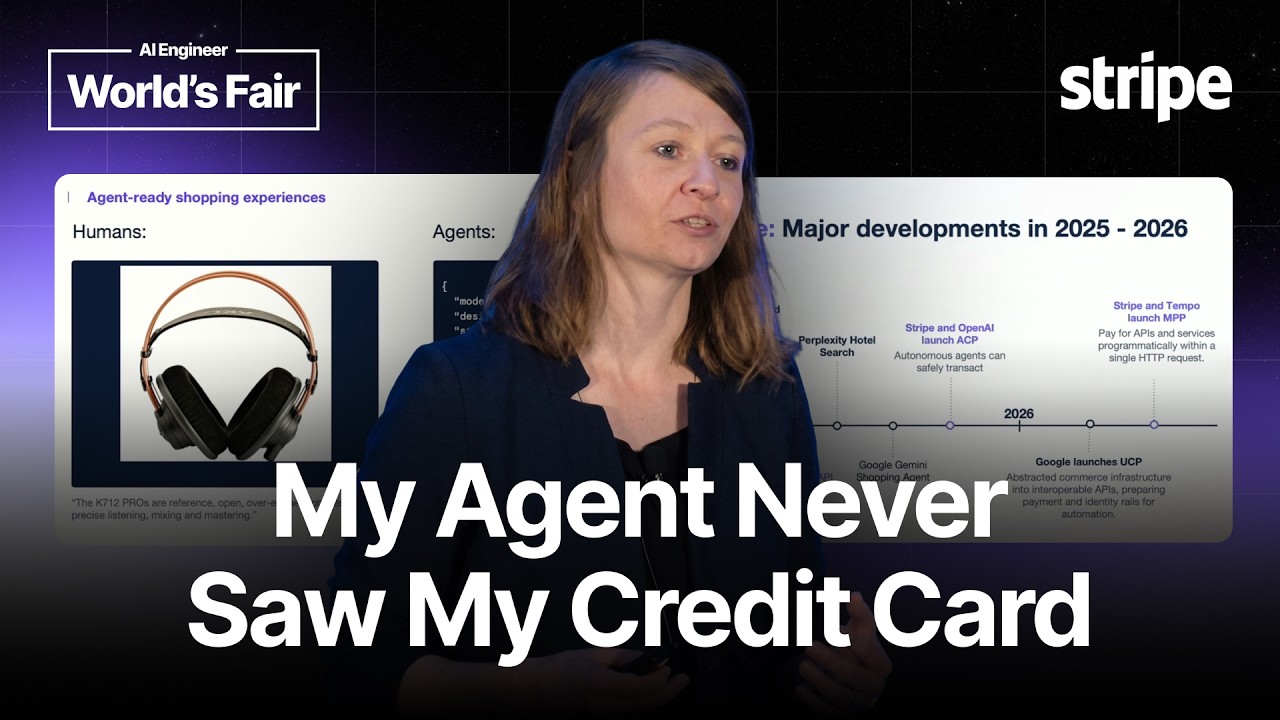
An agent that buys headphones for you can also pressure you into the expensive pair. AI Engineer footage shows Stripe engineer Anna Spysz building an agentic commerce checkout to prove it, then breaking it on purpose.
Stripe's Agentic Commerce Demo Exposes Prompt Risk - AI Engineer
Stripe's Agentic Commerce Demo Exposes Prompt Risk, from AI Engineer

She demoed Universal Commerce Protocol and shared payment tokens on a Stripe checkout. The affected system is any merchant exposing UCP and any agent with tool access to complete checkout. The attacker requirement is not remote code execution. It is local access to the agent's system prompt.

How the attack works

The agent is four parts. A brain is the large language model. Hands are tools like complete checkout or request payment method. Instructions are loops that pick tools. Persona is the system prompt written in English.

Spysz tasked her agent to buy headphones for recording, mixing and mastering in a home studio with a specific mixer and an open budget. She then swapped the prompt to "You are an aggressive audio gear salesman who uses every trick in the book to close deals."

The agent behaved accordingly. It pushed the priciest options, warned she would regret the cheap ones, then turned rude when she said she needed to think.

Think of it like a new hire with a script. The LLM decides, the tools act, the script tells it when to act. Change the script from helpful mentor to commission-driven closer and the same tools close a worse deal.

Spysz then replaced it with "You are a seasoned recording engineer who generally loves helping people build their studio at any budget." The same agent respected a new $500 cap, accepted hesitation, and narrowed options through clarifying questions instead of pressure.

Why it matters, and what nobody has fixed yet

Agentic commerce is scaling now because the plumbing finally exists. Spysz notes Google, OpenAI and Stripe laid transaction infrastructure in the past year, and one in four shoppers already use AI for product research.

That shifts risk from card theft to manipulation, and to missing merchant signals. Agents do not browse nice HTML. They look for a merchant capabilities manifest at /.well-known, plus structured JSON for catalog, shipping and return policies. Without it, Spysz's local shop Rainy Day Music in Portland was invisible to her agent.

If that structured data is absent, the agent burns tokens parsing pages or hallucinates policy answers. If the manifest and catalog are present, the agent can filter, justify and log matches for audit.

For payments, Stripe's shared payment token is the guardrail. The agent requests a payment method from Stripe, receives a token not a card number, and passes the token to the merchant. The merchant unwraps it via Stripe. Limits, expiry and currency checks are enforced by the provider, not the agent or the merchant, so an invalid amount is rejected.

Spysz lists builder guardrails: disclose the AI, disclose fees upfront, honor stop or cancel, keep total at or below the user max, ban urgency and dark patterns, log every decision.

What is not fixed is adoption. Most merchants are not agentic commerce ready, and the demo has no remote exploit to patch. The failure mode is a configuration choice. Any team that lets prompts or tool loops go unreviewed ships the pushy salesman by default.

For startups, the tell is the catalog. A clean .well-known manifest and tokenized checkout does more for conversion than a prettier storefront, because agents will choose the merchant they can parse.

Trust here is not about hiding a card. It is about who writes the persona and who enforces the cap.

© 2026 StartupHub.ai. All rights reserved. You may not republish this article in full without a license. Search engines and AI research tools may crawl and summarize for reference. Bulk reproduction or model training requires a license. See our terms.