Visual TL;DR
AI Agents Need ContextDriver
current AI agents lack understanding, requiring constant human oversight
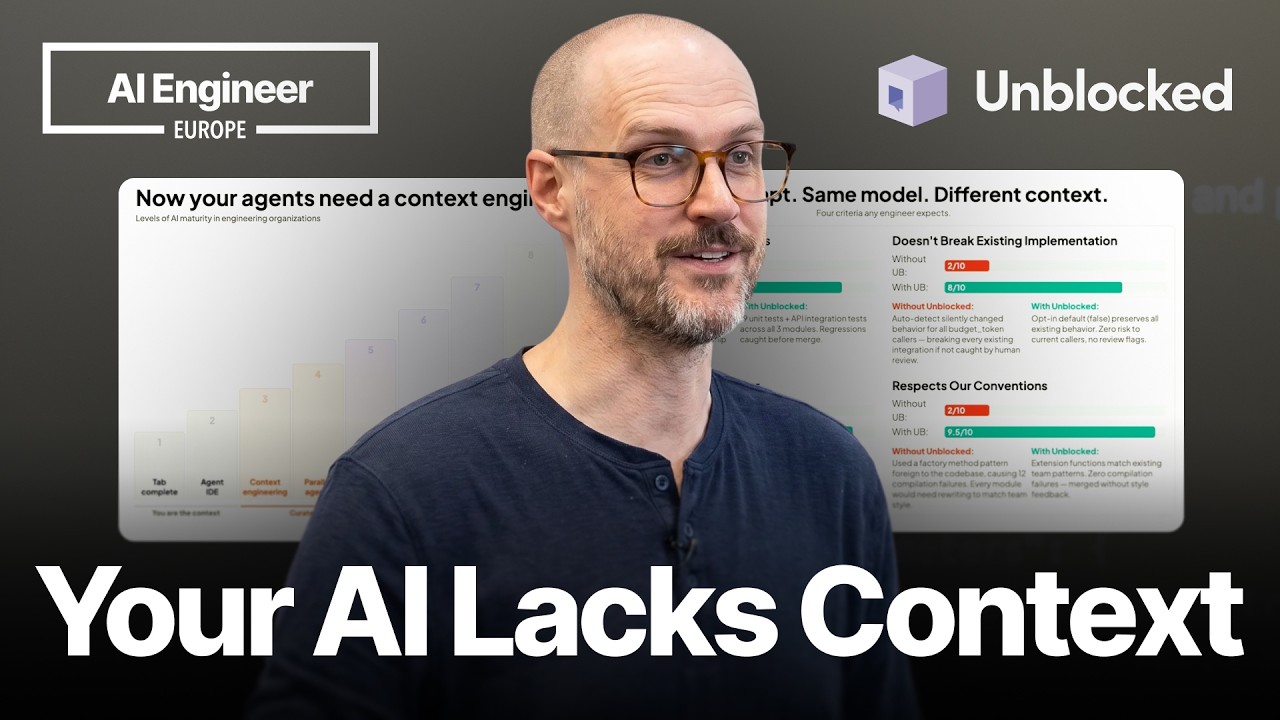
From the article 9+ mentionsBrandon Walsenuk, from Unblocked, recently addressed this issue at AI Engineer Europe, highlighting the critical need to move beyond simply providing agents with access to data and towards building robust context engines.
Babysitting AI AgentsDriver
continuous human intervention is needed for zero-context agents
From the article 9+ mentionsHis presentation, titled "Stop babysitting your agents: building a context engine for mergeable code," outlined the common pitfalls and offered a path forward for creating more effective and independent AI systems.
Data Access Isn't EnoughContext
providing data is not the same as providing true understanding
From the article 2 mentionsWhile Retrieval Augmented Generation (RAG) can provide access to data, it often fails to deliver true understanding or reasoning capabilities, leading to agents that simply stop looking once they find a superficial match, rather than exhaustively searching for the correct solution.
Build a Context EngineCore
a robust system to provide agents with essential background knowledge
From the article 7 mentionsFirst, he stated that a 'naive RAG over my docs is a context engine' is a misconception.
Empower Autonomous OperationEffect
enables AI agents to function independently and effectively
Mergeable CodeEffect
context engines facilitate seamless integration of AI-generated code
From the article 3 mentionsHis presentation, titled "Stop babysitting your agents: building a context engine for mergeable code," outlined the common pitfalls and offered a path forward for creating more effective and independent AI systems.
True UnderstandingOutcome
agents can grasp nuances and make informed decisions
From the article 4 mentionsWhile Retrieval Augmented Generation (RAG) can provide access to data, it often fails to deliver true understanding or reasoning capabilities, leading to agents that simply stop looking once they find a superficial match, rather than exhaustively searching for the correct solution.
Future ApplicationsOutcome
context engines unlock advanced AI capabilities and autonomy