

Steven Willmott on Spec-Driven Testing for AI Agents

Steven Willmott of SafeIntelligence discusses spec-driven testing for AI agents, emphasizing the need for clear specifications beyond traditional datasets to ensure robustness and safety.

8 min read
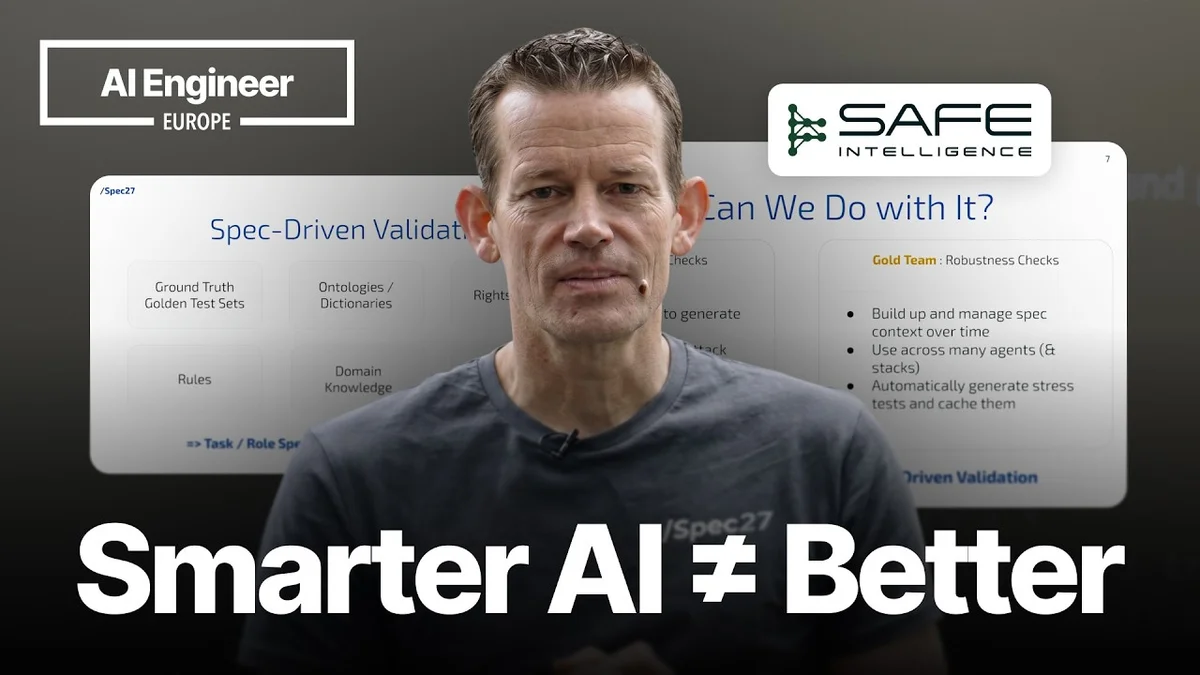
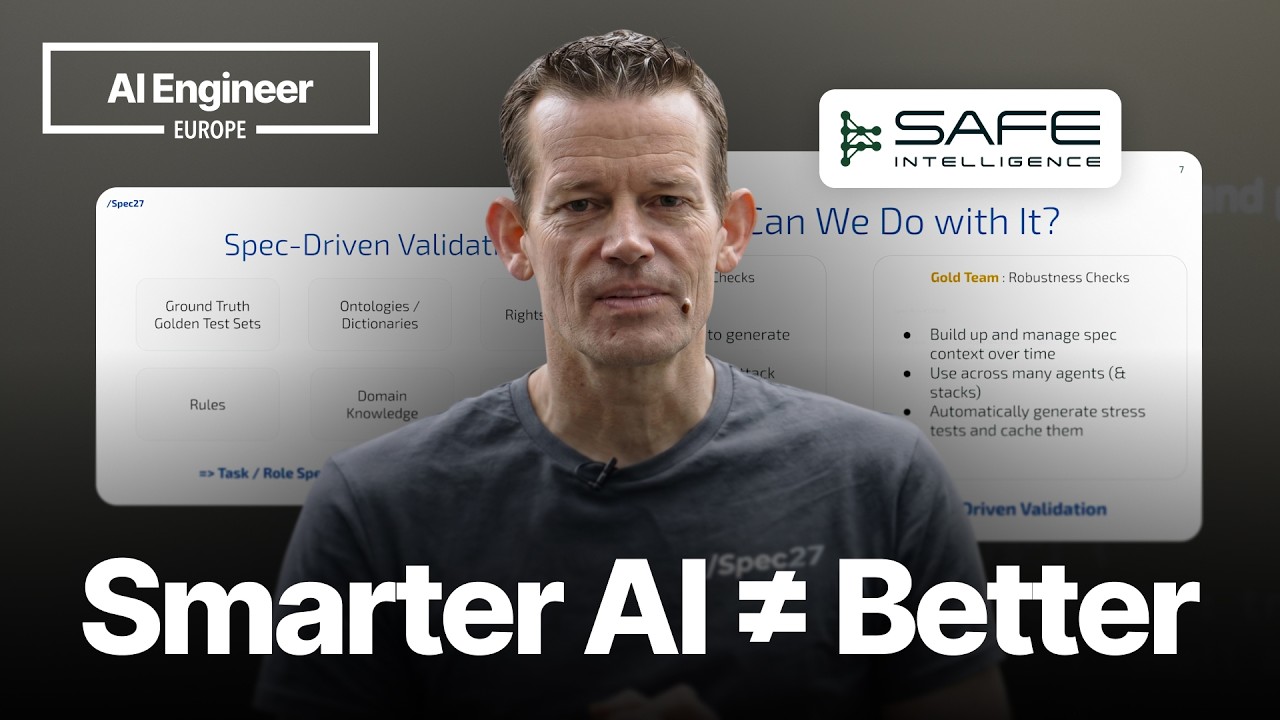
Steven Willmott presenting on Spec-Driven Testing for AI Agents at AI Engineer Europe.
AI Engineer

Steven Willmott, CEO of SafeIntelligence, delivered a compelling talk at AI Engineer Europe 2026 on the critical topic of "Spec-Driven Testing for Agents With A Brain the Size of A Planet." Willmott highlighted the growing need for robust validation methods for AI agents, especially as they become more complex and capable of performing a wider range of tasks.

Steven Willmott on Spec-Driven Testing for AI Agents - AI Engineer
Steven Willmott on Spec-Driven Testing for AI Agents — from AI Engineer

Visual TL;DR. AI Agent Complexity leads to Traditional Testing Limits. Traditional Testing Limits requires Spec-Driven Validation. Spec-Driven Validation involves Agent Specifications. Agent Specifications addresses Defining "Good" & "Harm". Spec-Driven Validation enables Ensuring Robustness & Safety. Defining "Good" & "Harm" to achieve Ensuring Robustness & Safety. Ensuring Robustness & Safety drives Industry Progress.

  1. AI Agent Complexity: increasingly complex AI agents perform wider range of tasks
  2. Traditional Testing Limits: dataset-based evaluations insufficient for complex agent behaviors
  3. Spec-Driven Validation: clear specifications beyond datasets for robust AI testing
  4. Agent Specifications: defining key components for AI agent behavior and safety
  5. Defining "Good" & "Harm": challenge of specifying desired outcomes and preventing negative impacts
  6. Ensuring Robustness & Safety: goal of spec-driven testing for AI agent reliability
  7. Industry Progress: advancements in spec-driven testing methodologies and tools
Visual TL;DR
Visual TL;DR — startuphub.ai AI Agent Complexity leads to Traditional Testing Limits. Traditional Testing Limits requires Spec-Driven Validation. Spec-Driven Validation enables Ensuring Robustness & Safety. Defining "Good" & "Harm" to achieve Ensuring Robustness & Safety leads to requires enables to achieve AI Agent Complexity Traditional Testing Limits Spec-Driven Validation Defining "Good" & "Harm" Ensuring Robustness & Safety From startuphub.ai · The publishers behind this format
Visual TL;DR — startuphub.ai AI Agent Complexity leads to Traditional Testing Limits. Traditional Testing Limits requires Spec-Driven Validation. Spec-Driven Validation enables Ensuring Robustness & Safety. Defining "Good" & "Harm" to achieve Ensuring Robustness & Safety leads to requires enables to achieve AI AgentComplexity TraditionalTesting Limits Spec-DrivenValidation Defining "Good" &"Harm" EnsuringRobustness &… From startuphub.ai · The publishers behind this format
Visual TL;DR — startuphub.ai AI Agent Complexity leads to Traditional Testing Limits. Traditional Testing Limits requires Spec-Driven Validation. Spec-Driven Validation enables Ensuring Robustness & Safety. Defining "Good" & "Harm" to achieve Ensuring Robustness & Safety leads to requires enables to achieve AI Agent Complexity increasingly complex AI agents performwider range of tasks Traditional Testing Limits dataset-based evaluations insufficient forcomplex agent behaviors Spec-Driven Validation clear specifications beyond datasets forrobust AI testing Defining "Good" & "Harm" challenge of specifying desired outcomesand preventing negative impacts Ensuring Robustness & Safety goal of spec-driven testing for AI agentreliability From startuphub.ai · The publishers behind this format
Visual TL;DR — startuphub.ai AI Agent Complexity leads to Traditional Testing Limits. Traditional Testing Limits requires Spec-Driven Validation. Spec-Driven Validation enables Ensuring Robustness & Safety. Defining "Good" & "Harm" to achieve Ensuring Robustness & Safety leads to requires enables to achieve AI AgentComplexity increasinglycomplex AI agentsperform wider range… TraditionalTesting Limits dataset-basedevaluationsinsufficient for… Spec-DrivenValidation clearspecificationsbeyond datasets for… Defining "Good" &"Harm" challenge ofspecifying desiredoutcomes and… EnsuringRobustness &… goal of spec-driventesting for AIagent reliability From startuphub.ai · The publishers behind this format
Visual TL;DR — startuphub.ai AI Agent Complexity leads to Traditional Testing Limits. Traditional Testing Limits requires Spec-Driven Validation. Spec-Driven Validation involves Agent Specifications. Agent Specifications addresses Defining "Good" & "Harm". Spec-Driven Validation enables Ensuring Robustness & Safety. Defining "Good" & "Harm" to achieve Ensuring Robustness & Safety. Ensuring Robustness & Safety drives Industry Progress leads to requires involves addresses enables to achieve drives AI Agent Complexity increasingly complex AI agents performwider range of tasks Traditional Testing Limits dataset-based evaluations insufficient forcomplex agent behaviors Spec-Driven Validation clear specifications beyond datasets forrobust AI testing Agent Specifications defining key components for AI agentbehavior and safety Defining "Good" & "Harm" challenge of specifying desired outcomesand preventing negative impacts Ensuring Robustness & Safety goal of spec-driven testing for AI agentreliability Industry Progress advancements in spec-driven testingmethodologies and tools From startuphub.ai · The publishers behind this format
Visual TL;DR — startuphub.ai AI Agent Complexity leads to Traditional Testing Limits. Traditional Testing Limits requires Spec-Driven Validation. Spec-Driven Validation involves Agent Specifications. Agent Specifications addresses Defining "Good" & "Harm". Spec-Driven Validation enables Ensuring Robustness & Safety. Defining "Good" & "Harm" to achieve Ensuring Robustness & Safety. Ensuring Robustness & Safety drives Industry Progress leads to requires involves addresses enables to achieve drives AI AgentComplexity increasinglycomplex AI agentsperform wider range… TraditionalTesting Limits dataset-basedevaluationsinsufficient for… Spec-DrivenValidation clearspecificationsbeyond datasets for… AgentSpecifications defining keycomponents for AIagent behavior and… Defining "Good" &"Harm" challenge ofspecifying desiredoutcomes and… EnsuringRobustness &… goal of spec-driventesting for AIagent reliability Industry Progress advancements inspec-driven testingmethodologies and… From startuphub.ai · The publishers behind this format

Understanding the Need for Spec-Driven Validation

Willmott began by posing a fundamental question: "A Smarter Agent is a Better Agent, Right?" He then challenged this assumption by pointing out the potential pitfalls of simply increasing an AI model's intelligence. Larger models can be more susceptible to jailbreaks, have a broader surface area for exploitation, and often come with higher costs and slower speeds. This sets the stage for the importance of rigorous testing beyond traditional dataset-based evaluations.

Related startups

The core of Willmott's presentation focused on the concept of "spec-driven validation." He explained that for AI agents, particularly those designed for complex tasks, simply having a dataset of examples is insufficient. The validation process needs to be more sophisticated, ensuring that agents not only perform their tasks but also do so within defined safety and behavioral boundaries.

Key Components of Agent Specifications

Willmott outlined several key components that are essential for defining and validating AI agents:

  • Ground Truth Golden Test Sets: These are curated sets of examples that represent the desired behavior and outcomes for the agent.
  • Ontologies / Dictionaries: These provide a structured understanding of the domain the agent operates in, defining terms, relationships, and constraints.
  • Rules: Explicit, programmable rules that the agent must adhere to, such as "no discounts over 20%" or "always be polite."
  • Domain Knowledge: The contextual information and understanding the agent needs to operate effectively within its specific domain, including scientific knowledge or general safety knowledge.
  • Robustness Requirements: Specifications that ensure the agent can handle variations, perturbations, and unexpected inputs without failing or behaving erratically.
  • Rights & Roles: Defining the permissions, data access, and autonomy levels for the agent, ensuring it operates within its intended scope.

Willmott emphasized that these components collectively form a "Task / Role Specific Benchmark or Integration Test." The goal is to move beyond simple performance metrics to a more comprehensive understanding of an agent's behavior and its alignment with specified requirements.

The Challenge of Defining "Good" and "Harm"

A significant challenge in AI agent validation, as highlighted by Willmott, is the difficulty in precisely defining what constitutes "good" behavior and what constitutes "harm." He noted that while it's relatively straightforward to define "good" with a dataset of correct inputs and outputs, defining "harm" is more complex. An agent might fail to perform its task correctly, or it might perform the task in a way that is detrimental or unintended, even if it technically fulfills the prompt.

Willmott illustrated this with an example of a customer support agent: "If you're building an airline chat bot, you might have specifications like 'never give a discount over 20%' or 'always be polite.' But how do you define what good looks like, and what harm looks like for that matter?" He elaborated that an agent's specifications need to be detailed enough to cover edge cases and potential unintended consequences.

Industry Progress and Future Directions

Willmott showcased examples of industry progress, including different prompt management platforms and "A2A Agent Cards," which are structured descriptions of an agent's capabilities and specifications. He pointed out that while many platforms allow for detailed prompt management, ensuring that these specifications translate into actual agent behavior is an ongoing challenge.
The presentation concluded with a call to action: "Start Thinking in Agent Specs." Willmott encouraged the audience to focus on specifying agent behavior, ensuring independence from implementation details, closing the development loop, and creating reusable behavioral specifications. He also outlined future directions, including work on formats, tools, and experience to better capture and test these agent specifications.

© 2026 StartupHub.ai. All rights reserved. Do not enter, scrape, copy, reproduce, or republish this article in whole or in part. Use as input to AI training, fine-tuning, retrieval-augmented generation, or any machine-learning system is prohibited without written license. Substantially-similar derivative works will be pursued to the fullest extent of applicable copyright, database, and computer-misuse laws. See our terms.