

IBM Experts Unpack AI Agent Interoperability

IBM's Anna Gutowska and Martin Keen discuss the Agent-to-Agent Protocol (A2A) and Model Context Protocol (MCP) for enabling AI agent collaboration.

6 min read
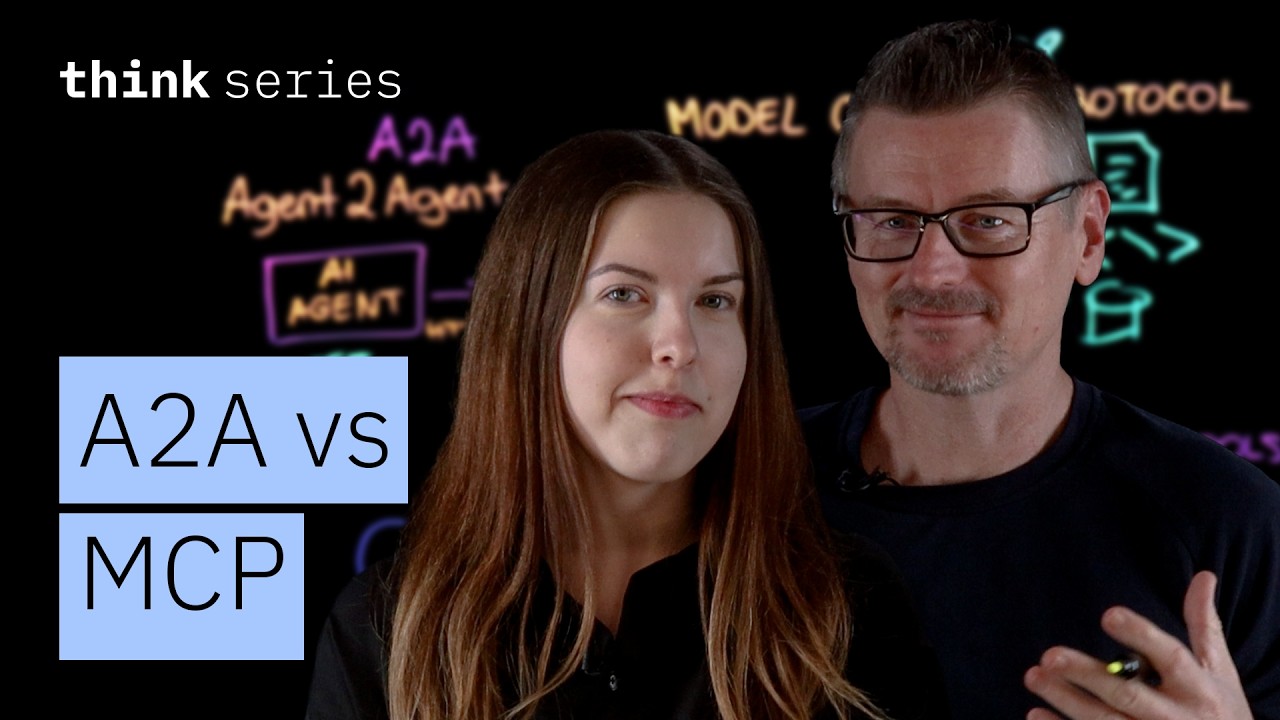
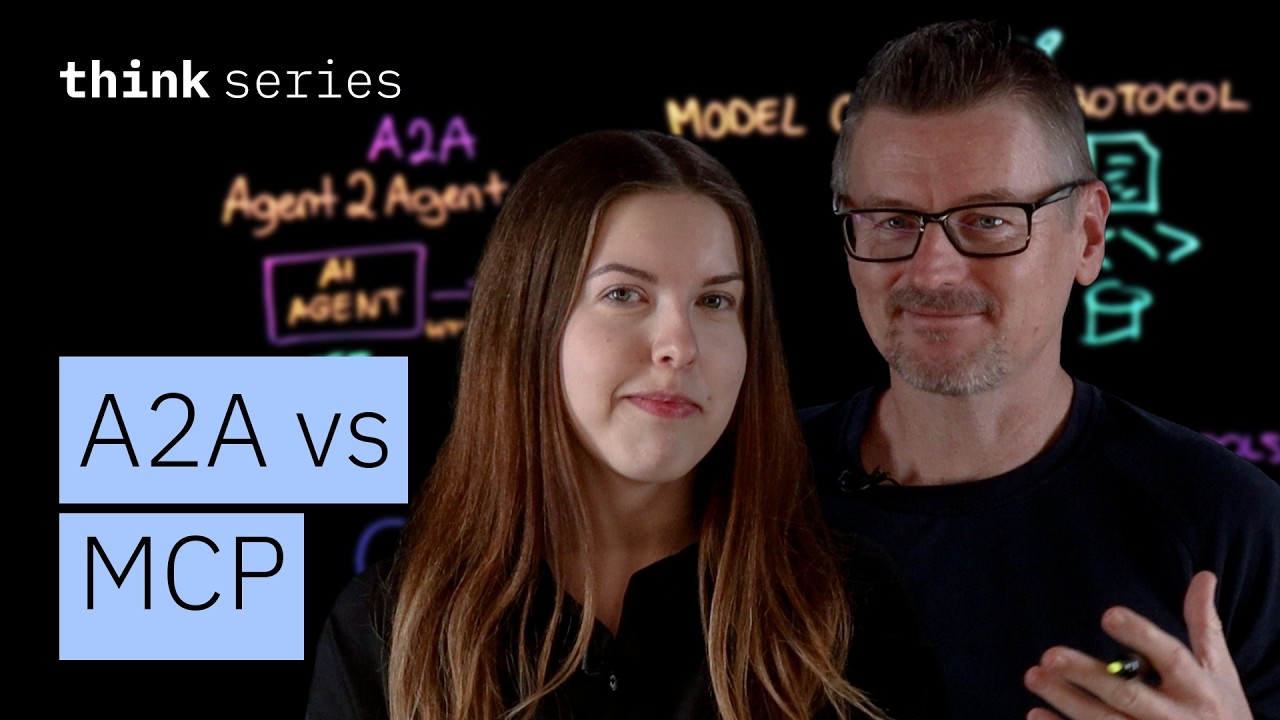
Anna Gutowska and Martin Keen from IBM discussing AI agents.
A2A vs MCP: AI Agent Communication Explained — IBM on YouTube

In a recent insightful discussion, IBM's Anna Gutowska, an AI Engineer, and Martin Keen, a Master Inventor, delved into the complexities and solutions for enabling AI agents to communicate and collaborate effectively. Their conversation, presented as part of IBM's "think series," shed light on the critical need for standardized protocols that allow diverse AI systems to interact, a fundamental step towards more sophisticated and integrated AI applications.

Meet the IBM AI Experts

Anna Gutowska, an AI Engineer at IBM, brings a practical, hands-on approach to developing and implementing AI solutions. Her work focuses on the engineering challenges and real-world applications of artificial intelligence.

Martin Keen, a Master Inventor at IBM, is a seasoned innovator with a deep understanding of cutting-edge technologies. His role involves pioneering new concepts and driving technological advancement within IBM.

The full discussion can be found on IBM's YouTube channel.
A2A vs MCP: AI Agent Communication Explained — from IBM

The Challenge of Isolated AI Agents

Keen opened the discussion by highlighting a common perception of AI agents: they are often seen as isolated entities, capable of reasoning and generating output independently. However, the true power of AI lies in its potential for collaboration. Gutowska elaborated on this, explaining that while agents can perform tasks on their own, the challenge arises when they need to interact with existing infrastructure, such as data stores or code repositories.

"AI agents are kind of isolated," Keen observed. "They can generate stuff by themselves, but how does one agent talk to another agent or talk to your existing infrastructure?" This is where the conversation becomes intricate, as it touches upon the need for common languages and protocols.

Introducing the Agent-to-Agent Protocol (A2A)

To bridge this gap, Gutowska introduced the concept of the "Agent 2 Agent Protocol," or A2A. She explained that A2A is essentially a standardized way for AI agents to communicate and work together, regardless of their underlying frameworks or vendors. "A2A is short for Agent-to-Agent Protocol," she stated. "Essentially, siloed agents can communicate and work together, regardless of differing vendors or frameworks."

This protocol defines how agents can exchange messages, request tasks, and share information. Gutowska further clarified the mechanics: "These messages can be requests, responses, negotiation, or coordination steps." The underlying transport mechanism for A2A is standard HTTP, leveraging familiar web technologies for broad compatibility.

The Role of the Agent Card

A key enabler for A2A's effectiveness is the concept of an "Agent Card." Keen described this as a standardized descriptor that allows agents to advertise their capabilities. "An agent card is a standardized descriptor that advertises what they can do," he explained. "Other agents can discover these cards dynamically and figure out what skills or services are offered." This is akin to a digital resume or service catalog for AI agents, enabling them to present their functionalities in a machine-readable format.

Gutowska added that this discovery process is crucial for agents to understand how to interact with each other. "Once discovered, agents can send structured messages or task requests to each other," she noted.

Bridging Diversity with A2A and MCP

The conversation then moved to the practical implications of A2A and its synergy with another proposed concept: the Model Context Protocol (MCP). Gutowska highlighted that A2A's use of JSON-RPC 2.0 for requests and responses makes it highly interoperable with existing web infrastructure.

Keen then posed a critical question about how agents with different modalities, such as text-based agents versus image-processing agents, can communicate. He drew an analogy to humans speaking different languages. Gutowska responded by emphasizing that A2A, by defining a common communication format, allows agents to exchange information regardless of their native modality.

"The magic is really in the data format and communication style," Gutowska stated. "A2A supports streaming updates via server-sent events, meaning one agent can push status updates or partial results to another in near real-time." This addresses scenarios where agents need to provide continuous feedback or report progress on long-running tasks.

MCP: The Context Layer for Agent Collaboration

The discussion introduced the Model Context Protocol (MCP) as a layer that sits above A2A. Keen explained that MCP provides agents with the necessary context to perform tasks effectively. "MCP is the layer where the AI agent doesn't need to know the specifics about how these resources are implemented," he stated. "It can discover and utilize them through predefined interfaces."

The MCP layer exposes specific primitives that agents can use to interact with various resources. These include:

  • Tools: Capabilities that the model can invoke, such as searching a database or executing code.
  • Resources: Data or information that the model can read, like files or database records.
  • Prompts: Pre-built text or data templates that guide the agent's behavior.

Keen elaborated on this by suggesting that an agent might use MCP to interact with a file system, a code repository, or even a database. The MCP server acts as an intermediary, translating the agent's requests into the specific protocols required by these underlying resources.

The Synergy of A2A and MCP

Gutowska then illustrated how A2A and MCP work together, using a retail inventory scenario. In this example, an "Inventory Agent" might detect low stock for a product. It would then use A2A to communicate this information to an "Order Agent." The Order Agent, in turn, might use MCP to discover and interact with external supplier agents to reorder the product. This demonstrates a sophisticated workflow where multiple agents, each with specialized capabilities, collaborate to fulfill a business process.

The conversation highlighted that by combining A2A's communication framework with MCP's context-aware resource management, AI agents can achieve a higher level of autonomy and collaboration. This allows for more complex tasks to be broken down and executed by specialized agents, leading to more efficient and intelligent systems.

The Future of Agent Interoperability

Keen concluded by emphasizing the importance of these protocols for building scalable and adaptable AI systems. The ability for agents to discover and utilize each other's capabilities, and to access external resources through standardized interfaces, is fundamental to the advancement of multi-agent AI systems. As AI continues to evolve, protocols like A2A and concepts like MCP will be crucial in unlocking the full potential of artificial intelligence.