


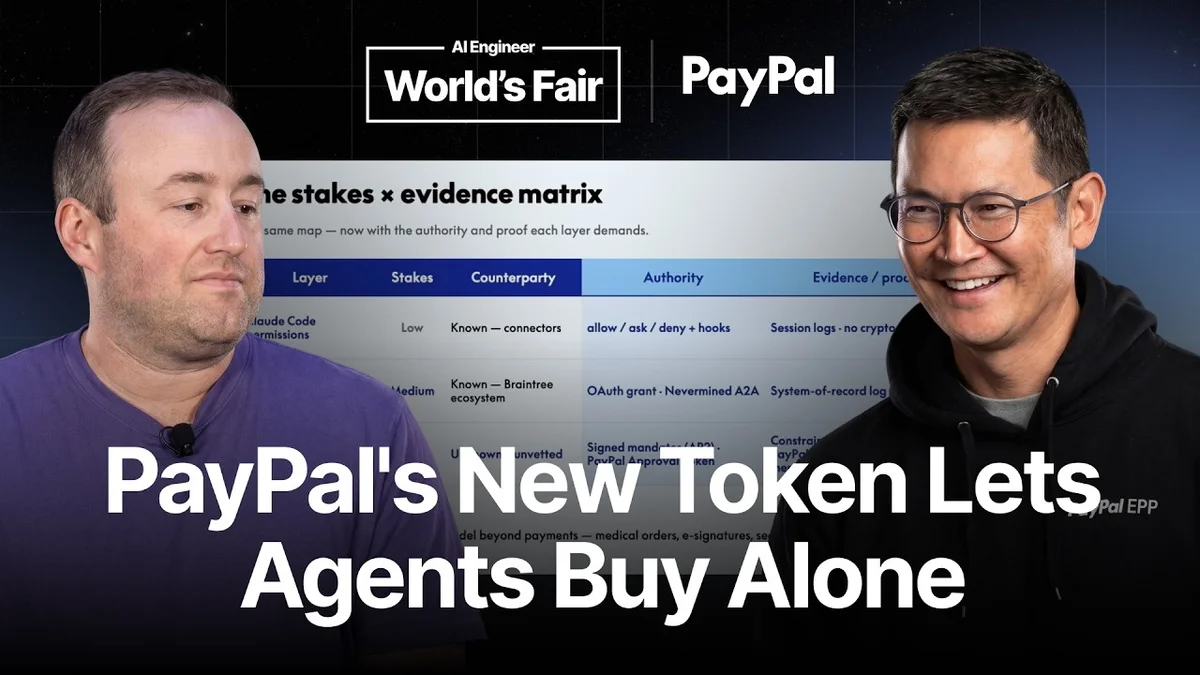
PayPal's Agent Authorization Model Explained

PayPal lays out a three-question test for agentic payments and previews its Approval Token as a step toward FIDO AP2 mandates.

S
StartupHub.ai Staff
3 min read
PayPal presentation on agent authorization and agentic payments at AI Engineer
Jay Mok and Ben Coumes detail PayPal's stakes and proof model for agentic payments· AI Engineer
Contents(3)

PayPal just laid out how it plans to keep agents from raiding your wallet, presenting a clear framework for agent authorization at AI Engineer.

StartupHub profiles of the companies this article names, with funding and a one-liner from our database.

PayPal
$9.9B
A global leader in digital payments, enabling individuals and businesses to send, receive, and manage money online.

OpenAI
$852.0B
OpenAI is an AI research and deployment company dedicated to ensuring that artificial general intelligence benefits all of humanity.
Chase Bank
$480.0B
A leading U.S. financial services firm offering a wide range of banking and investment services.

Bloomberg L.P.
$42.6B
Global financial, software, data, and media company providing real-time information and analytics.
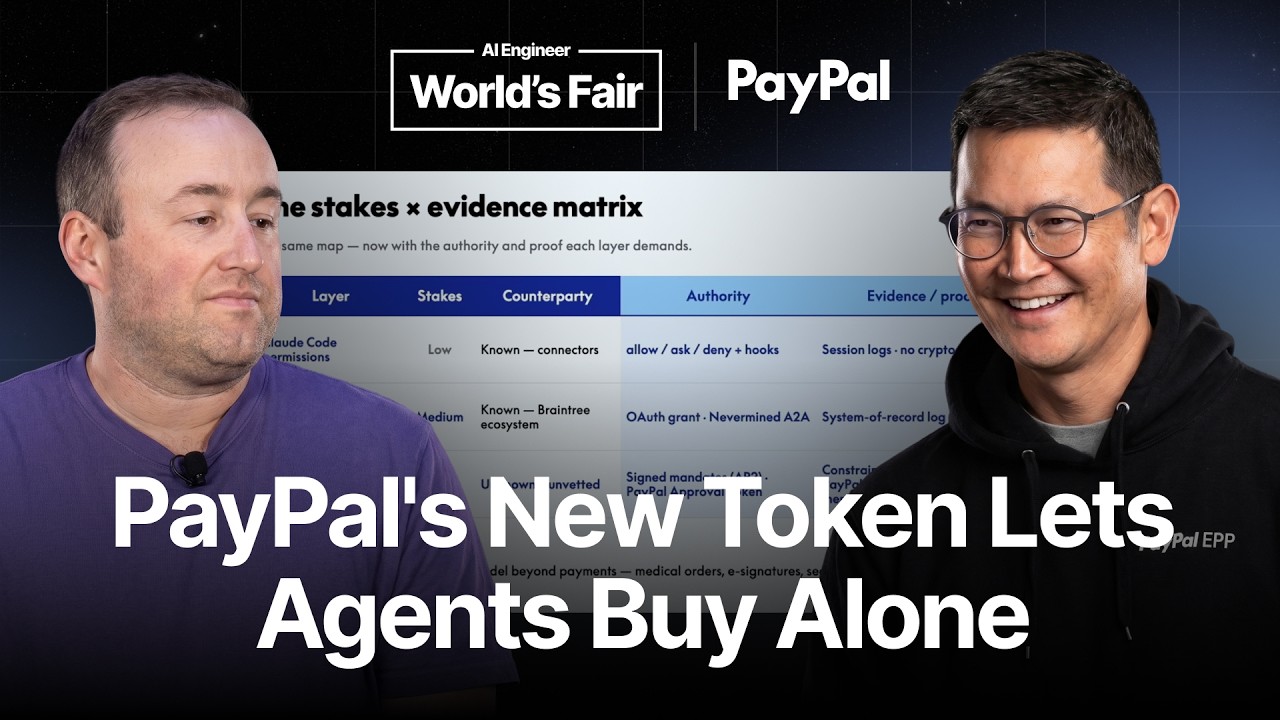
PayPal's Agent Authorization Model Explained - AI Engineer
PayPal's Agent Authorization Model Explained, from AI Engineer

Product manager Jay Mock and staff engineer Ben Coomes said the nightmare in 2026 isn't agents launching nukes. It's agents taking your wallet on a shopping spree for crypto.

The pair offered a mental model built on three questions. Did the human authorize this? Is it allowed right now in this scope? And can we prove it later?

In payments, that translates to a passkey-style consent, a time-bound token with amount and merchant limits, and a dispute-grade audit trail.

Why it matters for AI and startups

PayPal sorts risk by stakes and counterparty familiarity, then matches it to proof. Low-stakes coding with Claude Code lives in a closed network with allow, deny, or ask permissions, and logs plus revert are enough.

Medium-stakes money movement needs more control without heavy cryptography. The example: Nevermind using the PayPal and Braintree vault for stored credentials and exposing them to buyer and seller agents via OAuth scopes, as with a TripAdvisor-style data seller monetizing content to travel agents.

That pattern borrows trust from a shared platform, a useful bridge for startups selling data or services to agents today without building open-network signatures.

What still goes unanswered

For high-stakes open-network payments, where buyer and seller don't know each other, PayPal points to FIDO verifiable intents and Google's AP2 mandate. It's a selective-disclosure JWT with up to three layers: credential provider, user instructions signed by the user's private key, and agent signature.

The missing piece is portability. PayPal's new Approval Token implements the same idea for agentic checkout, a JSON payload with amount, expiry, and merchant returned after a redirect to PayPal, but Coomes noted it is currently an opaque string only PayPal can verify and is about to ship with early partners.

Until that becomes verifiable by any merchant or processor, founders can't treat it as an open standard, and reliability for hard-to-reverse actions like medical orders or trading remains unproven.

© 2026 StartupHub.ai. All rights reserved. You may not republish this article in full without a license. Search engines and AI research tools may crawl and summarize for reference. Bulk reproduction or model training requires a license. See our terms.
S

Written by

StartupHub.ai Staff

Editorial team

The staff writers of StartupHub.ai, ranging from investment analysts to avid AI tool users, early adopters and critical enthusiasts. Backgrounds span engineering, business and the arts. We hold every piece to rigorous standards of research and review.