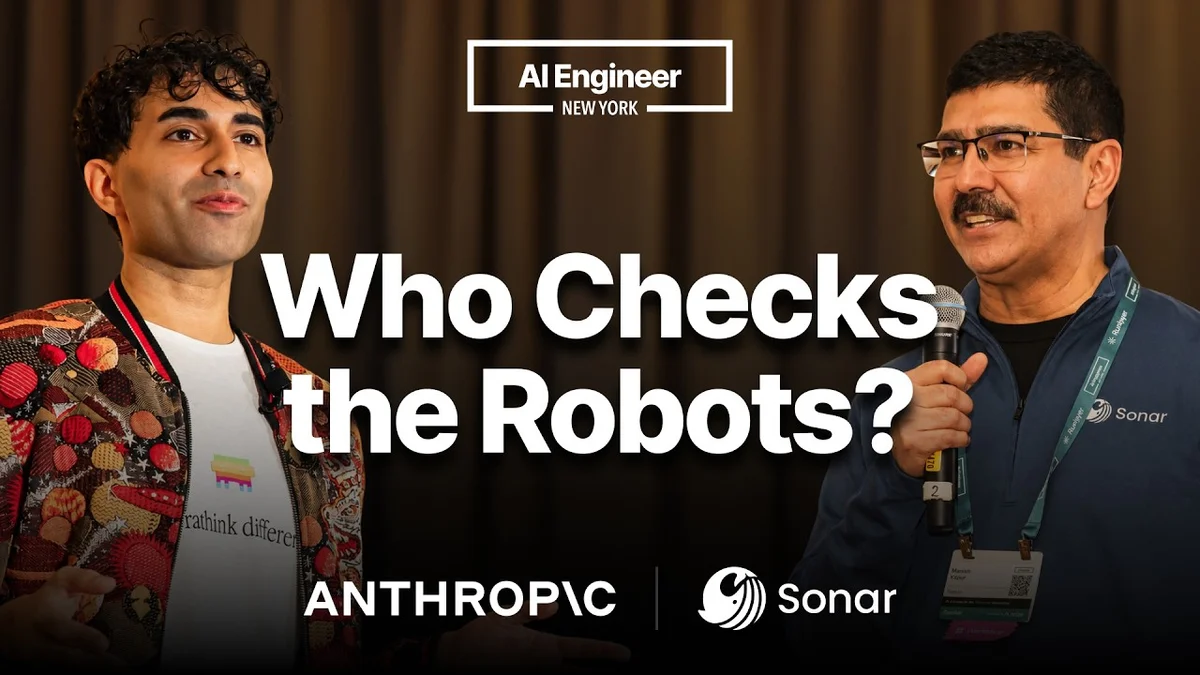
Addy Osmani said AI Engineer that Anthropic now merges about 30,000 code changes every day, up from about 2,500 in May, and that the team relies on agents to try the build like a real user before a human looks. The jump was the news in a joint session with Manish Kapur of Sonar on who verifies the software factory.
That factory matters. A software factory is a production line that loops through scoping, building, checking and shipping code at scale.
Osmani described two points on the spectrum. A lights-on factory keeps people in the loop to apply judgment and taste at each step. A dark factory runs the loop on its own and pulls people in only for exceptions. Most teams are in between. Kapur cited CircleCI data on 28 million workflows this year showing throughput up 59% while three in 10 attempts to merge to production still fail, and Sonar survey data of more than 1,000 developers finding 84% say AI gets features and fixes to production faster even as pull requests get larger.
The hard part is not writing. Osmani said coding is solved and 76% of developers report AI now produces code faster than they can verify it. His answer for gaining confidence is to give agents the means to prove the work. At Anthropic that means Claude does a first pass review that opens the experience in a browser, runs tools and linting, and records evidence such as video or screenshots. Hooks then study diffs on every edit and loop to correct the pull request quickly, with team taste codified in shared files like Claude.md and agents.md so the reviewer knows what good looks like. Kapur framed the same need as zero trust, multi-layered verification in every loop, a deterministic layer for bugs and security issues like SQL injection, an agentic layer for logic and intent, and a supply chain layer for CVEs and malicious packages. Sonar has been building in that direction, including its Hunter agent for logic bugs SAST misses.
Context helps. Osmani spent 14 years at Google before moving to lead developer experience for Claude Code at Anthropic, where he ships product a couple of times a day and feeds friction back into the tool. That cadence looks different from Google's more gated review culture, and from the shift inside Anthropic itself that Felix Berger described where execution cost fell enough that his team dropped coding interviews because newer engineers using agents were outpacing more tenured coders. The common thread is that model quality, even with Opus 4.5, is already good enough that the next gains come from verification, specifically end-to-end and property and visual checks that let a team auto-merge with confidence.
There are limits. Only 28% of companies have approved agents and shared controls, and about 5% run software factories autonomously, so most agents still touch broad systems with weak identity and telemetry. Both speakers stressed control, permissions and the sandbox, with Kapur calling for guide rails that keep agents on track and Osmani noting a PR is safe to merge only when you have full confidence or have mitigated risk as far as possible. That leaves practical choices. Label agent-written code in the pull request for now, keep a human owner accountable, and watch whether your tests give agents, and reviewers, enough evidence to sign off without reading every line.