

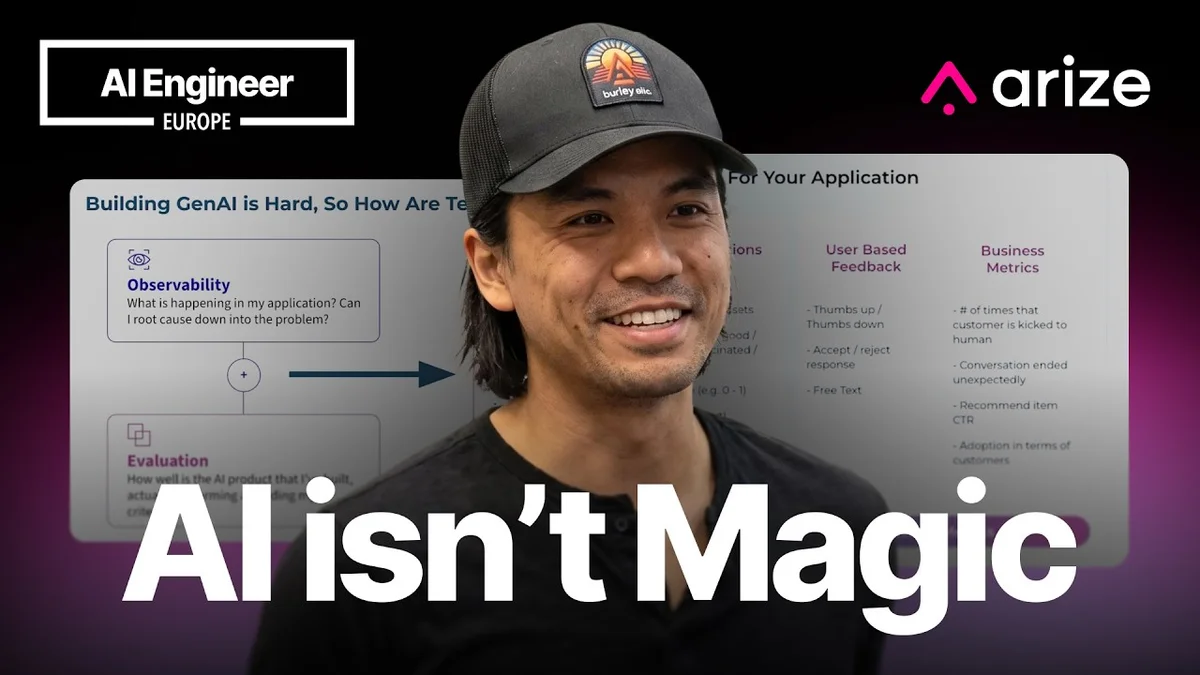
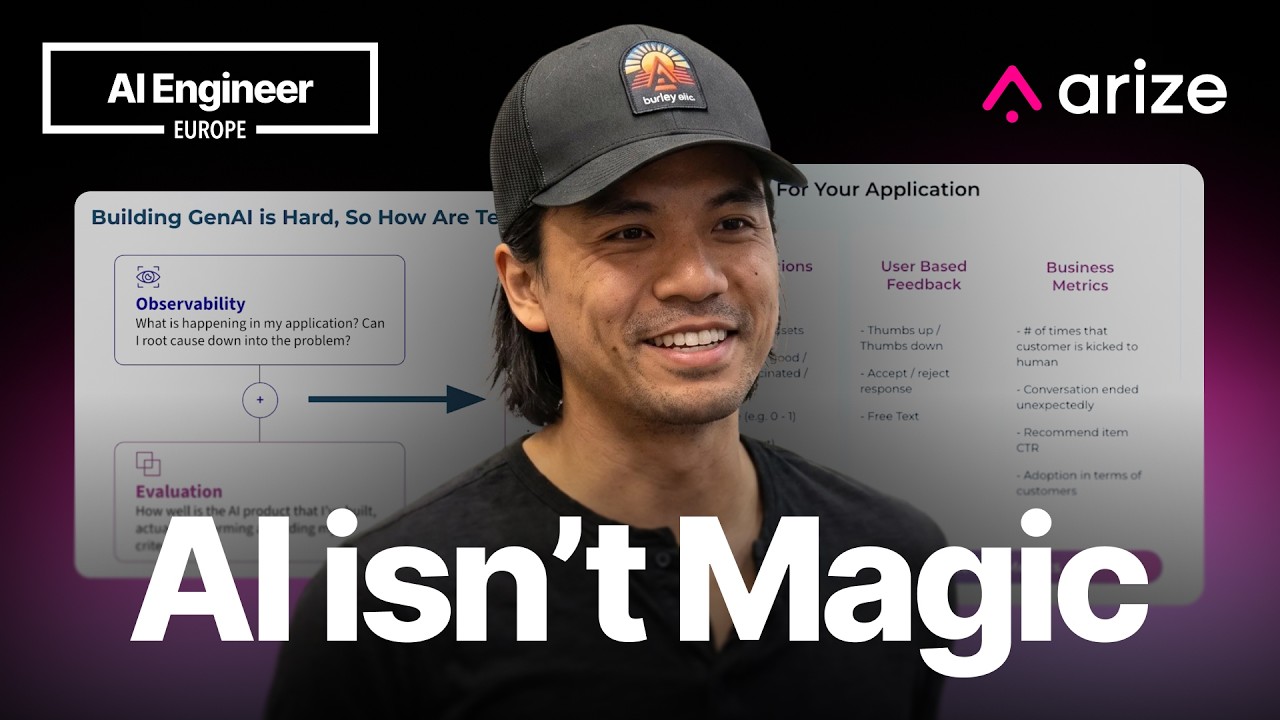
Dat Ngo on Arize: LLM Observability Platform

Dat Ngo from Arize AI explains their LLM observability, evaluation, and experimentation platform, crucial for building robust GenAI applications.

Dat Ngo presenting on Arize AI's LLM observability platform to an audience.
Dat Ngo, AI Architect at Arize AI, discusses the company's LLM observability, evaluation, and experimentation platform.· AI Engineer
Visual TL;DR
GenAI Development ChallengesDriver
building sophisticated AI systems is complex and requires systematic approach
From the articleNgo outlined three fundamental pillars for tackling the complexities of GenAI development.
Arize AI PlatformCore
LLM observability, evaluation, and experimentation platform for GenAI
From the article 9+ mentionsNgo highlighted Arize AI's platform as a solution designed to support these critical pillars.
Observability PillarContext
understanding internal application behavior and identifying root causes
From the article 7 mentionsIn a recent presentation, Dat Ngo, an AI architect at Arize AI, shed light on the critical role of observability, evaluation, and experimentation in the development of Generative AI applications.
Evaluation PillarContext
assessing AI performance against defined criteria and desired outcomes
From the article 9 mentionsSecond, evaluation focuses on how well the AI product is performing according to defined criteria.
Experimentation PillarContext
continuous improvement and refinement of AI models
From the article 5 mentionsFinally, experimentation and improvement are the ultimate goals.
Empowering GenAI DevEffect
enabling robust and reliable generative AI applications
Future of AIOutcome
driving innovation and development in AI technologies
Contents(5)

In a recent presentation, Dat Ngo, an AI architect at Arize AI, shed light on the critical role of observability, evaluation, and experimentation in the development of Generative AI applications. Ngo emphasized that building these sophisticated systems is challenging and requires a systematic approach to ensure they function effectively and reliably.

Dat Ngo on Arize: LLM Observability Platform - AI Engineer
Dat Ngo on Arize: LLM Observability Platform, AI Engineer

Understanding the Core Pillars: Observability, Evaluation, and Experimentation

Ngo outlined three fundamental pillars for tackling the complexities of GenAI development. First, observability is key to understanding what is happening within an application and identifying the root cause of problems. This involves gaining insight into the AI's behavior and performance in real-time.

Second, evaluation focuses on how well the AI product is performing according to defined criteria. This requires robust methods for assessing the AI's outputs and ensuring they align with desired outcomes.

Finally, experimentation and improvement are the ultimate goals. The ultimate aim of observability and evaluation is to provide the knowledge needed to iterate and enhance the AI system, driving continuous progress and refinement.

Arize AI's Platform: Empowering GenAI Development

Ngo highlighted Arize AI's platform as a solution designed to support these critical pillars. The platform aims to make AI work by providing tools for development, observability, and evaluation. Ngo noted that Arize AI works with many of the world's leading AI teams and enterprises, helping them navigate the complexities of deploying AI.

The platform's approach is built around understanding what teams are building, how they are building it, and the challenges they face. This includes addressing issues like the lack of transparency in how AI agents or harnesses function, and the difficulties in understanding the underlying mechanisms.

Key Features and Functionality

Ngo showcased how Arize AI facilitates these processes through features like tracing, which captures the flow of applications built using various libraries, and evaluation, which allows for the assessment of AI performance. The platform also supports experimentation, enabling teams to test and iterate on their models.

The presentation also touched upon the importance of telemetry in enabling observable and traceable AI applications. Arize AI's integrations, such as with LangChain, OpenTelemetry, and other popular frameworks, simplify the process of instrumenting AI applications and sending data for analysis.

Ngo demonstrated the platform's capabilities through concrete examples, showing how developers can use it to debug their models, understand agent behavior, and identify performance bottlenecks. The detailed visualization of AI execution paths, known as span traces, allows users to see how data flows between different components and identify potential issues.

Personas and Their Needs

The discussion also delved into the different user personas that Arize AI caters to. Technical users, such as AI engineers and data scientists, are focused on code automation, pipelines, and application performance. They need tools that help them build, deploy, and optimize AI systems efficiently.

On the other hand, domain experts, like subject matter experts and AI product managers, are concerned with domain prompt engineering, tracking, and ensuring product success. They need insights into how the AI is performing from a business perspective.

Arize AI bridges this gap by providing a platform that offers both deep technical insights and business-oriented evaluations, enabling a collaborative approach to AI development and deployment.

The Future of AI Development with Arize

Ngo concluded by emphasizing that the goal is to automate the process of building and improving AI applications, making it more accessible and efficient for teams. By providing comprehensive observability and evaluation tools, Arize AI aims to empower developers to create more reliable, performant, and impactful AI solutions.

© 2026 StartupHub.ai. All rights reserved. You may not republish this article in full without a license. Search engines and AI research tools may crawl and summarize for reference. Bulk reproduction or model training requires a license. See our terms.
Daniel Singer

Written by

Daniel Singer

Editor, StartupHub.ai

Daniel Singer is the editor of StartupHub.ai, a technology expert and thought leader on AI and its applications across sectors, from fintech and healthcare to developer tooling and consumer software. He writes and tests the tools covered here thoroughly and regularly, and built StartupHub.ai to give founders, operators and buyers a clearer read on what they are actually being sold.