

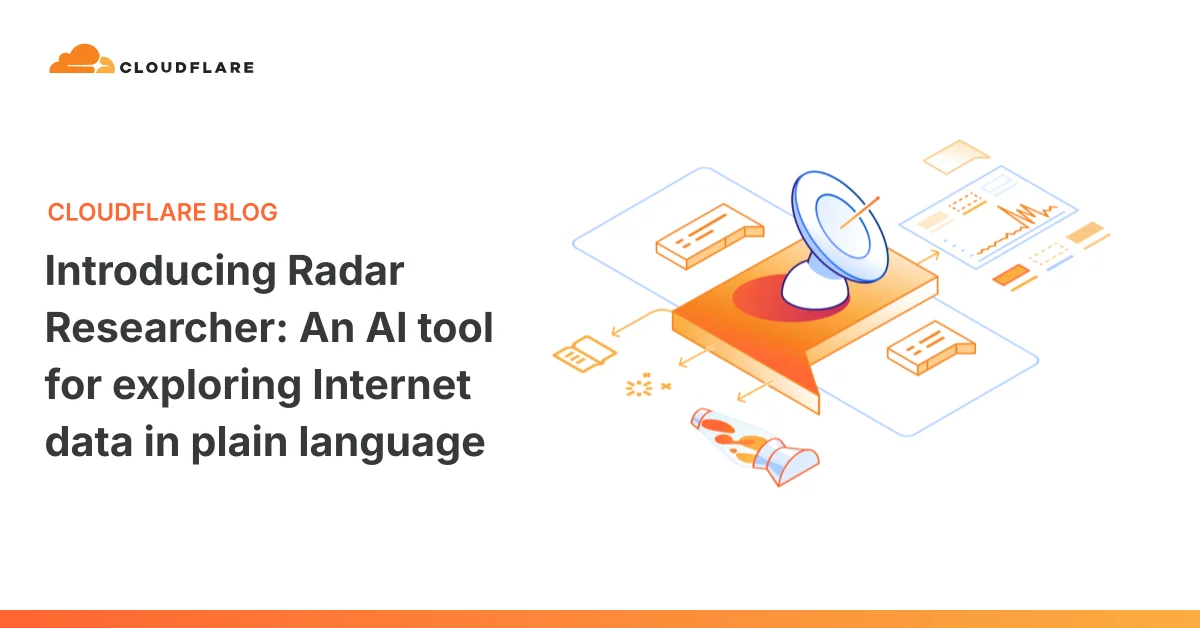
Cloudflare Adds AI to Internet Data Explorer

Cloudflare launches Radar Researcher, an AI tool that lets users query Internet data using plain language, simplifying access to complex insights.

Screenshot of Cloudflare's Radar Researcher interface showing a chat interaction.
Cloudflare
Visual TL;DR
Complex Data AccessDriver
navigating complex interfaces or understanding API documentation to get Internet insights
From the article 4 mentionsThis move aligns with a broader industry trend of democratizing data access through AI.
Cloudflare RadarCore
platform offering insights into global Internet activity and traffic trends
From the article 9+ mentionsCloudflare is making its vast trove of Internet data more accessible with the launch of Radar Researcher.
Radar Researcher AICore
new AI tool built on Cloudflare's developer platform using a large language model
From the article 9+ mentionsThe core idea behind Radar Researcher is to lower the barrier to entry for data exploration.
Plain Language QueriesEffect
users can type questions about Internet data instead of manual filters or API calls
From the article 2 mentionsThis new AI-powered tool, available on the Cloudflare Radar platform, allows users to ask questions about Internet traffic and trends using plain language.
Simplified Data AccessOutcome
lowering the barrier to entry for exploring vast amounts of Internet data
From the articleThis move aligns with a broader industry trend of democratizing data access through AI.
Journalist ExampleContext
a journalist can ask about the impact of an Internet outage using simple language
From the article 3 mentionsInvestors are increasingly looking for AI startups that solve real-world problems by making complex information digestible and useful, and Radar Researcher is a prime example of this.
Enhanced InsightsOutcome
making Cloudflare's vast trove of Internet data more accessible and understandable
From the article 4 mentionsCloudflare Radar has long served as a valuable resource, offering insights into global Internet activity.
Contents(3)

Cloudflare is making its vast trove of Internet data more accessible with the launch of Radar Researcher. This new AI-powered tool, available on the Cloudflare Radar platform, allows users to ask questions about Internet traffic and trends using plain language.

Cloudflare Radar has long served as a valuable resource, offering insights into global Internet activity. However, accessing this data often required navigating complex interfaces or understanding API documentation. Radar Researcher aims to change that. As detailed on Cloudflare's blog, the tool is built on Cloudflare's developer platform and uses a large language model (LLM) to interpret user queries.

Simplifying Data Access

The core idea behind Radar Researcher is to lower the barrier to entry for data exploration. Instead of manually selecting filters, choosing specific pages, or writing custom API calls, users can simply type their questions. For instance, a journalist covering an Internet outage can ask about its impact without spending valuable time searching for the right graph. The AI then generates real, interactive charts and a concise explanation, mirroring the visualizations found across Radar.

This move aligns with a broader industry trend of democratizing data access through AI. Similar to how tools like ChatGPT have made complex information retrieval easier for the general public, Radar Researcher brings that convenience to specialized Internet infrastructure data. This is particularly beneficial for non-technical users like human rights advocates or journalists who need quick, reliable insights.

Contextual AI Interaction

Radar Researcher offers several features to enhance the user experience. Users can choose the depth of the answer, from a brief summary to a more detailed report. The tool also suggests follow-up questions, encouraging further exploration. Conversations are saved and searchable, allowing users to revisit past queries. A unique feature is the ability to audit the AI's reasoning, showing which datasets were queried and how the LLM arrived at its answer.

Furthermore, the tool integrates directly with existing Radar visualizations. Users can click an "Explain with AI" option on any chart, and Radar Researcher will automatically use that specific visualization as the starting point for the conversation. It analyzes a screenshot of the chart, the underlying data from Radar's API, and the current view's parameters (like date range and filters) to provide a contextually relevant explanation. This multi-modal approach, combining visual input, API data, and query parameters, ensures accuracy and relevance.

Why This Matters

For the broader AI and startup industry, Radar Researcher signifies a maturing approach to making specialized data accessible. Cloudflare, known for its extensive network infrastructure and security services, is now applying AI to unlock the value of its operational data for a wider audience. This could inspire other large infrastructure providers or data-rich companies to develop similar tools, turning their internal data into accessible insights.

This also highlights the growing importance of AI agents that can interact with complex data sources. By grounding its LLM in real-time data via Radar's API, Cloudflare is ensuring its AI provides factual, up-to-date answers rather than speculative information. This focus on data integrity is crucial as AI tools become more integrated into critical decision-making processes for businesses and researchers.

For founders, this showcases a practical application of AI beyond generative text or image creation. Building AI tools that interface with specific, proprietary datasets and offer actionable insights presents a significant opportunity. Investors are increasingly looking for AI startups that solve real-world problems by making complex information digestible and useful, and Radar Researcher is a prime example of this.

The ability to audit the AI's reasoning is also a critical step towards building trust in AI systems. As AI becomes more powerful, transparency in how it reaches conclusions will be paramount for adoption across sensitive sectors like cybersecurity and infrastructure management, areas where Cloudflare operates heavily.

While the tool is currently in beta, its availability across all Radar pages suggests a commitment to integrating AI deeply into Cloudflare's product offerings. This initiative builds on Cloudflare's existing AI investments, such as its AI Gateway and Workers AI, further positioning the company at the intersection of AI and network infrastructure.

© 2026 StartupHub.ai. All rights reserved. You may not republish this article in full without a license. Search engines and AI research tools may crawl and summarize for reference. Bulk reproduction or model training requires a license. See our terms.
Daniel Singer

Written by

Daniel Singer

Editor, StartupHub.ai

Daniel Singer is the editor of StartupHub.ai, a technology expert and thought leader on AI and its applications across sectors, from fintech and healthcare to developer tooling and consumer software. He writes and tests the tools covered here thoroughly and regularly, and built StartupHub.ai to give founders, operators and buyers a clearer read on what they are actually being sold.