Visual TL;DR
Predicting Code EditsContext
AI model predicts user's next code edit as they type
Ultra-Low LatencyDriver
Must operate under 300ms per keystroke for real-time use
From the article 2 mentionsThis process must be extremely fast, operating on every keystroke with a latency budget under 300 milliseconds, necessitating a small, specialized model.
Data ConsiderationsContext
Focus on 'settled data' and production vs. synthetic sources
From the article 8 mentionsIn his presentation, Kunkle explained the technical pipeline and data considerations involved in training such a model, emphasizing the challenges and solutions encountered in production environments.
Teacher Frontier ModelCore
Generates training data for the Zeta2 prediction model
From the article 2 mentionsThis data is fed into a 'teacher frontier' model, which generates predictions.
Offline EvaluationContext
Assessing model performance before production deployment
From the articleFor offline evaluation, Kunkle mentioned metrics such as 'deltaChrF' (character F-score), exact lines matched, reversal ratio, and kept rate.
Training PipelineCore
Ingests production and synthetic data for model training
From the article 6 mentionsIn his presentation, Kunkle explained the technical pipeline and data considerations involved in training such a model, emphasizing the challenges and solutions encountered in production environments.
Production MonitoringContext
Continuous tracking of model performance in live environment
From the article 3 mentionsThe core of the training process involves a pipeline that ingests both 'production data' (snapshots of user activity) and 'synthetic data' (git commits).
Zeta2 ModelCore
Specialized, small AI model for fast keystroke prediction
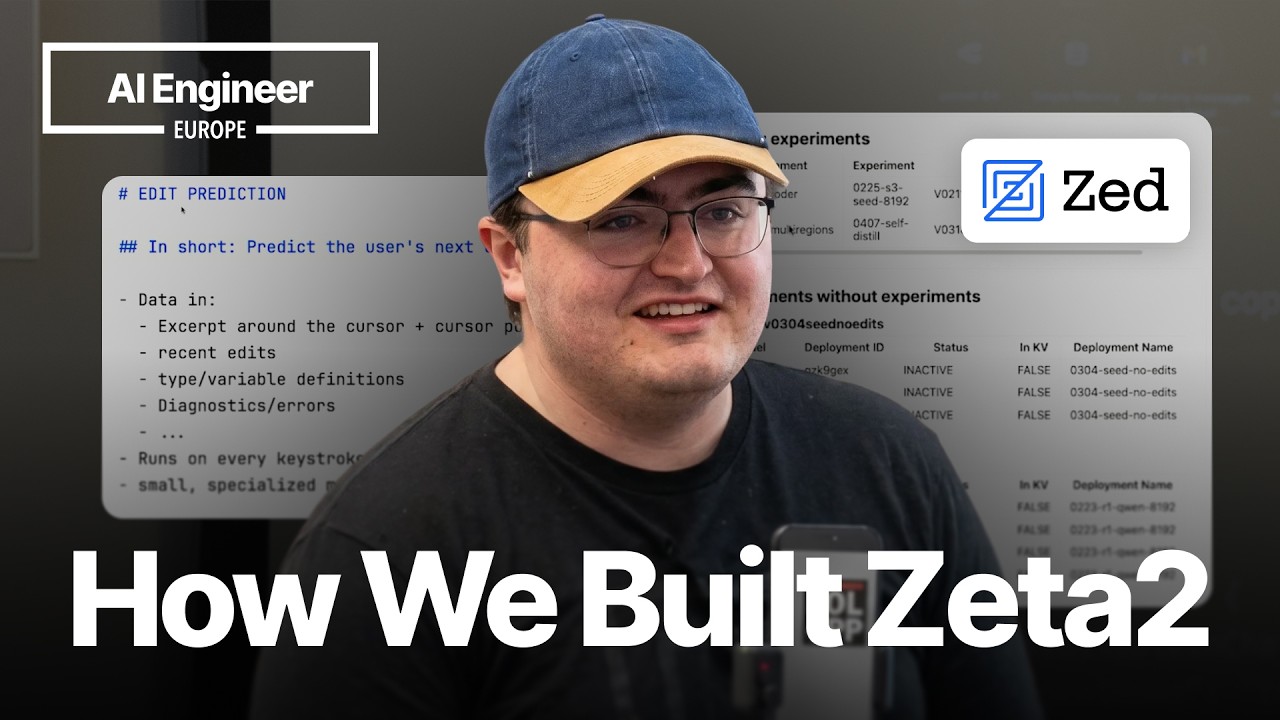
From the article 9+ mentionsBen Kunkle, Lead at Zed Industries, detailed the process of building Zeta2, an AI model designed to predict a user's next edit as they type.
Faster CodingEffect
Enables quicker and more efficient code writing for users