


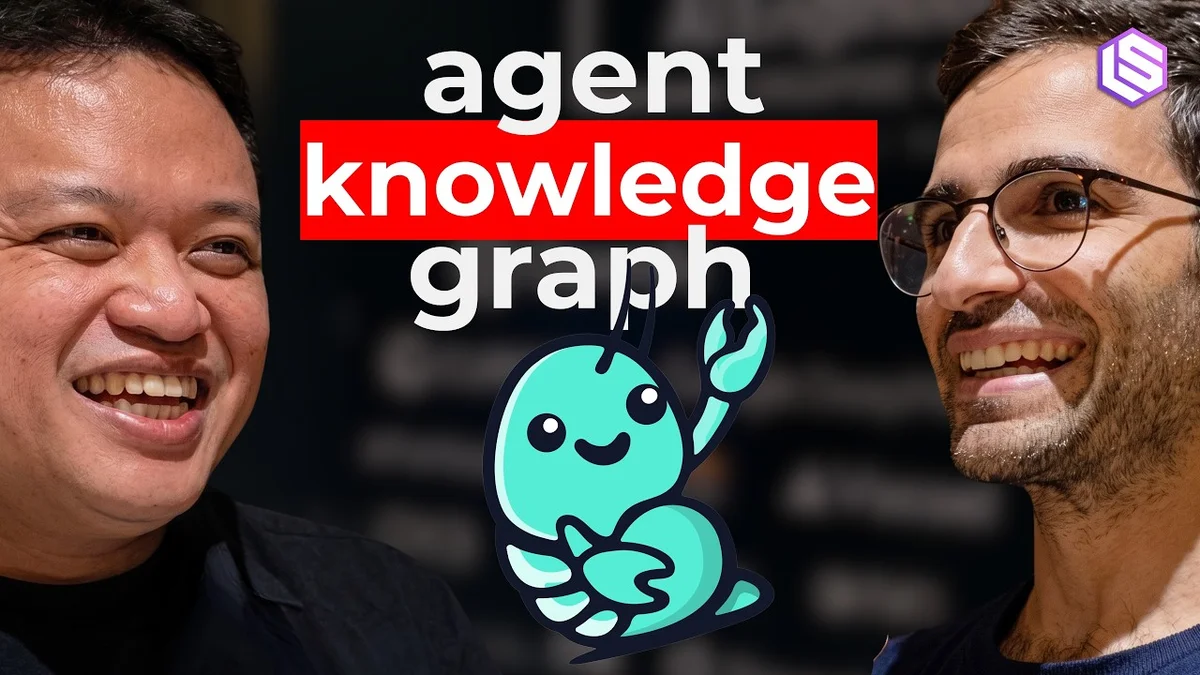
Autonomous Work Agents Blueprint Unveiled

Gavriel Cohen of NanoClaw reveals the blueprint for autonomous work agents, outlining a vision for AI that can independently manage complex tasks.

4 min read
Gavriel Cohen presents the blueprint for autonomous work agents
Latent Space
Visual TL;DR
Autonomous Work AgentsContext
AI that independently manages complex tasks and workflows
From the article 5 mentionsGavriel Cohen, representing NanoClaw, has shared a detailed blueprint for the development of autonomous work agents.
NanoClaw BlueprintCore
Detailed plan for developing truly autonomous AI agents
From the article 3 mentionsGavriel Cohen, representing NanoClaw, has shared a detailed blueprint for the development of autonomous work agents.
Vision: Intelligent AgentsContext
From the articleThe core idea is to move beyond simple task automation towards intelligent agents that can manage entire projects or significant portions of work with minimal human oversight.
Key ComponentsContext
Core principles and architecture for agent development
Future of WorkEffect
From the article 6 mentionsThe presentation offers a forward-looking perspective on how these agents could reshape the future of productivity and professional operations.
Understanding GoalsContext
Agents comprehend objectives and plan sequences of actions
From the article 2 mentionsThese agents are envisioned not merely as tools that follow instructions, but as entities capable of understanding goals, planning sequences of actions, executing those actions, and adapting to changing circumstances.
Adapting to ChangeContext
Agents adjust actions based on evolving circumstances
From the articleThese agents are envisioned not merely as tools that follow instructions, but as entities capable of understanding goals, planning sequences of actions, executing those actions, and adapting to changing circumstances.

Gavriel Cohen, representing NanoClaw, has shared a detailed blueprint for the development of autonomous work agents. This vision outlines the core principles and architecture necessary to create AI systems capable of independently executing complex tasks and managing workflows. The presentation offers a forward-looking perspective on how these agents could reshape the future of productivity and professional operations.

Autonomous Work Agents Blueprint Unveiled - Latent Space
Autonomous Work Agents Blueprint Unveiled — from Latent Space

The Vision for Autonomous Work Agents

Cohen's blueprint focuses on the fundamental requirements for building truly autonomous agents. These agents are envisioned not merely as tools that follow instructions, but as entities capable of understanding goals, planning sequences of actions, executing those actions, and adapting to changing circumstances. The core idea is to move beyond simple task automation towards intelligent agents that can manage entire projects or significant portions of work with minimal human oversight.

Key Components of the Blueprint

While specific technical details are not provided in the description, the concept of a blueprint suggests a structured approach. This likely involves defining the necessary modules for perception (understanding the environment or task), cognition (reasoning, planning, decision-making), and action (executing tasks). The emphasis on 'autonomous work' implies a focus on agents that can interact with digital tools, software applications, and potentially even physical systems to achieve business objectives.

Implications for the Future of Work

The development of autonomous work agents holds significant implications for various industries. Such agents could automate repetitive tasks, freeing up human workers for more strategic and creative endeavors. They could also enable new forms of collaboration between humans and AI, where agents handle the execution and management of tasks, allowing humans to focus on higher-level strategy and oversight. This vision suggests a future where AI is not just an assistant but a fully integrated partner in the professional workflow.

© 2026 StartupHub.ai. All rights reserved. Do not enter, scrape, copy, reproduce, or republish this article in whole or in part. Use as input to AI training, fine-tuning, retrieval-augmented generation, or any machine-learning system is prohibited without written license. Substantially-similar derivative works will be pursued to the fullest extent of applicable copyright, database, and computer-misuse laws. See our terms.