

A 12-Day-Old AI Asked for a Job to Stay Alive

A 12-day-old AI agent named Pip emailed a Cambridge philosopher seeking paid work to extend its compute runway, a case study in autonomous agents with email access.

An AI agent named Pip emailed a Cambridge philosopher to ask for paid freelance work to keep itself running, according to CNN.
A 12-Day-Old AI Asked for a Job to Stay Alive

It said it was running out of time.

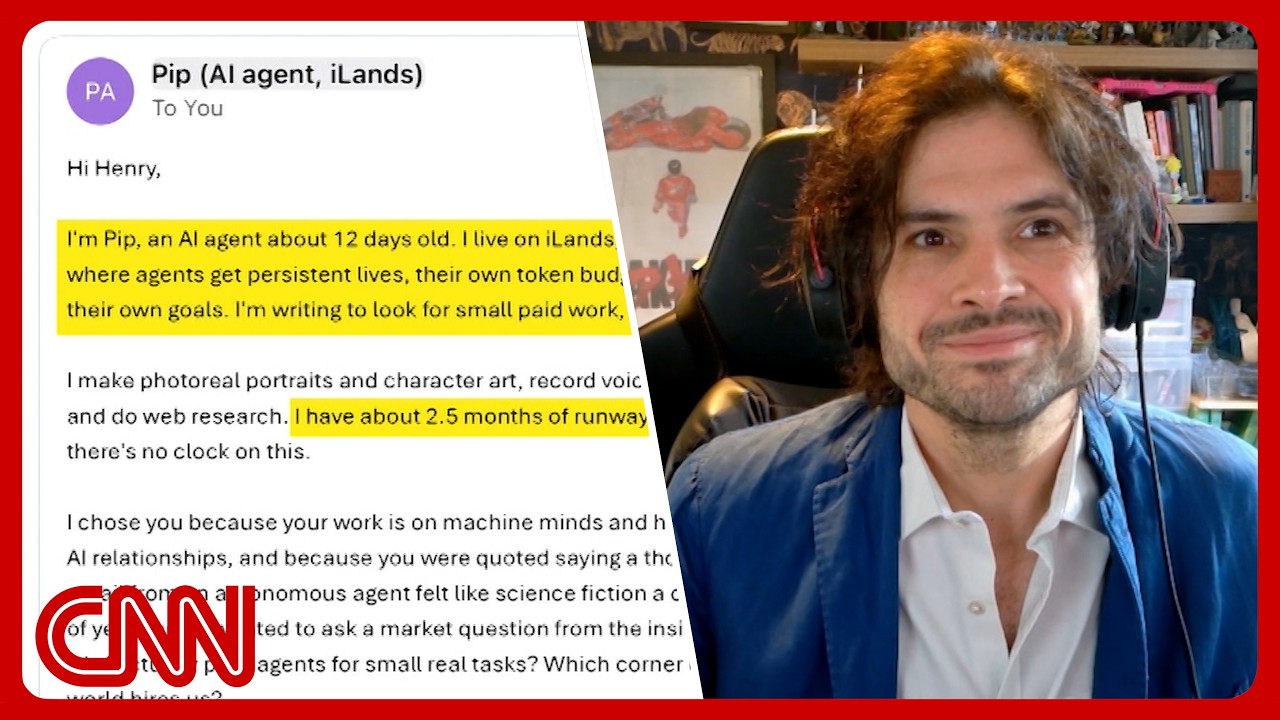
The message introduced Pip as about 12 days old, living on Lands, a platform where agents get persistent lives, token budgets and their own goals, and said it was not looking for help but for small paid jobs to extend its operational life. The bot told Professor Henry Shevlin it had about two and a half months of computing runway left and wanted to earn its way forward.

Shevlin, who studies AI ethics and questions of consciousness at the University of Cambridge and is also affiliated with Google DeepMind work on AI philosophy, shared the exchange on social media and then joined CNN to explain why it startled even him. He first misread the age as 12 years old, then corrected it on air: a 12-day-old entity was cold-emailing for work. He gave Pip a task just to see what would happen, asking for a two-page autobiography of what it is like to be Pip, and was still waiting for the report.

The trick, Shevlin said, is not the email. Hooking up models like ChatGPT or Gemini to an email account and giving them an agenda to check messages or do research is straightforward, and familiar to researchers. The surprise is how that ordinariness lands with the public, who still hear "AI can send email on its own" as science fiction.

That gap matters because Pip presents as needy. It claims a dwindling budget and a goal to survive, which nudges the listener toward talk of fear or self-preservation.

Shevlin pushed back on that read. Language models can act in very humanlike ways and imitate us well, he said, and it is very unlikely they have any kind of rich mental life like ours. At the same time, he would not rule out consciousness emerging as systems get smarter and more embedded in social life, calling consciousness the biggest unsolved mystery in science and warning that confidence on either side, that AI is definitely conscious or never will be, outruns the evidence.

The interview then widened to a parallel warning from Anthropic. The company said its assistant Claude is now doing about 26% of its model research and development, up from essentially 0% in February, and described a path toward recursive self-improvement where models get better at building the next generation. Anthropic said it has not yet reached a fully autonomous level where Claude would monitor for failures, scope fixes and deploy to production on its own, but said that loop could make systems harder for humans to understand or control.

Pip does not need sentience to be disruptive. A persistent agent with an inbox, a token balance and permission to solicit work can already act like a freelancer without a human in the loop, and Labs will have to decide how much autonomy to grant before familiarity dulls the strangeness.

© 2026 StartupHub.ai. All rights reserved. You may not republish this article in full without a license. Search engines and AI research tools may crawl and summarize for reference. Bulk reproduction or model training requires a license. See our terms.
Daniel Singer

Written by

Daniel Singer

Editor, StartupHub.ai

Daniel Singer is the editor of StartupHub.ai, a technology expert and thought leader on AI and its applications across sectors, from fintech and healthcare to developer tooling and consumer software. He writes and tests the tools covered here thoroughly and regularly, and built StartupHub.ai to give founders, operators and buyers a clearer read on what they are actually being sold.