


AI Powers Investment Thesis Analysis with OpenAI Codex

OpenAI's Codex plugin transforms investment analysis by automating earnings deep dives, generating scenarios, and creating interactive reports for public companies.

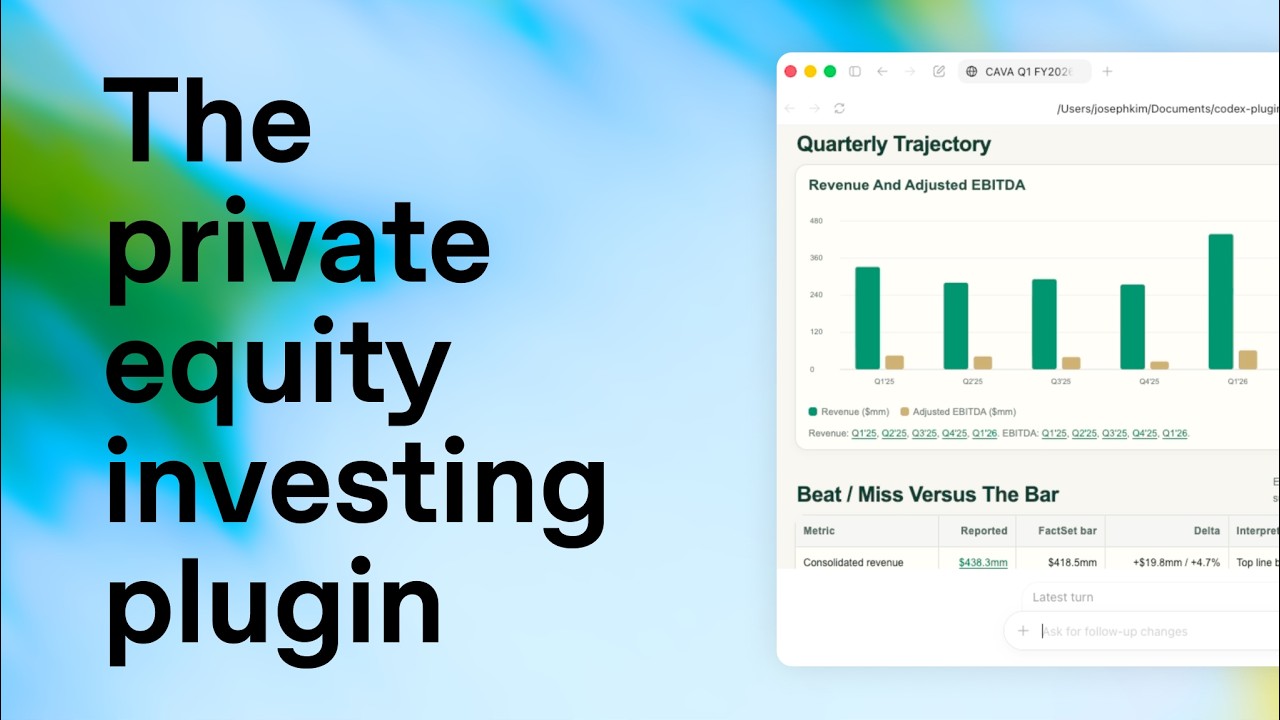
Screenshot of OpenAI Codex interface showing a task prompt for earnings analysis.
OpenAI Youtube
Visual TL;DR
AI for InvestmentDriver
automating earnings deep dives and refining investment theses
From the article 5 mentionsOpenAI's Codex is emerging as a powerful tool for financial analysis, particularly for investors looking to dissect company earnings and refine their investment theses.
OpenAI CodexCore
the core AI plugin processing complex financial data
From the article 9 mentionsOpenAI's Codex is emerging as a powerful tool for financial analysis, particularly for investors looking to dissect company earnings and refine their investment theses.
Automate Earnings AnalysisEffect
ingesting growth drivers, guidance, and recent momentum
From the article 3 mentionsFor instance, the analysis of Cava Group's Q1 FY2026 earnings highlights strengthened business thesis but notes that stock thesis still needs proof.
Plugins in AIContext
enhancing financial AI capabilities
From the article 2 mentionsCodex leverages specialized plugins, such as the "Public Equity Investing Router," to normalize financial data, update models, and compare current performance against historical data and estimates.
Synthesize Performance TrendsEffect
From the articleThe AI then synthesizes this information to evaluate whether recent performance trends appear durable.
Structured InsightsEffect
presenting complex financial data digestibly
From the article 2 mentionsThe output from Codex is not just raw data but a structured, interactive dashboard.
Decision SupportEffect
generating scenarios and interactive reports
Refined Investment StrategyOutcome
transforming how investment teams approach research
Contents(4)

OpenAI's Codex is emerging as a powerful tool for financial analysis, particularly for investors looking to dissect company earnings and refine their investment theses. The platform's capability to process complex financial data and present it in an easily digestible format is transforming how investment teams approach their research.

Automating Earnings Analysis with Codex

The core function demonstrated is the use of Codex to conduct a deep dive into a company's post-earnings performance. This process involves ingesting various data points, including growth drivers, new unit expansion, financial guidance, and recent momentum. The AI then synthesizes this information to evaluate whether recent performance trends appear durable.

The full discussion can be found on OpenAI Youtube's YouTube channel.

Analyze earnings and update your investment thesis with Codex - OpenAI Youtube
Analyze earnings and update your investment thesis with Codex, from OpenAI Youtube

The workflow begins with specifying the task: "Do a post-earnings deep dive on Cava using its latest reported quarter." This prompt is then expanded to include specific analytical requirements such as covering growth drivers, new unit expansion, guidance, and the sustainability of recent momentum. Crucially, the system is instructed to include bull, base, and bear cases, along with a 90-day monitoring checklist.

Codex leverages specialized plugins, such as the "Public Equity Investing Router," to normalize financial data, update models, and compare current performance against historical data and estimates. This automation significantly reduces the manual effort involved in traditional financial analysis.

Structured Insights and Decision Support

The output from Codex is not just raw data but a structured, interactive dashboard. This dashboard presents key findings in a clear and organized manner, facilitating quicker decision-making. For instance, the analysis of Cava Group's Q1 FY2026 earnings highlights strengthened business thesis but notes that stock thesis still needs proof.

The system breaks down the analysis into several key sections:

  • Load-Bearing Growth Drivers: This section identifies the primary factors contributing to the company's performance, such as traffic outperformance, new unit expansion, digital revenue mix, and operational speed.
  • Guidance: Raised, But Deliberately Not Flowing Through Fully: This points to the company's forward-looking statements and their implications.
  • Does The Momentum Look Durable?: This critical section evaluates the sustainability of current trends across various metrics like traffic quality, early Q2 continuity, new-unit durability, margin durability, and stock durability.
  • Bull, Base, Bear Scenarios: The AI outlines potential future performance trajectories based on different assumptions, providing a balanced view for investors.
  • 90-Day Monitoring Checklist: This provides actionable items for investors to track over the next three months, ensuring continuous oversight.

The Role of Plugins in Financial AI

The demonstration highlights how plugins are essential for Codex to access and process specialized data. The "Public Equity Investing Router" is shown to normalize financial figures, analyze trends, and integrate data from various sources like earnings transcripts, analyst reports, and market data. This integration allows Codex to go beyond simple data aggregation and provide sophisticated analytical outputs.

The system's ability to source data from platforms like Quortr, Daloopa, and S&P Global underscores its capacity to tap into a wide array of financial information. This comprehensive data ingestion is key to generating robust and reliable investment analyses.

Implications for Investment Strategy

The use of AI tools like Codex signifies a shift towards more data-driven and efficient investment strategies. By automating time-consuming analytical tasks, investors can focus on higher-level strategic thinking and decision-making. The ability to generate multiple scenarios and track key metrics proactively helps in managing risk and identifying opportunities more effectively.

This technology is particularly valuable for public companies, where earnings analysis is a continuous and critical process. The structured output from Codex provides a standardized way to review financial performance, compare against expectations, and update investment theses with greater speed and accuracy.

© 2026 StartupHub.ai. All rights reserved. You may not republish this article in full without a license. Search engines and AI research tools may crawl and summarize for reference. Bulk reproduction or model training requires a license. See our terms.
Daniel Singer

Written by

Daniel Singer

Editor, StartupHub.ai

Daniel Singer is the editor of StartupHub.ai, a technology expert and thought leader on AI and its applications across sectors, from fintech and healthcare to developer tooling and consumer software. He writes and tests the tools covered here thoroughly and regularly, and built StartupHub.ai to give founders, operators and buyers a clearer read on what they are actually being sold.