


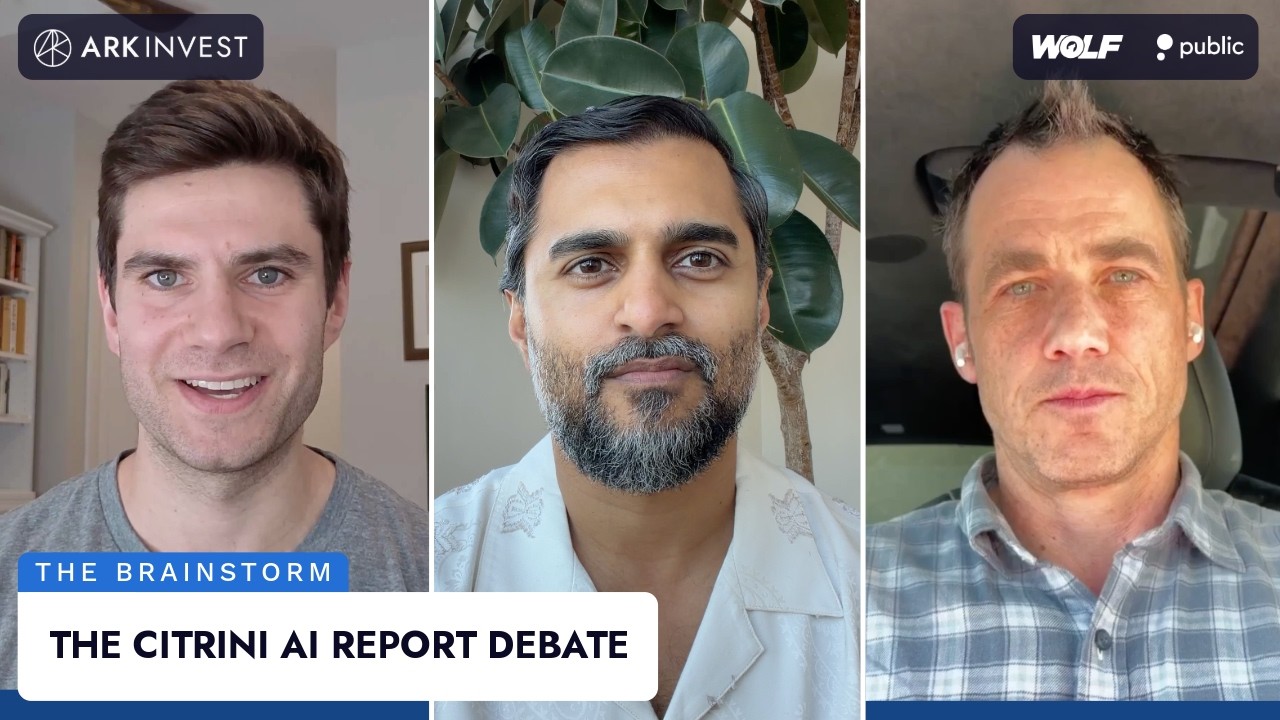
In a recent discussion on ARK Invest's 'The Brainstorm' YouTube channel, experts Alap Shah, Nick Grous, and Brett Winton delved into the profound implications of AI agents for the future of staffing and the broader economy. The conversation, titled 'The Leap to Agents, Staffing Overhaul,' explored how AI's growing capabilities are not only augmenting but also substituting for human labor, leading to potential economic upheaval and the emergence of 'one-person giants' capable of immense productivity.
The Rise of AI Agents and Their Impact on Productivity
Alap Shah, Chief Information Officer of Lotus Technology and co-author of the 2028 Global AI Intelligence Crisis report, highlighted the rapid progression of AI, particularly LLMs, and their potential to automate a significant portion of white-collar jobs. He noted that the efficiency gains are so substantial that companies can achieve in months what previously took years, leading to a potential radical restructuring of staffing needs.
Shah emphasized that AI agents are moving beyond mere augmentation to become direct substitutes for human tasks. He stated, "The leap to agents, staffing overhaul... AI agents have become incredibly important in the last few months and have been deployed very aggressively." He further elaborated on the shift in how businesses operate, noting that "AI agents can do a lot more than we think... they can do a lot more across our organizations, and consequently, we can do a lot more with fewer people." This sentiment underscores the transformative power of AI in driving productivity and efficiency.
Economic Implications: From Complement to Substitute
The discussion touched upon the shift in the economic paradigm, moving from an era where AI was primarily a complement to human labor to one where it is increasingly a substitute. Shah explained, "We are now in a situation where, for the first time in history, we're seeing AI agents that can do a lot more than we think... and consequently, we can do a lot more with fewer people." This transformation has significant implications for GDP growth and the labor market, potentially leading to a situation where AI agents can perform tasks that previously required large teams of human workers.
Shah posited a future where AI agents could significantly boost productivity, stating, "We've seen that the AI agents that we've been able to deploy... have really changed the velocity that we were able to generate building things." He further elaborated on the economic benefits: "It became pretty obvious that something was changing very very fast, and as I started really thinking through what that meant for staffing within my own company and the velocity that we were able to generate building things, it became pretty obvious that we weren't going to staff the businesses the way that we had thought in the past."