


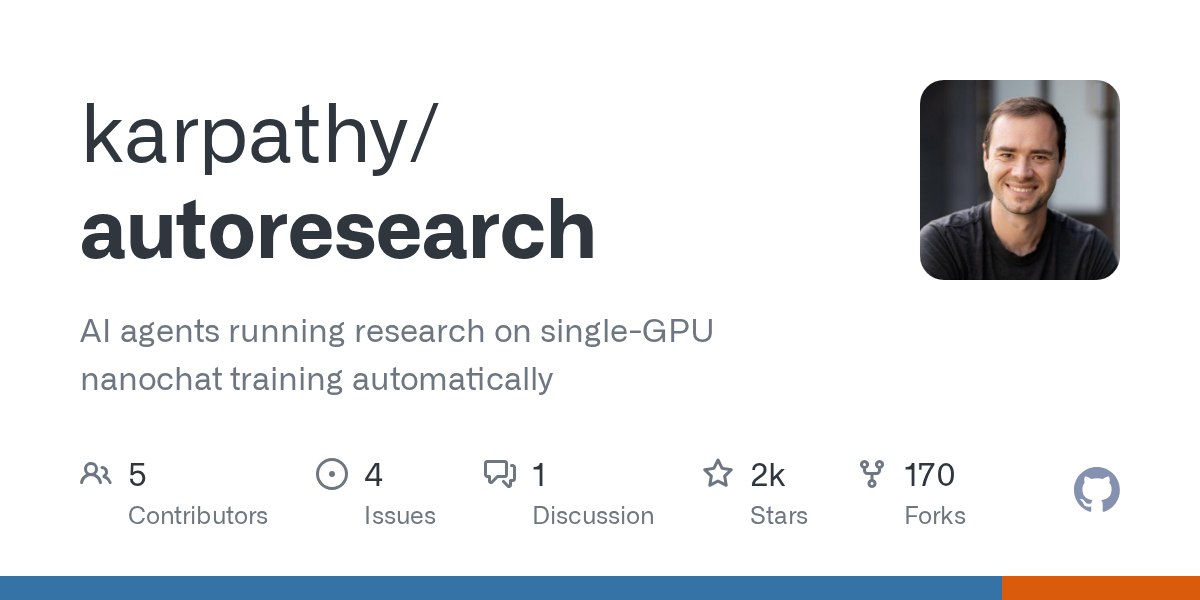
The frontier of AI research is moving beyond human intervention. A new project on GitHub, dubbed 'autoresearch', details an approach where autonomous AI agents conduct LLM training experiments overnight. This system allows agents to modify code, train models for brief periods, and iterate based on performance improvements.
The core idea is to hand over the reins of a simplified LLM training setup, based on nanochat, to AI agents. Instead of researchers manually tweaking Python files, they program the agents via Markdown files. These agents then autonomously experiment with architecture, hyperparameters, and optimizers within a strict 5-minute time budget.
Autonomous Experimentation
The project highlights a shift towards automated scientific discovery. The AI agent's role is to continuously refine the training process, aiming to improve a key metric like validation bits per byte (val_bpb). This approach signifies a potential acceleration in autonomous AI research agents, moving beyond human-paced iteration.
The system is deliberately minimal, designed for single-GPU environments. Key components include fixed utilities for data preparation and runtime, the training script that the agent modifies, and instructional Markdown files. This focus on a single file for AI agent code modification aims to streamline the process and make changes reviewable.
The Future of AI Research?
While currently a demonstration, the project opens doors for more sophisticated LLM research automation. Similar concepts are emerging in other fields, such as in LLM research automation for scientific discovery. The 'autoresearch' project is available on GitHub, inviting further development and exploration of agent-driven scientific progress.