

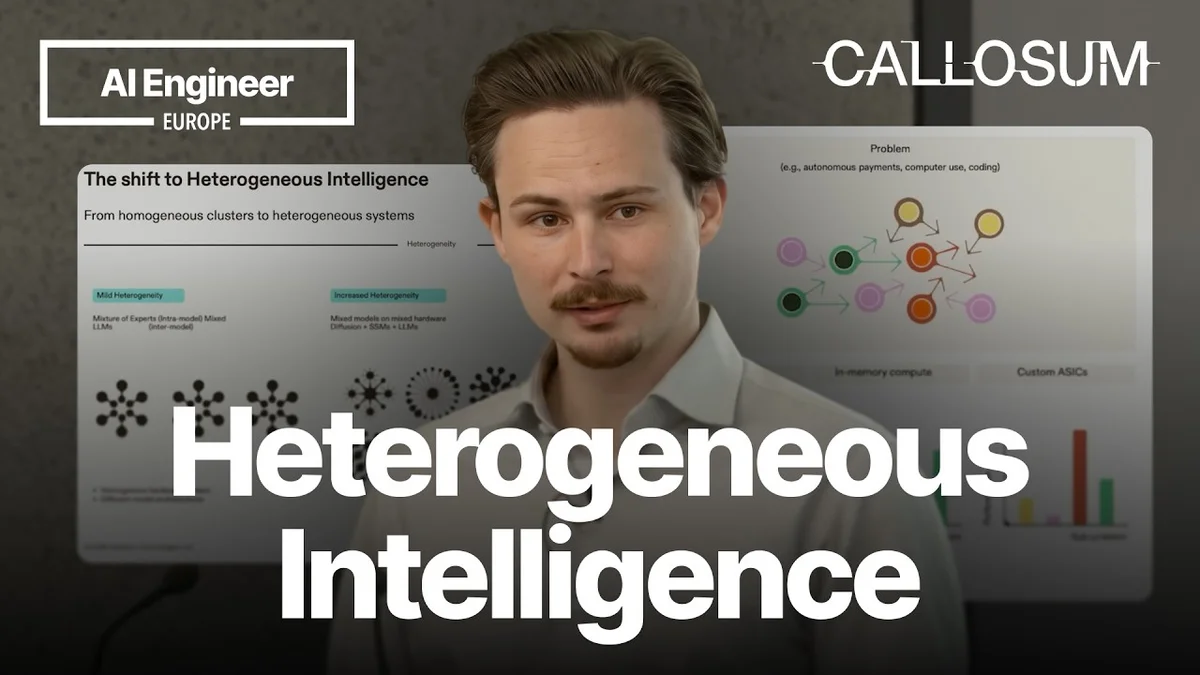
Adrian Bertagnoli on Heterogeneous Intelligence

Adrian Bertagnoli of Callosum discusses the shift from homogeneous to heterogeneous intelligence in AI, highlighting its benefits for complex problem-solving and future compute.

Adrian Bertagnoli speaking on stage about heterogeneous intelligence.
Adrian Bertagnoli, Founding Engineer at Callosum, presents on the future of AI.· AI Engineer
Visual TL;DR
Adrian BertagnoliCore
From the article 9+ mentionsAdrian Bertagnoli, Founding Engineer at Callosum, presented on "Scaling the Next Paradigm of Heterogeneous Intelligence," outlining a significant shift in how artificial intelligence is being developed and deployed.
Homogeneous AI DominanceContext
scaling single models on identical hardware, driven by neural scaling laws
From the article 4 mentionsBertagnoli argued that the current dominant paradigm of homogeneous intelligence, characterized by scaling single models on identical hardware, is giving way to a more sophisticated approach: heterogeneous intelligence.
Real-world ComplexityDriver
problems are inherently multi-step, open-ended, and require nuanced adaptation
From the articleHowever, Bertagnoli highlighted that real-world problems are inherently complex, often multi-step, and open-ended.
Shift to Heterogeneous AIContext
moving beyond single models to diverse, specialized AI components
From the article 9 mentionsAdrian Bertagnoli, Founding Engineer at Callosum, presented on "Scaling the Next Paradigm of Heterogeneous Intelligence," outlining a significant shift in how artificial intelligence is being developed and deployed.
Better Complex Problem SolvingEffect
enables AI to tackle multi-step, open-ended challenges more effectively
From the articleHowever, Bertagnoli highlighted that real-world problems are inherently complex, often multi-step, and open-ended.
Future Compute ReadinessEffect
prepares AI for evolving and diverse computational demands
From the articleBertagnoli concluded by looking ahead to the future of compute, suggesting that the paradigm is shifting from "made compute quicker" (CPU-dominated) and "made compute parallel" (GPU-dominated) to a third paradigm: "made compute heterogeneous." This shift, he argued, will unlock new frontiers in AI capabilities and cost-effectiveness for large-scale agentic AI.
Nuanced AI ApproachContext
adapting to diverse challenges with specialized AI capabilities
From the article 3 mentionsSolving them effectively requires not just larger models, but a more nuanced approach that can adapt to diverse challenges.

Contents(4)

Adrian Bertagnoli, Founding Engineer at Callosum, presented on "Scaling the Next Paradigm of Heterogeneous Intelligence," outlining a significant shift in how artificial intelligence is being developed and deployed. Bertagnoli argued that the current dominant paradigm of homogeneous intelligence, characterized by scaling single models on identical hardware, is giving way to a more sophisticated approach: heterogeneous intelligence.

StartupHub data

Companies working on this

Profiles of the companies named in this story, with funding and a one-liner from our database.

Callosum
$1.1B
A UK-based AI infrastructure startup building open, modular, and performant AI compute to challenge Silicon Valley's hardware monoculture.
Adrian Bertagnoli on Heterogeneous Intelligence - AI Engineer
Adrian Bertagnoli on Heterogeneous Intelligence, from AI Engineer

Understanding the Shift to Heterogeneous Intelligence

Bertagnoli began by defining the current paradigm as largely driven by scaling single models on single chips, a trend that emerged from the discovery of neural scaling laws. These laws suggested that more data and parameters directly correlated with improved model performance. However, Bertagnoli highlighted that real-world problems are inherently complex, often multi-step, and open-ended. Solving them effectively requires not just larger models, but a more nuanced approach that can adapt to diverse challenges.

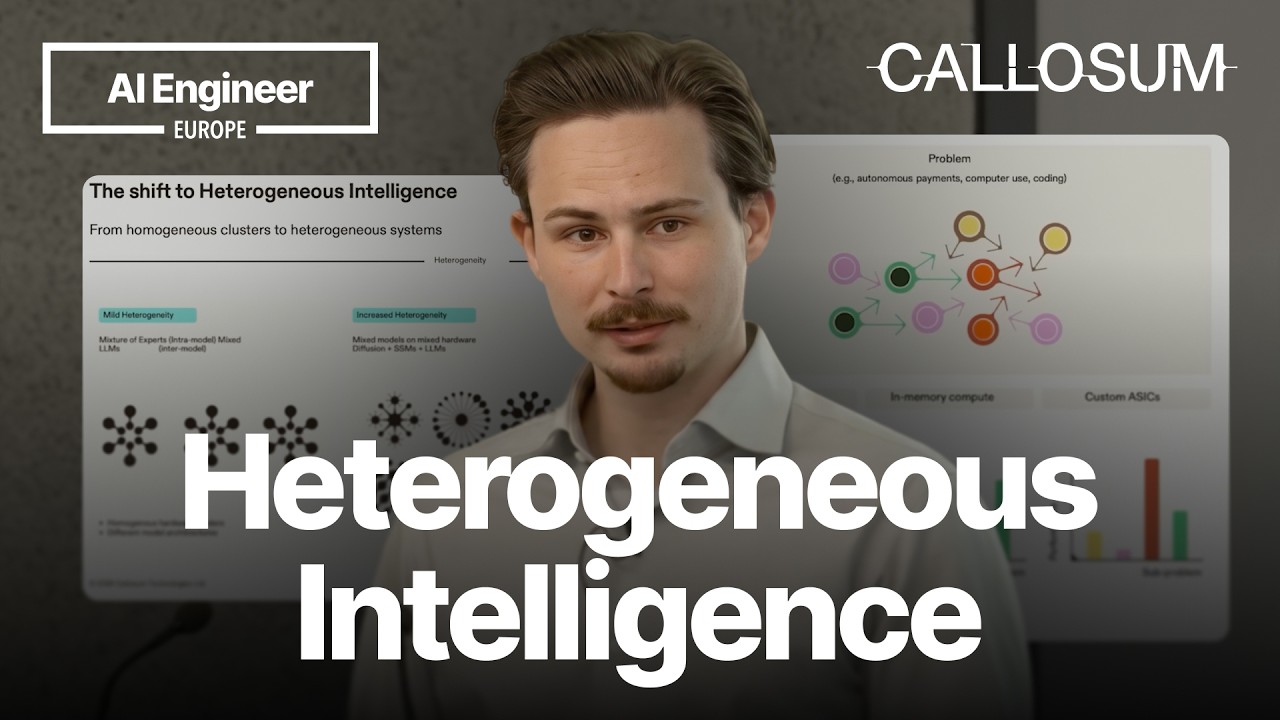
He explained that the paradigm is already shifting, evidenced by the emergence of concepts like "Mixture of Experts" and multi-agent systems, where different models collaborate. This movement towards heterogeneity is further supported by new generations of silicon designed to unlock new performance levels for specialized tasks. However, Bertagnoli noted a critical gap: the lack of infrastructure to unify these diverse components.

The Principle of Maximum Heterogeneity

Callosum, Bertagnoli's company, has formalized the theoretical foundation for this new paradigm, which they term "Maximum Heterogeneity." This principle suggests that by strategically distributing computational workloads across a diverse set of models and hardware, AI systems can achieve optimal performance. Bertagnoli illustrated this with a conceptual cube, where the axes represent different dimensions of heterogeneity, from model diversity to hardware specialization.

He presented research demonstrating that across various domains, including AI, neuroscience, economics, and ecology, heterogeneous resources can indeed push the "Pareto front" of what systems can achieve. This means that by leveraging diversity, systems can simultaneously improve performance and reduce costs, a feat difficult to accomplish with homogeneous approaches.

Bertagnoli elaborated on the practical implications, explaining that while homogeneous systems might scale by using many identical components, heterogeneous systems achieve greater efficiency by using the right tool for the right job. This involves mapping different sub-tasks to specialized models and hardware, thereby saving costs and increasing speed.

Heterogeneous Intelligence in Practice

The presentation showcased practical examples of this heterogeneous approach. In the realm of workflows, Bertagnoli highlighted "automated workflow decomposition" and "heterogeneous recursion," where complex tasks are broken down and managed by specialized agents. These agents, he explained, can be multimodal, incorporating various types of data and reasoning, and can be orchestrated to interact with each other.

A key aspect discussed was the concept of "heterogeneous hardware orchestration." This involves deploying different models onto specialized hardware, such as CPUs, GPUs, and custom ASICs, optimizing for the specific computational demands of each task. Bertagnoli pointed to the fact that while homogeneous scaling of LLMs on single chips was the norm, the move towards heterogeneous systems is now enabling more efficient inference.

Bertagnoli also presented benchmark results for their work, demonstrating significant improvements in cost and speed compared to existing models. For instance, their system, when applied to the LLM benchmark, was shown to be 12 times cheaper and 5 times faster than GPT-5.2 for long contexts, while maintaining comparable accuracy. Similarly, they achieved a 3x faster and 18x cheaper performance than Kimi-K2.5.

The system's ability to perform "active perception" allows it to dynamically match sub-tasks to the most appropriate models and hardware, further enhancing efficiency. Bertagnoli concluded by looking ahead to the future of compute, suggesting that the paradigm is shifting from "made compute quicker" (CPU-dominated) and "made compute parallel" (GPU-dominated) to a third paradigm: "made compute heterogeneous." This shift, he argued, will unlock new frontiers in AI capabilities and cost-effectiveness for large-scale agentic AI.

© 2026 StartupHub.ai. All rights reserved. You may not republish this article in full without a license. Search engines and AI research tools may crawl and summarize for reference. Bulk reproduction or model training requires a license. See our terms.
Daniel Singer

Written by

Daniel Singer

Editor, StartupHub.ai

Daniel Singer is the editor of StartupHub.ai, a technology expert and thought leader on AI and its applications across sectors, from fintech and healthcare to developer tooling and consumer software. He writes and tests the tools covered here thoroughly and regularly, and built StartupHub.ai to give founders, operators and buyers a clearer read on what they are actually being sold.

More from Daniel Singer