

The true power of artificial intelligence isn't unlocked by clever prompts alone; it resides in a deeper, more nuanced form of communication that transforms AI from a mere tool into a finely tuned thinking partner. This pivotal insight forms the bedrock of "Description," a core competency explored by Rick Dakan, Professor at Ringling College of Art and Design, within the Anthropic Academy's "AI Fluency: Framework & Foundations Course." Dakan illuminates how effective interaction with AI demands a shift from simple instruction to a collaborative environment where human intent and AI capability converge.
At its essence, AI fluency means engaging with AI systems effectively, efficiently, ethically, and safely. The "Description" competency, Dakan posits, is fundamental to this, encompassing far more than just crafting clever prompts. It involves explaining tasks, asking pertinent questions, providing rich context, and actively guiding the interaction to foster a shared intellectual space where both human and AI can achieve their best work. This collaborative dynamic builds a bridge between human intentions and AI's capabilities, moving beyond the simplistic notion of AI as a vending machine for information.
The first critical element of this descriptive mastery is **Product Description**: the ability to clearly define the characteristics of your desired output. Dakan underscores that the quality of AI-generated content hinges on the clarity of your initial request. "AI can't read your mind," he cautions, emphasizing the imperative to articulate every relevant detail. This means specifying context, desired format, target audience, stylistic nuances, and any other constraints that might shape the AI's response. Without this explicit guidance, the AI is left to infer, often leading to outputs that fall short of expectations.
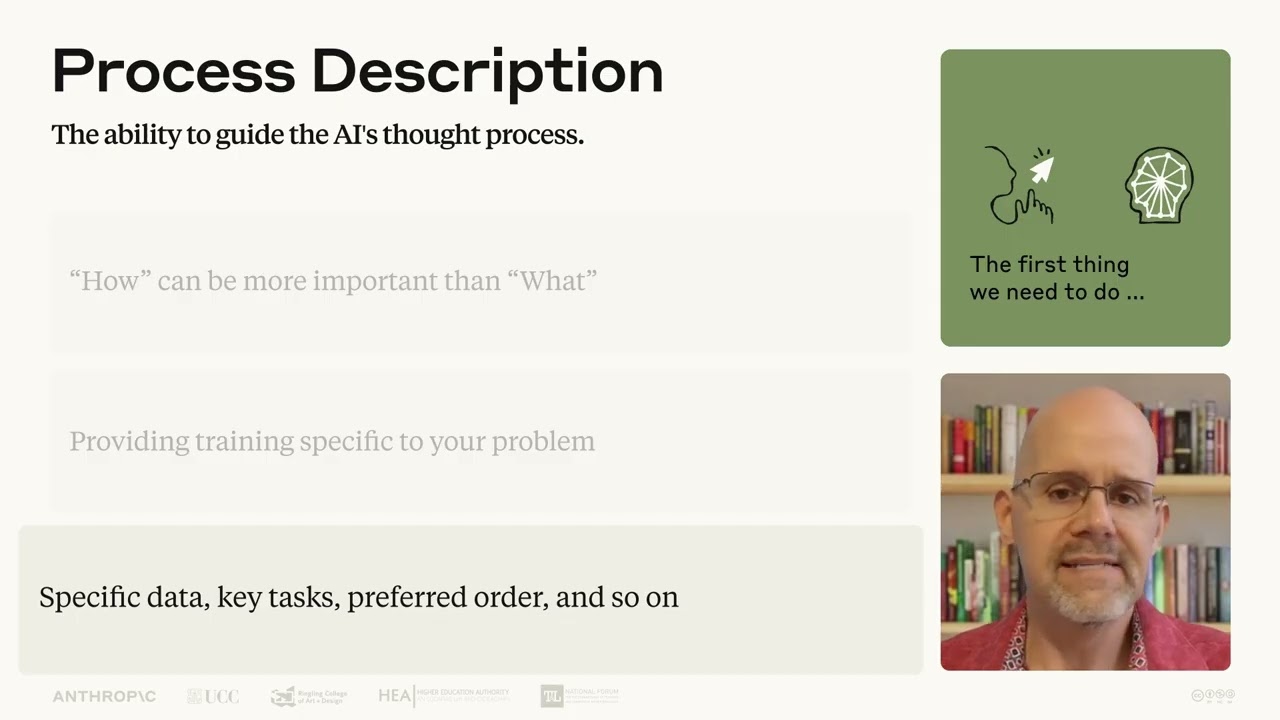
Next is **Process Description**, which focuses on guiding the AI's thought process. Sometimes, *how* an AI approaches a task is as, or even more, crucial than *what* the end goal is. Users can steer the AI's problem-solving methodology by providing specific training tailored to their unique challenges. This could involve general guidelines akin to a manual, step-by-step instructions like a detailed cookbook, or even demonstrating preferred approaches through examples. Dakan highlights that "The AI already has extensive training, but you're providing additional context specific to your unique situation." This bespoke guidance ensures the AI's internal logic aligns with the user's strategic intent, leading to more relevant and actionable outcomes.
Finally, there is **Performance Description**, which involves defining the behavioral aspects of an AI interaction. AI tools are not static databases; they are interactive systems capable of varied behaviors depending on the context, much like human collaborators. "AI tools are not databases or vending machines. They are interactive systems that can behave differently in different contexts, much like people might," Dakan explains. To optimize results, users must explicitly communicate the desired behavioral traits of the AI. Do you need it to challenge assumptions or simply follow your lead? Should it provide exhaustive detail or remain concise? Should it explain its reasoning or merely deliver an answer? Defining these behavioral parameters is crucial for shaping a productive and responsive AI partnership.