

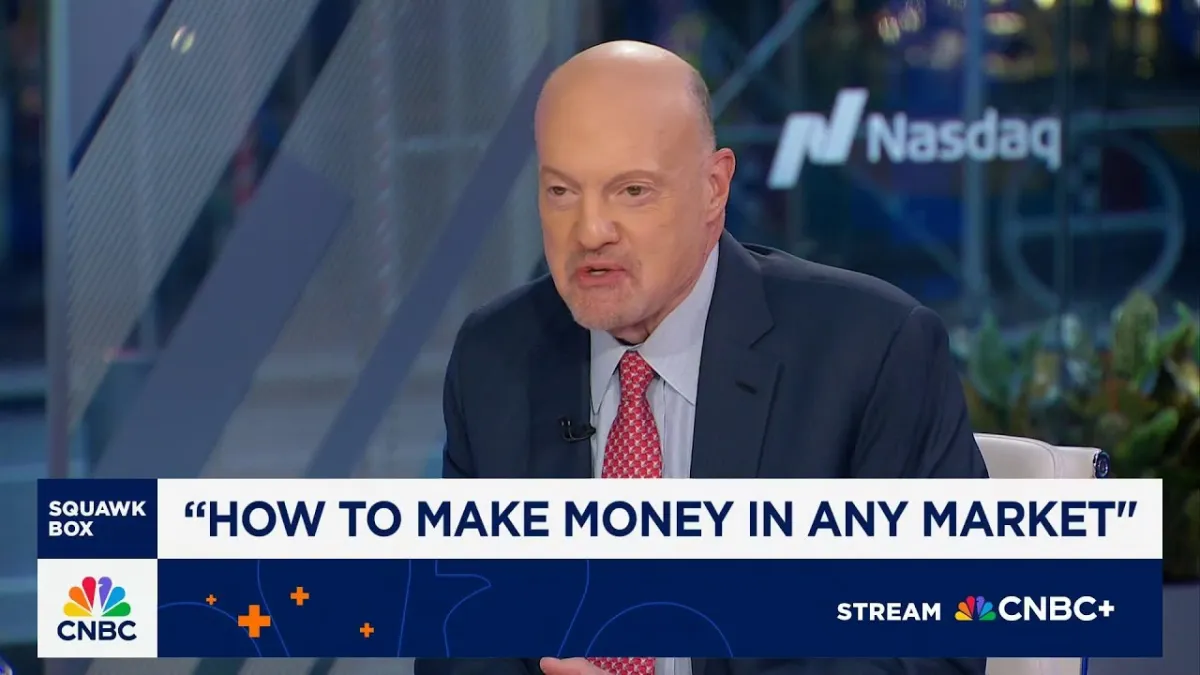
The artificial intelligence revolution, while hailed as a democratizing force for information, presents a complex landscape for investors. Jim Cramer, appearing on CNBC’s "Squawk Box" with co-hosts Becky Quick and Andrew Ross Sorkin, unpacked these nuances, coinciding with the release of his new book, "How to Make Money in Any Market." His commentary offered a blend of practical investment advice and sharp analysis on the AI boom's current realities, aimed squarely at navigating today's intricate financial currents.
Cramer's latest work, described as a "how-to" guide, champions active research for individual investors, moving beyond passive index fund strategies. He argues that the advent of AI has fundamentally altered the playing field for data access. "Now because of artificial intelligence, it's the same," Cramer stated, referring to the unprecedented ability of individual investors to tap into information once exclusive to professionals. Yet, he quickly cautioned that AI tools like ChatGPT are "so often incorrect," emphasizing the continued need for human verification and critical thinking in research. This duality highlights a core insight: while AI provides powerful tools, human acumen remains indispensable.
His broader market philosophy encourages a blend of individual stock picking and index fund investment, challenging the orthodoxy that often pushes investors solely towards passive vehicles. He advocates for observation and curiosity, encouraging investors to delve into company fundamentals rather than merely following trends. This shift towards empowered, informed decision-making is a central tenet of his new book, seeking to equip a new generation of investors with the tools to navigate volatile markets.
A significant portion of the discussion centered on the generational divide in investing. Cramer expressed concern over Gen Z's inclination towards "one-trick pony" meme stocks and zero-day options, contrasting it with a more sustainable, long-term approach. "I want investing, not trading," he asserted, lamenting a perceived cynicism among younger investors who believe saving is futile and that their financial prospects will never match those of their parents. He urged a return to the foundational principle of investing over time, highlighting his own experience of modest, consistent savings accumulating into substantial wealth.
Quick then introduced Cramer's concept of "two economies": a booming AI/tech sector and a consumer economy that "needs a little help." Cramer concurred, delving into the paradox of the current AI surge. Despite massive commitments, such as Nvidia's significant involvement with Open AI, he raised critical questions about immediate profitability. "None of these guys are really making money right now," he noted, referring to the large language model companies. This points to a crucial analytical insight: the AI boom, unlike some past tech expansions, is characterized by extensive "pseudo-vendor financing" and massive commitments without corresponding immediate cash generation. This reliance on debt and future projections, rather than present cash flow, marks a distinct characteristic of this technological cycle.