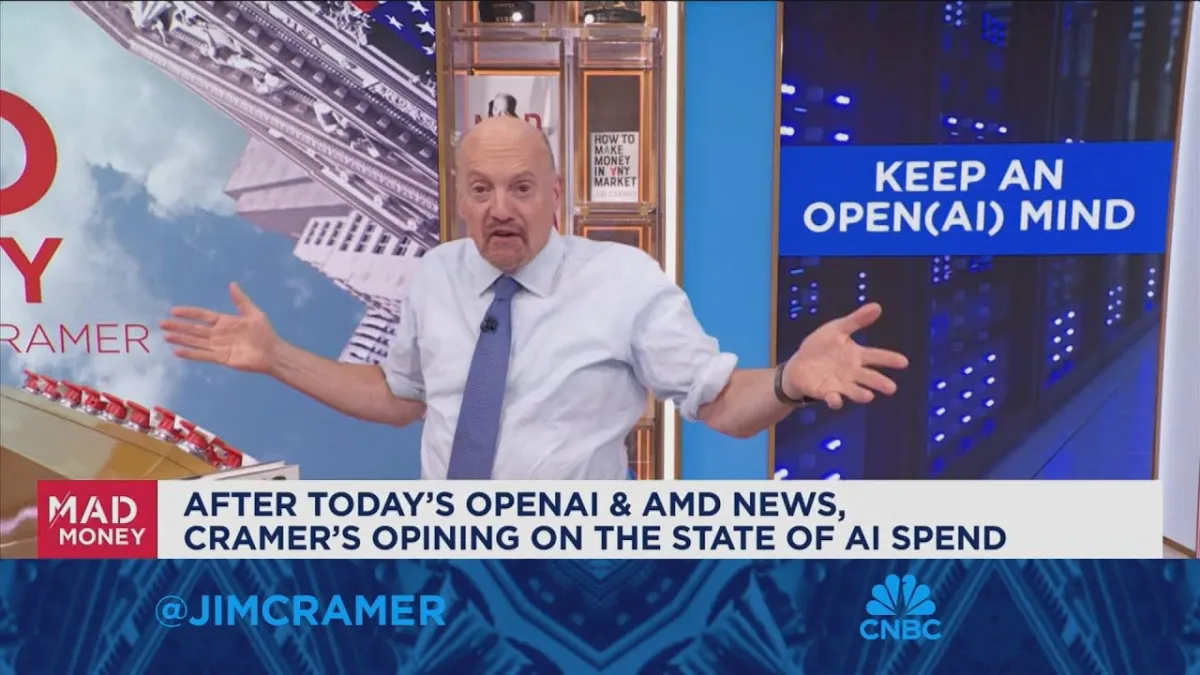
"I know, I am a believer," declared Jim Cramer on CNBC's "Mad Money," encapsulating his fervent conviction that artificial intelligence is poised to usher in the next industrial revolution. His impassioned commentary on the state of AI spend, particularly in the semiconductor sector, served as a rallying cry for those who might still doubt the technology's transformative power. Cramer, known for his energetic market analysis, spoke directly to the audience, framing the current AI landscape as a binary choice: either embrace its undeniable momentum or risk being left behind.
The context for Cramer’s emphatic stance was the recent market activity spurred by significant developments in AI infrastructure. Specifically, he highlighted a strategic partnership between AMD and OpenAI, a collaboration poised to deploy an astonishing six gigawatts of AMD GPUs. This revelation, following reports of OpenAI’s plans for substantial chip procurement, sent a clear signal to the markets, with AMD’s stock experiencing an immediate and dramatic surge.
The market’s response to this news was nothing short of electrifying. "AMD stock shot up 24% today," Cramer noted, pointing to a single-day gain that significantly outpaced broader market movements. This immediate capital appreciation in AMD, alongside strong performance from other data center stocks, propelled the NASDAQ to a record close and marked the S&P 500’s seventh consecutive record close. Such concentrated growth, even as the Dow Industrials saw a slight dip, underscores a powerful, singular bullish sentiment driving capital towards AI-centric investments.
One core insight Cramer underscored is the sheer scale of investment now flowing into AI infrastructure. The commitment from OpenAI to "spend tens of billions of dollars on AMD's highest-end chips in addition to Nvidia's chips" is a testament to the unprecedented demand for specialized hardware. This isn't merely an incremental upgrade to existing systems; it represents a fundamental, industrial-scale re-tooling of global computing capabilities. The energy consumption alone—six gigawatts—illustrates an infrastructure build-out comparable to establishing new power grids, signaling AI's foundational role in the evolving economy.
This is not a speculative bubble. It is a foundational shift.
Another critical insight emerging from Cramer’s commentary is the stark divergence between market action and lingering skepticism. Despite "countless AI skeptics" who question the technology’s long-term profitability or potential overvaluation, the market’s behavior reflects an unwavering belief in AI’s economic viability. The willingness of major players to commit vast sums to hardware procurement, coupled with the market’s confidence that these expenditures are justifiable and will yield returns, effectively silences the naysayers. The financial commitments are tangible, immediate, and reflect a strategic imperative rather than mere hype.
Cramer’s personal conviction in AI's revolutionary potential is not a recent phenomenon. He traced his belief back several years, recalling a pivotal conversation with Jensen Huang, the CEO of Nvidia. "Ever since Jensen Huang, the CEO of Nvidia, told me about the possibilities of accelerated computing and artificial intelligence... I thought that there could be some sort of revolution going here," he recounted. This early foresight, gleaned from one of the industry's most influential figures, solidified his long-term perspective on AI as a profound and inevitable force, rather than a fleeting technological trend.
His message to investors and industry leaders is unequivocal: the era of AI is here, and it demands attention and investment. The confluence of strategic partnerships, massive capital expenditure on advanced semiconductors, and a bullish market response paints a clear picture. The debate over AI’s potential is largely settled in the financial markets, where billions are being deployed to build the very infrastructure that will power this new industrial age.
Jim Cramer’s forceful articulation of AI’s revolutionary potential, bolstered by concrete market movements and strategic investments, paints a vivid picture of a technology rapidly reshaping economic realities. His commentary serves as a stark reminder to the startup ecosystem, VCs, and tech insiders that the era of AI is not merely arriving; it is actively being built through massive capital expenditure and strategic partnerships that are already yielding substantial market responses.