Claude.ai's latest advancement, the integration of "connectors," fundamentally redefines how artificial intelligence can serve as a truly capable productivity partner within an organization's existing digital ecosystem. As the product demonstration video, "Getting started with connectors in Claude.ai," illustrates, this feature allows users to "connect the tools you already use to unlock a smarter, more capable productivity partner with Claude." This is not merely about expanding data access; it's about transforming Claude into an active, contextual participant in complex workflows, moving beyond a conversational agent to a dynamic orchestrator of tasks.
The video, presented as a narrated walkthrough by Anthropic, Claude's developer, showcases the practical application and setup of these new connectors. The core message is clear: by linking Claude to a user's web-based applications and desktop files, the AI gains an unprecedented level of contextual understanding and the ability to execute actions across diverse platforms. This marks a pivotal shift in AI utility, enabling more sophisticated and integrated automation for businesses.
Fundamentally, connectors make Claude significantly more knowledgeable, translating directly into "more useful responses." This enhanced intelligence extends to handling various file types and data sources. Claude can now read uploaded documents, analyze spreadsheet data for insights, generate professional reports, and even create presentations, all while maintaining a comprehensive understanding of the user's broader objectives and the ongoing conversational context. This deep integration means the AI is no longer operating in a silo but is intrinsically linked to the operational data and tools that drive daily business activities.
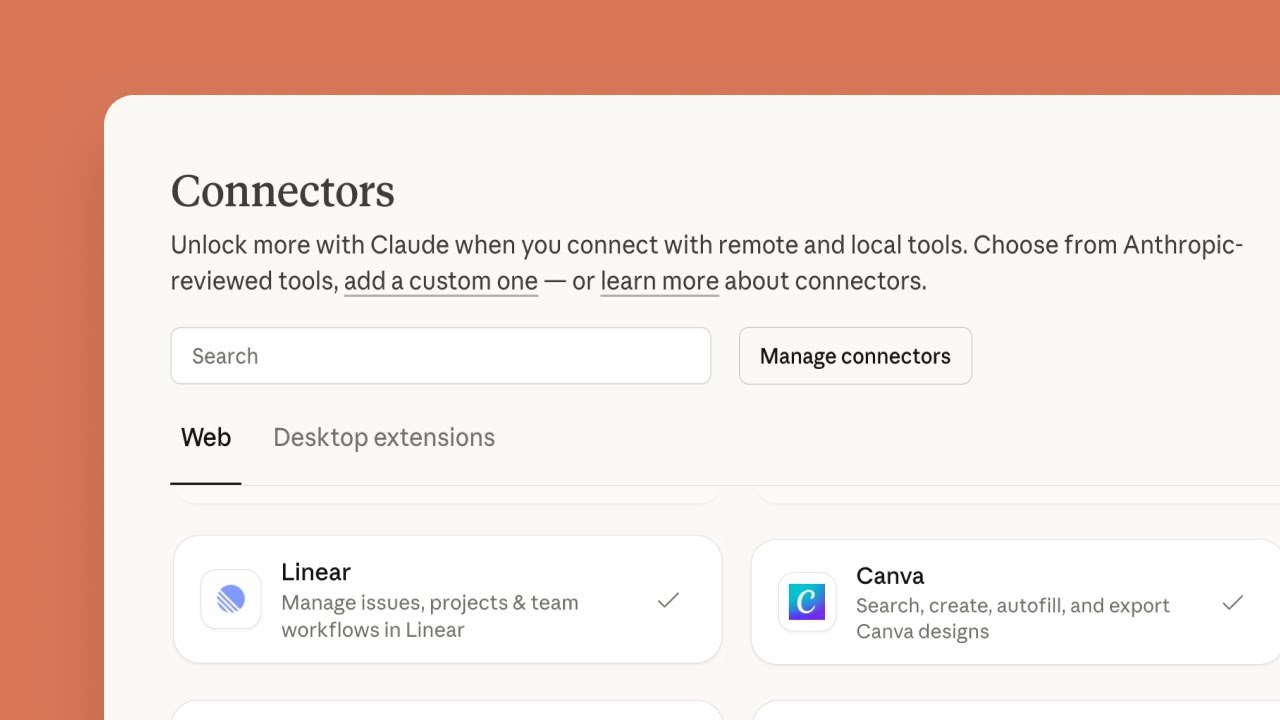
Setting up these connections is designed to be straightforward. Users access a "Search and tools" button within the Claude chat interface, revealing a sub-menu with options to add or manage connectors. A comprehensive directory lists available integrations, spanning web tools for productivity, communication, development, business, and automation, as well as desktop extensions for local file access. The connection process is securely managed via Anthropic's Model Context Protocol (MCP), ensuring safe authorization. A quick prompt to Claude, inquiring about its access to a newly connected tool, provides immediate confirmation of functionality.
Each connector offers specific permissions that users can toggle on or off with ease. This granular control allows organizations to precisely define the scope of Claude's access and actions, balancing powerful AI capabilities with robust security and privacy requirements.
Beyond merely retrieving information, connectors enable Claude to perform actions, creating a seamless "dynamic bridge across all the tools you use to get work done." This capability unlocks a new dimension of automation, where the AI can proactively contribute to operational tasks rather than simply providing information. The video compellingly demonstrates this through a common enterprise scenario: generating product release notes.
In the example, a user requests Claude to "pull the completed tickets from this week's production sprint and create product release notes using our standard communications template." Claude automatically connects to Linear to identify completed sprint tickets, extracting detailed feature descriptions, bug fixes, and improvements. Simultaneously, it searches Notion for the company’s standard release notes template. Within moments, Claude compiles accurate, professionally formatted release notes, complete with technical details and aligned with the company's style, ready for stakeholder review. This level of autonomous, multi-application workflow execution dramatically reduces manual effort and potential for human error.
This same integrated approach extends across an entire organizational workflow. Meeting notes can be transformed into actionable project tasks in Asana, comprehensive project updates can be distilled into concise executive summaries, and product requirement documents (PRDs) can be converted into visual Figma designs. "Claude enhances your productivity by integrating seamlessly with your digital tools," the demonstration concludes, highlighting the profound impact on efficiency and strategic resource allocation. The introduction of connectors marks a significant step towards a future where AI systems are not just intelligent assistants but deeply embedded, proactive partners in enterprise operations, capable of navigating and acting within complex digital environments.