

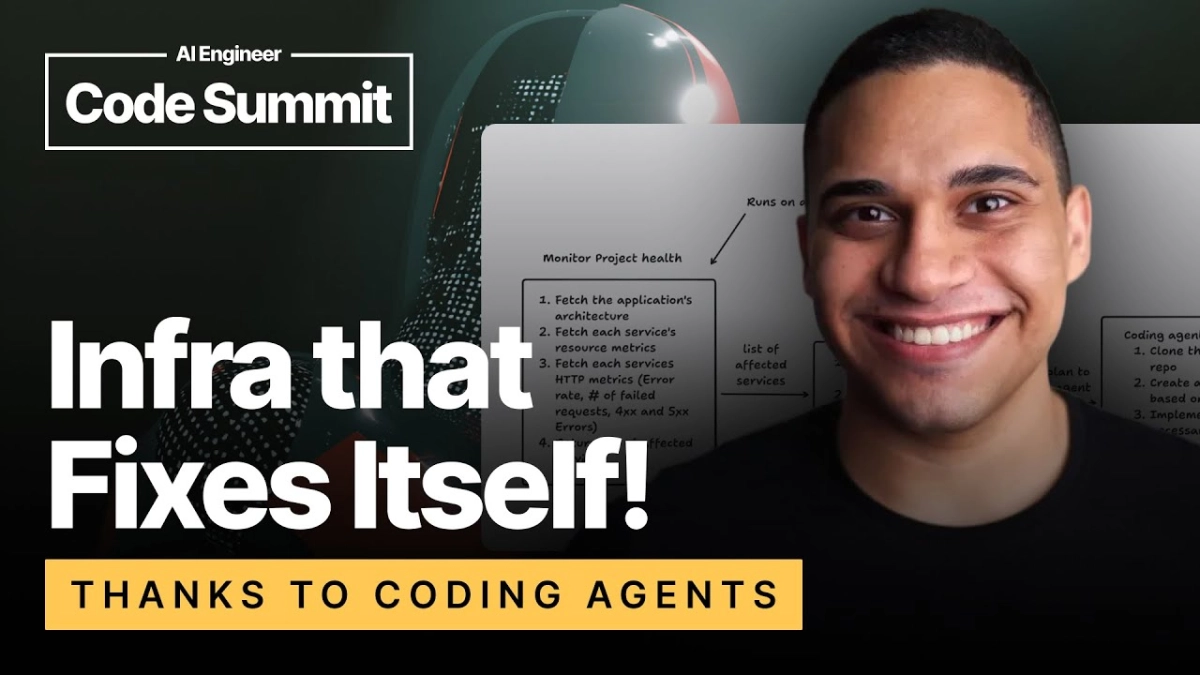
The promise of autonomous systems extends far beyond self-driving cars, now actively reshaping the very foundations of digital infrastructure. Mahmoud Abdelwahab, a Software Engineer at Railway, recently unveiled a groundbreaking product, Railway Autofix, demonstrating how coding agents can autonomously identify and rectify production issues, a paradigm shift from traditional reactive incident response. His presentation detailed a future where developers are liberated from the drudgery of debugging, instead reviewing AI-generated pull requests that fix problems before they escalate.

Abdelwahab’s talk introduced Railway Autofix, a plug-in template designed to integrate seamlessly into any Railway project. The core concept revolves around proactive infrastructure monitoring and the automated generation of fixes through coding agents like OpenCode, orchestrated by durable execution platforms such as Inngest. This innovative approach seeks to transform the often-stressful experience of managing production environments, moving from frantic firefighting to a streamlined, automated remediation process.
The conventional reality for many engineering teams involves a constant battle against production issues. Abdelwahab highlighted common scenarios: a memory leak leading to escalating memory utilization and eventual service crashes, or a database-heavy service suffering from slow queries, resulting in high response times and poor user experience. Such problems, whether immediately obvious or subtly insidious, typically trigger alerts that require manual investigation. Engineers must sift through logs, metrics, and traces, piecing together a mental picture of the issue before devising and implementing a fix. This laborious process is not only time-consuming but also diverts valuable engineering resources from innovation.
Railway Autofix proposes a radical departure from this reactive model. Instead of merely alerting, the system actively monitors the project’s health on a scheduled basis, systematically fetching application architecture details, resource metrics (CPU, memory), and HTTP metrics (error rates, response times) for all deployed services. This comprehensive data collection allows for a holistic understanding of the infrastructure's state over time, identifying deviations from expected behavior that might indicate an underlying issue. This temporal analysis is crucial, as Abdelwahab noted, "It's probably better to be able to analyze a slice of time, rather than just having a threshold being met, because it can get pretty noisy."
Once a potential issue is detected, the system pulls additional contextual information, such as build, deployment, and HTTP logs. This enriched dataset is then used to generate a detailed plan for remediation. This plan, a structured outline of identified problems and proposed solutions, is subsequently handed off to an AI coding agent. The agent’s role is not just diagnostic but prescriptive and executive.