

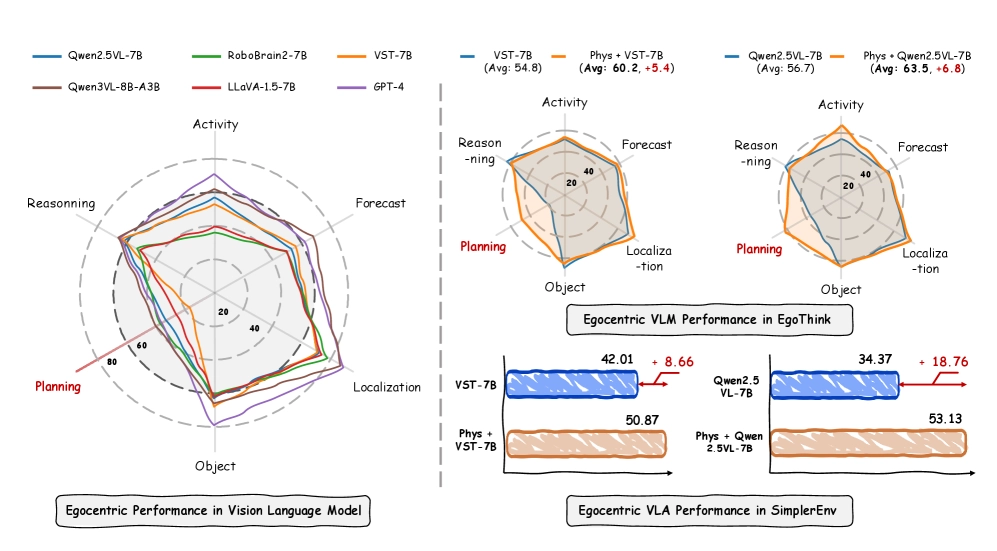
The fundamental bottleneck in building physically intelligent robots has long been the data. Vision Language Models (VLMs) are typically trained on vast troves of third-person video, creating a critical viewpoint mismatch when applied to a humanoid robot operating with a head-mounted, first-person (egocentric) camera. Collecting enough high-quality, diverse robot data to fix this gap is prohibitively expensive.
Now, a team of researchers has proposed a scalable solution: the PhysBrain model, an egocentric-aware embodied brain trained almost entirely on structured human video.
The core innovation is the Egocentric2Embodiment Translation Pipeline. This system takes raw human egocentric videos, sourced from large datasets like Ego4D, BuildAI (factory work), and EgoDex (lab manipulation), and converts them into E2E-3M, a massive dataset of 3 million structured VQA (Vision Question Answering) instances. Crucially, this process doesn't just describe the video; it enforces schema-driven, multi-level supervision covering planning decomposition, interaction mechanics, and temporal consistency, ensuring the data is reliable for embodied learning.
The resulting PhysBrain model, built on backbones like Qwen2.5-VL-7B, shows immediate and substantial gains in first-person understanding. When tested on the EgoThink benchmark, which measures egocentric reasoning across six dimensions, PhysBrain showed the most pronounced gains in the critical area of Planning compared to standard VLMs.
The New Scaling Law for Embodiment
The real test for any embodied brain is whether those cognitive gains translate into physical action. The researchers demonstrated that PhysBrain provides a superior egocentric initialization for downstream Vision-Language-Action (VLA) fine-tuning.