

Google DeepMind Puts Sign Language AI in Hands

Google DeepMind launches SL2T, bringing sign language translation to Gboard and Live Transcribe, enhancing digital accessibility for millions.

8 min read
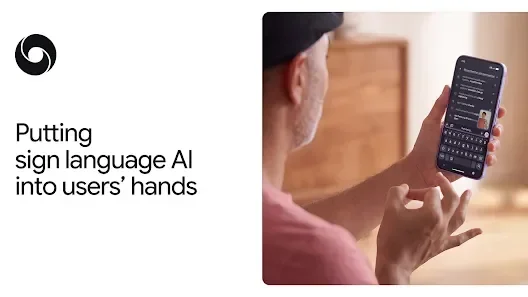
Google DeepMind team demonstrating sign language AI on a smartphone screen.
Deepmind

Visual TL;DR. Communication Divide drives need Sign Language AI. Sign Language AI powers Gboard & Live Transcribe. Gboard & Live Transcribe starts with ASL to English. Gboard & Live Transcribe enables Digital Inclusivity. Sign Language AI overcomes Linguistic Challenges. Digital Inclusivity leads to Future Potential.

  1. Communication Divide: 70 million Deaf and hard of hearing individuals use over 200 distinct sign languages
  2. Sign Language AI: Google DeepMind launches SL2T, a sign-language-to-text translation model
  3. Gboard & Live Transcribe: SL2T integrated into Google's consumer-facing Gboard and Live Transcribe applications
  4. ASL to English: initially supporting American Sign Language (ASL) to English translation
  5. Digital Inclusivity: empowering Deaf users to interact with devices and bridge communication gaps
  6. Linguistic Challenges: sign languages are independent linguistic systems requiring true machine translation
  7. Future Potential: transforming how Deaf users interact with their devices and the digital world
Visual TL;DR
Visual TL;DR, startuphub.ai Communication Divide drives need Sign Language AI. Sign Language AI powers Gboard & Live Transcribe. Gboard & Live Transcribe enables Digital Inclusivity drives need powers enables Communication Divide Sign Language AI Gboard & Live Transcribe Digital Inclusivity From startuphub.ai · The publishers behind this format
Visual TL;DR, startuphub.ai Communication Divide drives need Sign Language AI. Sign Language AI powers Gboard & Live Transcribe. Gboard & Live Transcribe enables Digital Inclusivity drives need powers enables CommunicationDivide Sign Language AI Gboard & LiveTranscribe DigitalInclusivity From startuphub.ai · The publishers behind this format
Visual TL;DR, startuphub.ai Communication Divide drives need Sign Language AI. Sign Language AI powers Gboard & Live Transcribe. Gboard & Live Transcribe enables Digital Inclusivity drives need powers enables Communication Divide 70 million Deaf and hard of hearingindividuals use over 200 distinct signlanguages Sign Language AI Google DeepMind launches SL2T, asign-language-to-text translation model Gboard & Live Transcribe SL2T integrated into Google'sconsumer-facing Gboard and Live Transcribeapplications Digital Inclusivity empowering Deaf users to interact withdevices and bridge communication gaps From startuphub.ai · The publishers behind this format
Visual TL;DR, startuphub.ai Communication Divide drives need Sign Language AI. Sign Language AI powers Gboard & Live Transcribe. Gboard & Live Transcribe enables Digital Inclusivity drives need powers enables CommunicationDivide 70 million Deaf andhard of hearingindividuals use… Sign Language AI Google DeepMindlaunches SL2T, asign-language-to-tex Gboard & LiveTranscribe SL2T integratedinto Google'sconsumer-facing… DigitalInclusivity empowering Deafusers to interactwith devices and… From startuphub.ai · The publishers behind this format
Visual TL;DR, startuphub.ai Communication Divide drives need Sign Language AI. Sign Language AI powers Gboard & Live Transcribe. Gboard & Live Transcribe starts with ASL to English. Gboard & Live Transcribe enables Digital Inclusivity. Sign Language AI overcomes Linguistic Challenges. Digital Inclusivity leads to Future Potential drives need powers starts with enables overcomes leads to Communication Divide 70 million Deaf and hard of hearingindividuals use over 200 distinct signlanguages Sign Language AI Google DeepMind launches SL2T, asign-language-to-text translation model Gboard & Live Transcribe SL2T integrated into Google'sconsumer-facing Gboard and Live Transcribeapplications ASL to English initially supporting American SignLanguage (ASL) to English translation Digital Inclusivity empowering Deaf users to interact withdevices and bridge communication gaps Linguistic Challenges sign languages are independent linguisticsystems requiring true machine translation Future Potential transforming how Deaf users interact withtheir devices and the digital world From startuphub.ai · The publishers behind this format
Visual TL;DR, startuphub.ai Communication Divide drives need Sign Language AI. Sign Language AI powers Gboard & Live Transcribe. Gboard & Live Transcribe starts with ASL to English. Gboard & Live Transcribe enables Digital Inclusivity. Sign Language AI overcomes Linguistic Challenges. Digital Inclusivity leads to Future Potential drives need powers starts with enables overcomes leads to CommunicationDivide 70 million Deaf andhard of hearingindividuals use… Sign Language AI Google DeepMindlaunches SL2T, asign-language-to-tex Gboard & LiveTranscribe SL2T integratedinto Google'sconsumer-facing… ASL to English initiallysupporting AmericanSign Language (ASL)… DigitalInclusivity empowering Deafusers to interactwith devices and… LinguisticChallenges sign languages areindependentlinguistic systems… Future Potential transforming howDeaf users interactwith their devices… From startuphub.ai · The publishers behind this format

Google DeepMind has taken a significant step towards digital inclusivity with the public release of its sign-language-to-text (SL2T) translation model. For the first time, this advanced AI is moving from the lab into consumer-facing products, aiming to empower the estimated 70 million Deaf and hard of hearing individuals worldwide who use one of the over 200 distinct sign languages. The breakthrough technology is now powering new sign language features in Google's Gboard and Live Transcribe applications, initially supporting American Sign Language (ASL) to English. This development, detailed in an announcement from Google DeepMind, promises to transform how Deaf users interact with their devices.

Unlike simple speech-to-text transcription, sign language translation presents unique computational challenges. Sign languages are independent linguistic systems with their own grammars and vocabularies, requiring true machine translation rather than direct word-for-word conversion. Furthermore, these languages utilize a complex interplay of hand movements, facial expressions, and body posture, demanding sophisticated computer vision to interpret simultaneous, nuanced physical cues. Early attempts, like sign language gloves, proved insufficient because they failed to capture this holistic, visual nature of signing. SL2T addresses these hurdles by processing sign language as a sequence of body pose landmarks, preserving user privacy by discarding raw video feeds and focusing solely on geometric coordinates for translation.

Bridging the Communication Divide

The SL2T model is the result of extensive data scaling and a user-centric, culturally informed approach. Trained on over 100,000 hours of data across more than 50 sign languages, with a substantial portion dedicated to ASL, the model learns shared linguistic structures. This multilingual training enables it to outperform single-language models. Google DeepMind emphasizes a commitment to building with the community, involving Deaf individuals in every stage from conceptualization to data collection and evaluation. An AI Sign Language Advisory Committee (AISLAC), comprising global Deaf organizations and experts, guides responsible deployment. This collaborative ethos is crucial for ensuring technology truly serves its intended users.

Practical Applications and Future Potential

The integration of SL2T into Gboard and Live Transcribe allows Deaf users to sign commands, messages, or responses directly to their phones, mirroring the convenience hearing users experience with voice dictation. Testers have reported that signing is faster, more natural, and more enjoyable than typing. Potential applications include web searches, drafting documents, and participating in conversations via Live Transcribe. While SL2T demonstrates impressive zero-shot performance on benchmarks like FLEURS-ASL, Google DeepMind also focused on practical deployment issues such as minimizing latency, preventing false positives on non-signing inputs, and ensuring fairness for left-handed signers. The company plans to expand SL2T to more languages and explore sign language generation capabilities, aiming for full parity with spoken and written languages in digital accessibility.

This advancement positions Google DeepMind's Gemini family of models, which generally scores 63/100 according to StartupHub.ai data, as a leader in specialized AI applications. While Gemini competes in a crowded field with models like Qwen (score 50/100) and more established players, its focus on niche, high-impact areas like sign language translation demonstrates a strategic depth. StartupHub.ai tracks competitors such as Buvex and Drofi, which score 7/100, highlighting the significant gap in capability and market readiness.

The availability of SL2T in Gboard and Live Transcribe on Pixel 11 devices, with broader device support and additional languages planned, marks a significant milestone. It underscores the growing trend of AI moving beyond general-purpose tasks to address specific, underserved communication needs. The success of SL2T could pave the way for similar AI-driven accessibility solutions across various communication modalities.

© 2026 StartupHub.ai. All rights reserved. Do not enter, scrape, copy, reproduce, or republish this article in whole or in part. Use as input to AI training, fine-tuning, retrieval-augmented generation, or any machine-learning system is prohibited without written license. Substantially-similar derivative works will be pursued to the fullest extent of applicable copyright, database, and computer-misuse laws. See our terms.