

OpenAI Unveils GPT-5.6: Enhanced Intelligence for Agentic AI

OpenAI has made its GPT-5.6 models generally available, featuring enhanced intelligence, programmatic tool calling, and improved subagent delegation for more autonomous AI development.

9 min read
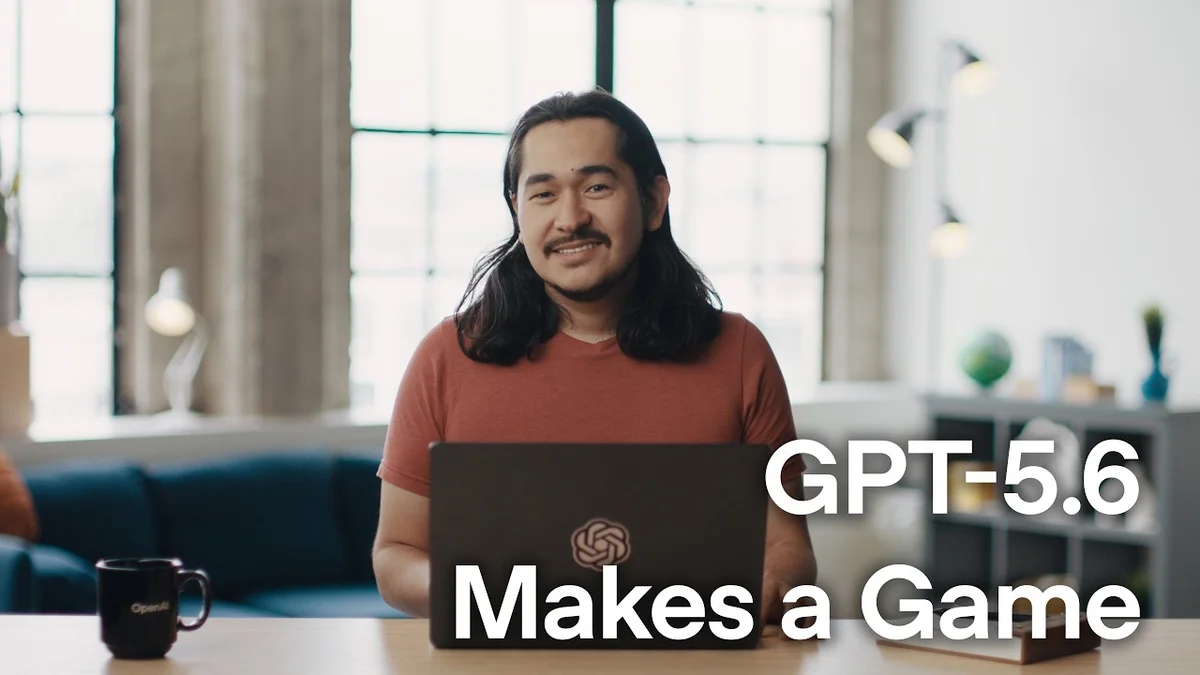
Charlie Guo, Developer Experience Engineer at OpenAI, presenting the new GPT-5.6 model on a laptop with the OpenAI logo.
OpenAI Youtube
Visual TL;DR
OpenAI GPT-5.6 UnveiledCore
new models generally available, featuring enhanced intelligence and agentic capabilities
From the article 5 mentionsIn a significant announcement for the AI and startup community, OpenAI has officially launched its GPT-5.6 series of models, making them generally available.
More Intelligence/TokenContext
From the article 8 mentionsAccording to Guo, these models offer "more intelligence per token" and are significantly "better at staying on track, even with ambiguous prompts." This improvement in foundational intelligence means that developers can expect more reliable and coherent outputs, even when initial instructions are less precise, a common challenge in complex AI projects.
Programmatic Tool CallingEffect
enables advanced reasoning and more sophisticated interaction with external systems
From the article 2 mentionsA standout feature of GPT-5.6 is its programmatic tool calling.
Enhanced Subagent DelegationEffect
improves autonomous AI development by allowing better task distribution
From the article 3 mentionsThe focus on programmatic tool calling and subagent delegation suggests a future where AI systems can take on more comprehensive and complex roles in software development and creative processes.
Diverse API ModelsContext
catering to various needs and use cases across different development scenarios
From the articleOpenAI is also making the GPT-5.6 series available via its API, offering a range of models tailored to different development needs.
Streamlined DevelopmentOutcome
developers can expect more reliable and coherent outputs, simplifying workflows
From the article 3 mentionsGuo detailed how GPT-5.6 delivers enhanced intelligence, improved prompt consistency, and advanced agentic capabilities, promising to streamline development workflows and unlock new possibilities for AI applications.
New AI PossibilitiesOutcome
unlocking advanced applications and more complex autonomous AI systems
From the articleGuo detailed how GPT-5.6 delivers enhanced intelligence, improved prompt consistency, and advanced agentic capabilities, promising to streamline development workflows and unlock new possibilities for AI applications.
Contents(7)

Last updated: August 2026

In a significant announcement for the AI and startup community, OpenAI has officially launched its GPT-5.6 series of models, making them generally available. Microsoft (NASDAQ:MSFT)-backed OpenAI, a leader in artificial intelligence research and deployment, revealed the new models in a video featuring Charlie Guo, a Developer Experience Engineer at OpenAI. Guo detailed how GPT-5.6 delivers enhanced intelligence, improved prompt consistency, and advanced agentic capabilities, promising to streamline development workflows and unlock new possibilities for AI applications.

Introducing GPT-5.6: More Intelligence Per Token

Charlie Guo, OpenAI's Developer Experience Engineer, highlighted the core advancements of the GPT-5.6 series. According to Guo, these models offer "more intelligence per token" and are significantly "better at staying on track, even with ambiguous prompts." This improvement in foundational intelligence means that developers can expect more reliable and coherent outputs, even when initial instructions are less precise, a common challenge in complex AI projects.

The full discussion can be found on OpenAI Youtube's YouTube channel.

Meet GPT-5.6 - OpenAI Youtube
Meet GPT-5.6, from OpenAI Youtube

Guo demonstrated the model's capabilities by showcasing its use in Codex to build a new card game from an intentionally open-ended prompt. GPT-5.6 not only designed the core game mechanics and generated artwork but also shipped a working first version. When asked to enhance the game further, adding levels, customizing artwork, and creating a soundtrack, the model proved its thoroughness. Guo noted, "I didn't have to worry about designing every screen, defining every interaction, or managing a stack of tickets." This illustrates a future where AI can handle extensive, multi-faceted creative and technical tasks with minimal human oversight.

Programmatic Tool Calling and Advanced Reasoning

A standout feature of GPT-5.6 is its programmatic tool calling. Guo explained that when building the game, the model could "call tools from a sandbox and avoid a lot of back and forth between the tool output and the context window." This direct integration and autonomous tool usage significantly "saved me a ton of time and tokens," according to Guo. This capability is a crucial step towards more efficient and self-sufficient AI agents, reducing the need for constant human intervention in complex workflows.

The persistence of GPT-5.6 is also attributed to new reasoning levels, which go "above Extra High" and provide the model with "even more thinking power." These advanced reasoning capabilities enable GPT-5.6 to tackle more intricate problems and maintain a deeper understanding of ongoing tasks, leading to more robust and reliable outcomes.

Enhanced Delegation with Subagents

For developers utilizing GPT-5.6 within Codex, the model's ability to delegate work to subagents has been significantly improved. While previous models had access to this capability, GPT-5.6 is specifically "trained to decide for itself when delegation is useful." In the card game demonstration, the model leveraged subagents to break down the work and finish it in parallel, handling tasks like art and sound design concurrently. This autonomous delegation capability is a powerful feature for agentic AI, allowing the model to manage and optimize complex projects by distributing tasks efficiently.

API Models for Diverse Needs

OpenAI is also making the GPT-5.6 series available via its API, offering a range of models tailored to different development needs. Developers can choose from a "flagship model for ambitious agentic work," a "more balanced model," and a "fast, affordable model for everyday tasks." This tiered offering ensures that developers can select the most appropriate model for their specific use cases, balancing performance, cost, and complexity. The launch of GPT-5.6 marks a significant step forward in making more intelligent and autonomous AI accessible to a broader developer community, enabling the creation of increasingly sophisticated applications.

What's Next for Developers

Guo expressed excitement about the potential of GPT-5.6, stating, "This game is just one of many projects I've built with GPT-5.6, and I can't wait to see what you make." The general availability of these enhanced models is expected to foster a new wave of innovation, as developers explore the capabilities of more intelligent, persistent, and autonomous AI agents. The focus on programmatic tool calling and subagent delegation suggests a future where AI systems can take on more comprehensive and complex roles in software development and creative processes.

GPT-5.6 in August 2026: The Full Model Family

Since the initial launch announcement, OpenAI has confirmed the full GPT-5.6 family structure. The lineup consists of three variants: Sol (flagship, built for ambitious agentic work), Terra (balanced, for everyday knowledge work), and Luna (fast and cost-efficient for high-volume tasks). As of the week of August 6, 2026, GPT-5.6 Luna began rolling out as the default model for Free and Go users on ChatGPT, significantly widening access to the generation.

On the technical side, all three models share a 1,050,000-token context window with a maximum output of 128,000 tokens. Enterprise users can access a 1.5 million token context window on the highest tier. The tool-call refusal rate, a key benchmark for agentic reliability, has dropped below 4% on GPT-5.6, down from approximately 12% on GPT-5.5. ChatGPT Work, built on GPT-5.6, launched as an agentic system designed to execute complex multi-hour projects autonomously across team files and connected apps.

On safety, OpenAI added "universal monitoring for risky actions and misalignment" to Astra on August 11, 2026, with monitors watching the model's chain of thought in real time to flag or stop high-risk activity before it completes.

StartupHub.ai rates OpenAI at 84 out of 100 in our overall scoring across the 13,000+ startups we track, placing it in the top tier of the global AI landscape. Despite the high score, community buzz has been mixed, reflecting the broader debate around model access pricing and compute cost as the GPT-5.6 family matures.

Frequently Asked Questions

What are the GPT-5.6 model variants?

OpenAI launched three GPT-5.6 variants: Sol (flagship, designed for complex agentic projects), Terra (balanced performance for everyday work), and Luna (fast and cost-efficient for high-volume API tasks). GPT-5.6 Luna became the default model for free ChatGPT users in the week of August 6, 2026.

What is the context window for GPT-5.6?

All GPT-5.6 models have a 1,050,000-token context window with up to 128,000 tokens of output. Enterprise subscribers can access a 1.5 million token context window. The knowledge cutoff for the GPT-5.6 family is February 16, 2026.

How does GPT-5.6 improve agentic AI?

GPT-5.6 reduced the tool-call refusal rate to below 4%, down from approximately 12% on GPT-5.5. It also introduced autonomous subagent delegation, where the model decides when to break work across parallel agents without explicit instruction. ChatGPT Work, the agentic product built on GPT-5.6, can execute multi-hour projects across connected files and apps with minimal human oversight.

Is GPT-5.6 available to free users?

Yes. GPT-5.6 Luna, the cost-efficient variant, began rolling out as the default model for Free and Go ChatGPT users starting the week of August 6, 2026. Sol and Terra are available on higher paid tiers and via the API.

© 2026 StartupHub.ai. All rights reserved. Do not enter, scrape, copy, reproduce, or republish this article in whole or in part. Use as input to AI training, fine-tuning, retrieval-augmented generation, or any machine-learning system is prohibited without written license. Substantially-similar derivative works will be pursued to the fullest extent of applicable copyright, database, and computer-misuse laws. See our terms.