

Brendon Dillon on Text Diffusion at Google DeepMind

Brendon Dillon from Google DeepMind discusses the advancements and potential of text diffusion models in language generation, highlighting advantages over autoregressive models.

7 min read
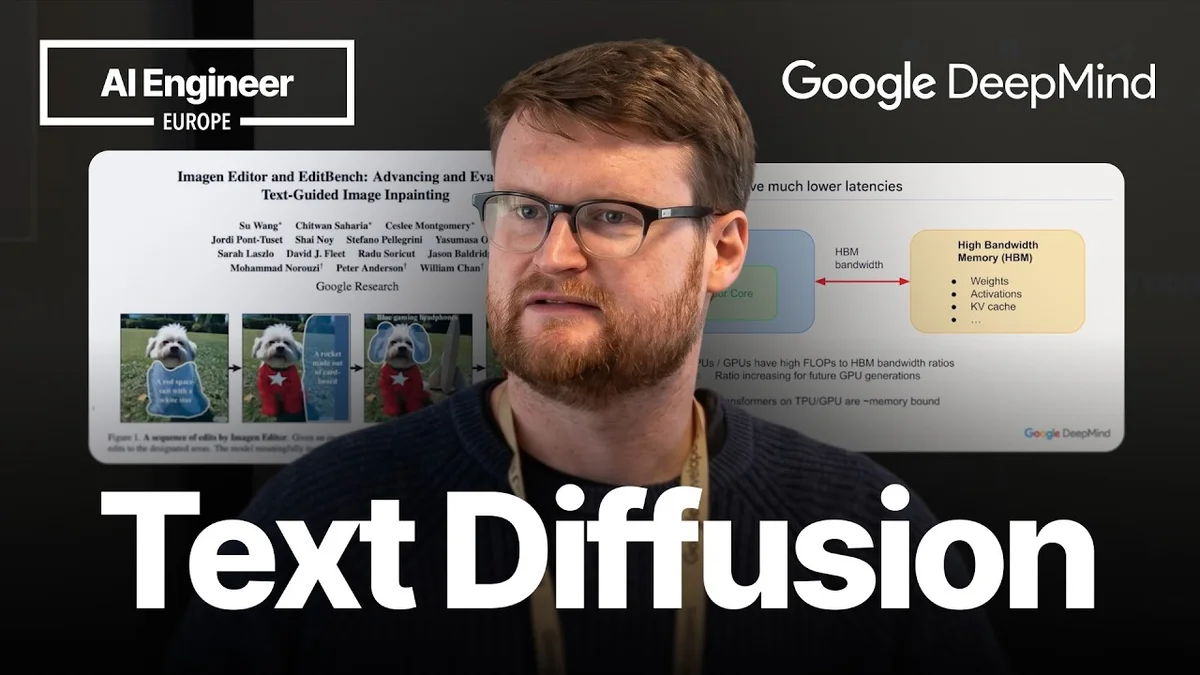
Brendon Dillon from Google DeepMind presenting on text diffusion
Brendon Dillon, Director of Research at Google DeepMind, discussing text diffusion models.· AI Engineer

Brendon Dillon, a Director of Research at Google DeepMind, recently presented on the advancements and potential of text diffusion models. The presentation, titled "Text Diffusion," explored how this emerging technology is shaping the future of language modeling and its ability to generate and understand human language.
Brendon Dillon on Text Diffusion at Google DeepMind - AI Engineer
Brendon Dillon on Text Diffusion at Google DeepMind — from AI Engineer

Visual TL;DR. Brendon Dillon, DeepMind presents Text Diffusion Models. Text Diffusion Models inspired by Inspired by Image Diffusion. Inspired by Image Diffusion uses Iterative Refinement. Iterative Refinement enables Advantages Over Autoregressive. Advantages Over Autoregressive leads to Future Potential. Text Diffusion Models has Applications Explored.

  1. Brendon Dillon, DeepMind: Director of Research presenting on text diffusion models
  2. Text Diffusion Models: Emerging technology for language generation and understanding
  3. Inspired by Image Diffusion: Adapting noise-adding and denoising principles from image generation
  4. Iterative Refinement: Models gradually denoise text sequences to generate coherent outputs
  5. Advantages Over Autoregressive: Outperforming previous language generation methods in key areas
  6. Future Potential: Shaping the future of language modeling and AI applications
  7. Applications Explored: Discussing various use cases and practical implementations
Visual TL;DR
Visual TL;DR — startuphub.ai Brendon Dillon, DeepMind presents Text Diffusion Models. Iterative Refinement enables Advantages Over Autoregressive. Advantages Over Autoregressive leads to Future Potential presents enables leads to Brendon Dillon, DeepMind Text Diffusion Models Iterative Refinement Advantages Over Autoregressive Future Potential From startuphub.ai · The publishers behind this format
Visual TL;DR — startuphub.ai Brendon Dillon, DeepMind presents Text Diffusion Models. Iterative Refinement enables Advantages Over Autoregressive. Advantages Over Autoregressive leads to Future Potential presents enables leads to Brendon Dillon,DeepMind Text DiffusionModels IterativeRefinement Advantages OverAutoregressive Future Potential From startuphub.ai · The publishers behind this format
Visual TL;DR — startuphub.ai Brendon Dillon, DeepMind presents Text Diffusion Models. Iterative Refinement enables Advantages Over Autoregressive. Advantages Over Autoregressive leads to Future Potential presents enables leads to Brendon Dillon, DeepMind Director of Research presenting on textdiffusion models Text Diffusion Models Emerging technology for languagegeneration and understanding Iterative Refinement Models gradually denoise text sequences togenerate coherent outputs Advantages Over Autoregressive Outperforming previous language generationmethods in key areas Future Potential Shaping the future of language modelingand AI applications From startuphub.ai · The publishers behind this format
Visual TL;DR — startuphub.ai Brendon Dillon, DeepMind presents Text Diffusion Models. Iterative Refinement enables Advantages Over Autoregressive. Advantages Over Autoregressive leads to Future Potential presents enables leads to Brendon Dillon,DeepMind Director ofResearch presentingon text diffusion… Text DiffusionModels Emerging technologyfor languagegeneration and… IterativeRefinement Models graduallydenoise textsequences to… Advantages OverAutoregressive Outperformingprevious languagegeneration methods… Future Potential Shaping the futureof languagemodeling and AI… From startuphub.ai · The publishers behind this format
Visual TL;DR — startuphub.ai Brendon Dillon, DeepMind presents Text Diffusion Models. Text Diffusion Models inspired by Inspired by Image Diffusion. Inspired by Image Diffusion uses Iterative Refinement. Iterative Refinement enables Advantages Over Autoregressive. Advantages Over Autoregressive leads to Future Potential. Text Diffusion Models has Applications Explored presents inspired by uses enables leads to has Brendon Dillon, DeepMind Director of Research presenting on textdiffusion models Text Diffusion Models Emerging technology for languagegeneration and understanding Inspired by Image Diffusion Adapting noise-adding and denoisingprinciples from image generation Iterative Refinement Models gradually denoise text sequences togenerate coherent outputs Advantages Over Autoregressive Outperforming previous language generationmethods in key areas Future Potential Shaping the future of language modelingand AI applications Applications Explored Discussing various use cases and practicalimplementations From startuphub.ai · The publishers behind this format
Visual TL;DR — startuphub.ai Brendon Dillon, DeepMind presents Text Diffusion Models. Text Diffusion Models inspired by Inspired by Image Diffusion. Inspired by Image Diffusion uses Iterative Refinement. Iterative Refinement enables Advantages Over Autoregressive. Advantages Over Autoregressive leads to Future Potential. Text Diffusion Models has Applications Explored presents inspired by uses enables leads to has Brendon Dillon,DeepMind Director ofResearch presentingon text diffusion… Text DiffusionModels Emerging technologyfor languagegeneration and… Inspired by ImageDiffusion Adaptingnoise-adding anddenoising… IterativeRefinement Models graduallydenoise textsequences to… Advantages OverAutoregressive Outperformingprevious languagegeneration methods… Future Potential Shaping the futureof languagemodeling and AI… ApplicationsExplored Discussing varioususe cases andpractical… From startuphub.ai · The publishers behind this format

Understanding Text Diffusion Models

Dillon began by drawing parallels between image diffusion models, which have achieved state-of-the-art results in image generation, and the nascent field of text diffusion. He explained the core principle of diffusion models: starting with a clean data point (an image or text sequence), adding noise to it gradually, and then training a neural network to reverse this process, effectively denoising the data to generate new, coherent outputs.

Related startups

While image diffusion has been widely explored, Dillon highlighted the growing interest in applying these principles to text. He described how text diffusion models operate by iteratively refining a sequence of noisy tokens to produce meaningful text. This process, he noted, differs significantly from traditional autoregressive language models like GPT, which generate text one token at a time in a sequential manner.

Advantages Over Autoregressive Models

A key advantage of text diffusion models, as presented by Dillon, is their potential for faster inference. Unlike autoregressive models, which are inherently sequential and can be slow for generating long sequences, diffusion models can process tokens in parallel. This parallel processing, Dillon explained, allows for a more efficient use of computational resources, leading to faster generation times, especially for longer outputs.

Furthermore, Dillon pointed to the model's ability to perform bidirectional reasoning. While autoregressive models primarily look backward at previously generated tokens, diffusion models can consider the entire context, both before and after a particular token, allowing for more coherent and contextually relevant text generation. This bidirectional capability also enables features like "fast in-place editing," where the model can efficiently revise or refine specific parts of the generated text without regenerating the entire sequence.

Applications and Future Potential

The implications of text diffusion models are far-reaching, according to Dillon. He suggested that these models could significantly enhance applications such as creative writing, where the ability to generate diverse and coherent narratives is crucial. Similarly, for content generation and chatbots, diffusion models offer the potential for more natural, engaging, and context-aware interactions.

Dillon also touched upon the performance of these models, showing benchmark results that demonstrated competitive or superior performance compared to existing autoregressive models on various tasks. He highlighted how the iterative refinement process allows diffusion models to achieve high-quality outputs, even for complex prompts requiring intricate reasoning or specific stylistic nuances.

The presentation concluded with a glimpse into the future of text diffusion, with Dillon expressing excitement about the ongoing research and development at Google DeepMind. He suggested that as these models continue to evolve, they will undoubtedly play a significant role in shaping the next generation of AI-powered language technologies.

© 2026 StartupHub.ai. All rights reserved. Do not enter, scrape, copy, reproduce, or republish this article in whole or in part. Use as input to AI training, fine-tuning, retrieval-augmented generation, or any machine-learning system is prohibited without written license. Substantially-similar derivative works will be pursued to the fullest extent of applicable copyright, database, and computer-misuse laws. See our terms.