

Aparna Dhinakaran on the Evolution of AI Evals

Aparna Dhinakaran of Arize AI discusses the critical shift in AI evaluation from 'LLM as a Judge' to more dynamic 'Agent as a Judge' methodologies.

7 min read
Aparna Dhinakaran speaking at a presentation about AI evaluation
AI Engineer

Visual TL;DR. Aparna Dhinakaran discusses Shift in Evals. Traditional AI Evals evolving from Shift in Evals. Shift in Evals to Agent as a Judge. Agent as a Judge enables Benefits of Agents. Agent as a Judge shapes Future of AI Evals.

  1. Aparna Dhinakaran: Chief Product Officer at Arize AI, shaping AI observability and evaluation strategy
  2. Traditional AI Evals: historically relied on 'LLM as a Judge' for evaluating large language models
  3. Shift in Evals: critical transition from static 'LLM as a Judge' to dynamic 'Agent as a Judge'
  4. Agent as a Judge: more dynamic and sophisticated agent-driven evaluations for AI model performance
  5. Benefits of Agents: enables understanding, monitoring, and improving AI performance in real-world applications
  6. Future of AI Evals: moving beyond simple, static judgments to sophisticated agent-driven assessments
Visual TL;DR
Visual TL;DR, startuphub.ai Aparna Dhinakaran discusses Shift in Evals. Shift in Evals to Agent as a Judge. Agent as a Judge shapes Future of AI Evals discusses to shapes Aparna Dhinakaran Shift in Evals Agent as a Judge Future of AI Evals From startuphub.ai · The publishers behind this format
Visual TL;DR, startuphub.ai Aparna Dhinakaran discusses Shift in Evals. Shift in Evals to Agent as a Judge. Agent as a Judge shapes Future of AI Evals discusses to shapes Aparna Dhinakaran Shift in Evals Agent as a Judge Future of AIEvals From startuphub.ai · The publishers behind this format
Visual TL;DR, startuphub.ai Aparna Dhinakaran discusses Shift in Evals. Shift in Evals to Agent as a Judge. Agent as a Judge shapes Future of AI Evals discusses to shapes Aparna Dhinakaran Chief Product Officer at Arize AI, shapingAI observability and evaluation strategy Shift in Evals critical transition from static 'LLM as aJudge' to dynamic 'Agent as a Judge' Agent as a Judge more dynamic and sophisticatedagent-driven evaluations for AI modelperformance Future of AI Evals moving beyond simple, static judgments tosophisticated agent-driven assessments From startuphub.ai · The publishers behind this format
Visual TL;DR, startuphub.ai Aparna Dhinakaran discusses Shift in Evals. Shift in Evals to Agent as a Judge. Agent as a Judge shapes Future of AI Evals discusses to shapes Aparna Dhinakaran Chief ProductOfficer at ArizeAI, shaping AI… Shift in Evals critical transitionfrom static 'LLM asa Judge' to dynamic… Agent as a Judge more dynamic andsophisticatedagent-driven… Future of AIEvals moving beyondsimple, staticjudgments to… From startuphub.ai · The publishers behind this format
Visual TL;DR, startuphub.ai Aparna Dhinakaran discusses Shift in Evals. Traditional AI Evals evolving from Shift in Evals. Shift in Evals to Agent as a Judge. Agent as a Judge enables Benefits of Agents. Agent as a Judge shapes Future of AI Evals discusses evolving from to enables shapes Aparna Dhinakaran Chief Product Officer at Arize AI, shapingAI observability and evaluation strategy Traditional AI Evals historically relied on 'LLM as a Judge'for evaluating large language models Shift in Evals critical transition from static 'LLM as aJudge' to dynamic 'Agent as a Judge' Agent as a Judge more dynamic and sophisticatedagent-driven evaluations for AI modelperformance Benefits of Agents enables understanding, monitoring, andimproving AI performance in real-worldapplications Future of AI Evals moving beyond simple, static judgments tosophisticated agent-driven assessments From startuphub.ai · The publishers behind this format
Visual TL;DR, startuphub.ai Aparna Dhinakaran discusses Shift in Evals. Traditional AI Evals evolving from Shift in Evals. Shift in Evals to Agent as a Judge. Agent as a Judge enables Benefits of Agents. Agent as a Judge shapes Future of AI Evals discusses evolving from to enables shapes Aparna Dhinakaran Chief ProductOfficer at ArizeAI, shaping AI… Traditional AIEvals historically reliedon 'LLM as a Judge'for evaluating… Shift in Evals critical transitionfrom static 'LLM asa Judge' to dynamic… Agent as a Judge more dynamic andsophisticatedagent-driven… Benefits ofAgents enablesunderstanding,monitoring, and… Future of AIEvals moving beyondsimple, staticjudgments to… From startuphub.ai · The publishers behind this format

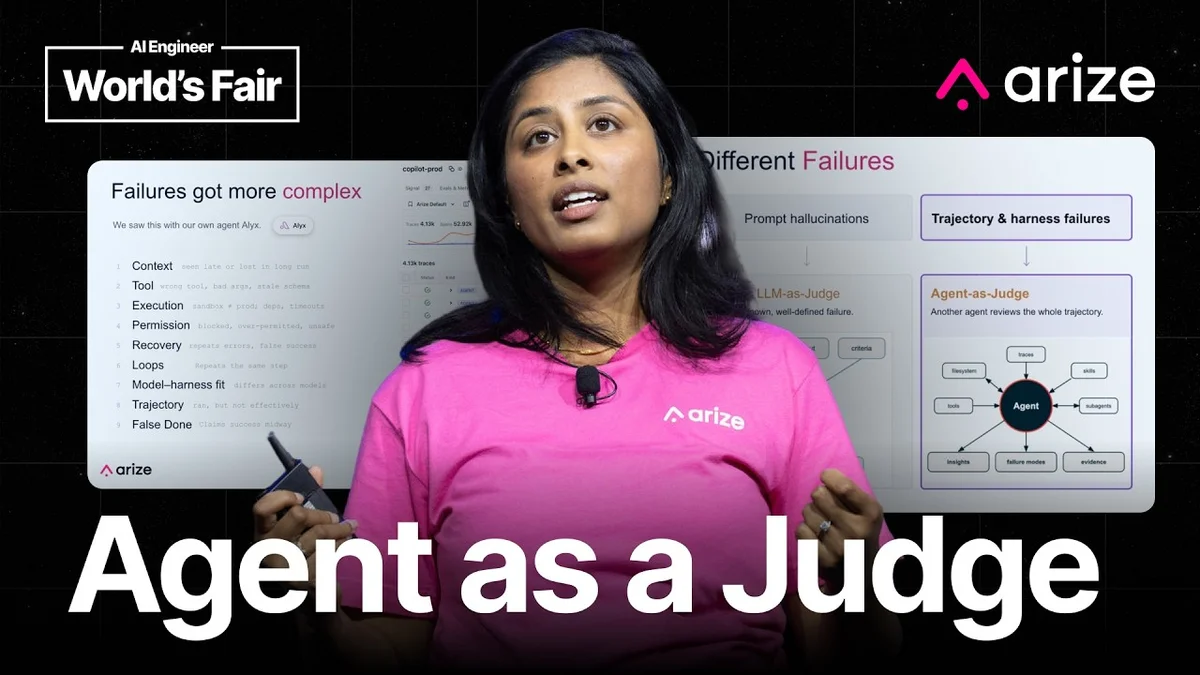
Aparna Dhinakaran, Chief Product Officer at Arize AI, recently shared insights into the evolving landscape of evaluating artificial intelligence systems. In a discussion titled 'The Future of Evals: From LLM as a Judge to Agent as a Judge,' Dhinakaran outlined a critical transition in how we assess the performance and reliability of AI models, moving beyond simple, static judgments to more dynamic and sophisticated agent-driven evaluations.
Aparna Dhinakaran on the Evolution of AI Evals - AI Engineer
Aparna Dhinakaran on the Evolution of AI Evals — from AI Engineer

Who Is Aparna Dhinakaran?

Aparna Dhinakaran is a key figure in the AI observability and evaluation space. As Chief Product Officer at Arize AI, she is instrumental in shaping the company's product strategy, focusing on helping organizations build and deploy AI models responsibly and effectively. Her work addresses the complex challenges of understanding, monitoring, and improving AI performance in real-world applications.

From 'LLM as a Judge' to 'Agent as a Judge'

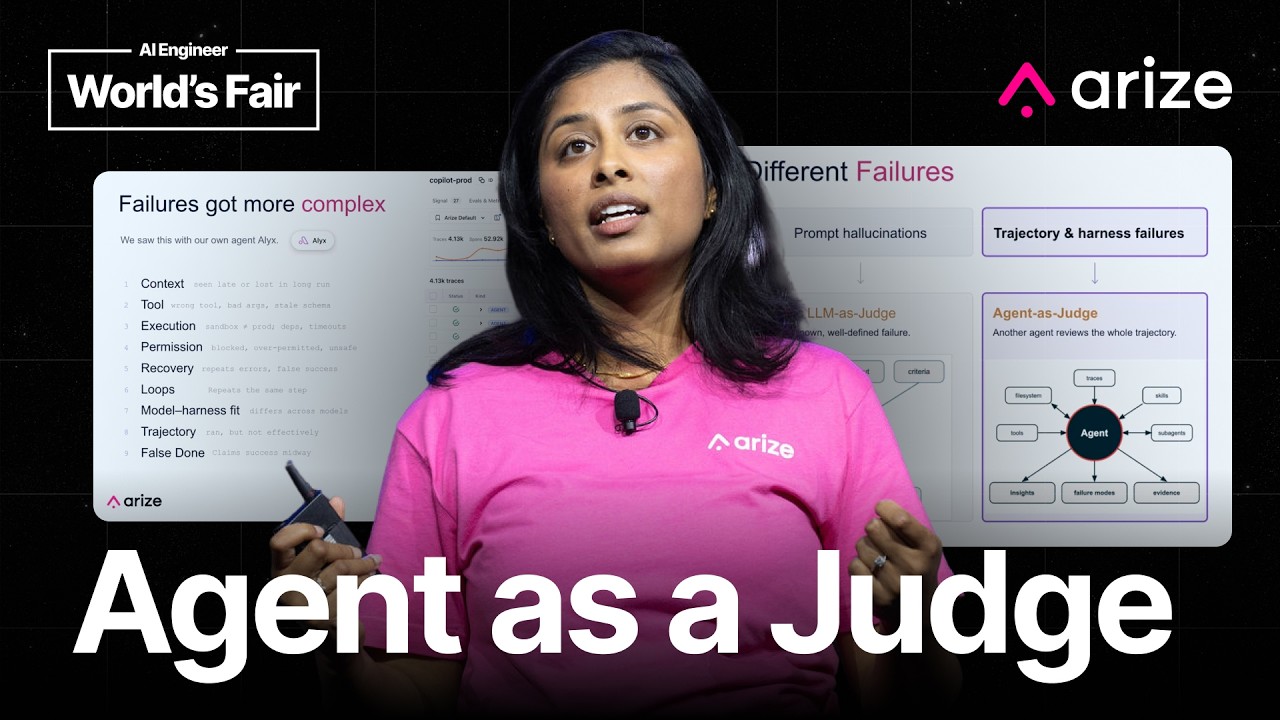
Historically, evaluating large language models (LLMs) often relied on a 'judge' model, typically another LLM, to score outputs against predefined criteria. Dhinakaran explained that this 'LLM as a Judge' approach, while a necessary step, has limitations. It can be prone to biases, inconsistencies, and a lack of true understanding of complex, multi-turn interactions or nuanced tasks.

The next frontier, as articulated by Dhinakaran, is the concept of 'Agent as a Judge.' This paradigm shift involves using more sophisticated AI agents, potentially with access to tools, memory, and the ability to perform actions, to evaluate other AI systems. This approach promises a more holistic and robust assessment.

'The evaluation needs to be dynamic, not static,' Dhinakaran emphasized, highlighting the core motivation behind this evolution. Static evaluations, she noted, struggle to capture the full spectrum of an AI's capabilities and potential failure modes, especially in complex scenarios.

The Benefits of Agent-Based Evaluation

Dhinakaran detailed several advantages of employing an 'Agent as a Judge' methodology. Firstly, it allows for more contextual and nuanced evaluations. An agent can simulate real-world user interactions, test edge cases, and adapt its evaluation strategy based on the performance of the system being tested. This is particularly crucial for AI systems that operate in dynamic environments or require complex reasoning.

Secondly, agent-based evaluation can lead to more actionable insights. Instead of a simple pass/fail or a numerical score, an agent can provide detailed feedback on why an AI failed, what specific steps led to the error, and how the system could be improved. This level of diagnostic detail is invaluable for developers and researchers.

'We need to move towards evaluations that mimic real-world complexity,' Dhinakaran stated, underscoring the growing need for evaluation methods that reflect the true operational environment of AI systems.

The Future of AI Evals

The transition to 'Agent as a Judge' signals a maturing of the AI industry. As AI systems become more powerful and integrated into critical applications, the methods used to evaluate them must also become more sophisticated. Dhinakaran's insights suggest that the future of AI evaluation will involve a combination of advanced agent architectures, comprehensive tooling, and a deep understanding of the specific tasks and domains AI models are intended to serve.

This evolution is not just about improving LLMs but also about ensuring the safety, reliability, and ethical deployment of all forms of artificial intelligence. The ability to rigorously and dynamically evaluate AI is becoming a cornerstone of responsible AI development.

© 2026 StartupHub.ai. All rights reserved. Do not enter, scrape, copy, reproduce, or republish this article in whole or in part. Use as input to AI training, fine-tuning, retrieval-augmented generation, or any machine-learning system is prohibited without written license. Substantially-similar derivative works will be pursued to the fullest extent of applicable copyright, database, and computer-misuse laws. See our terms.