

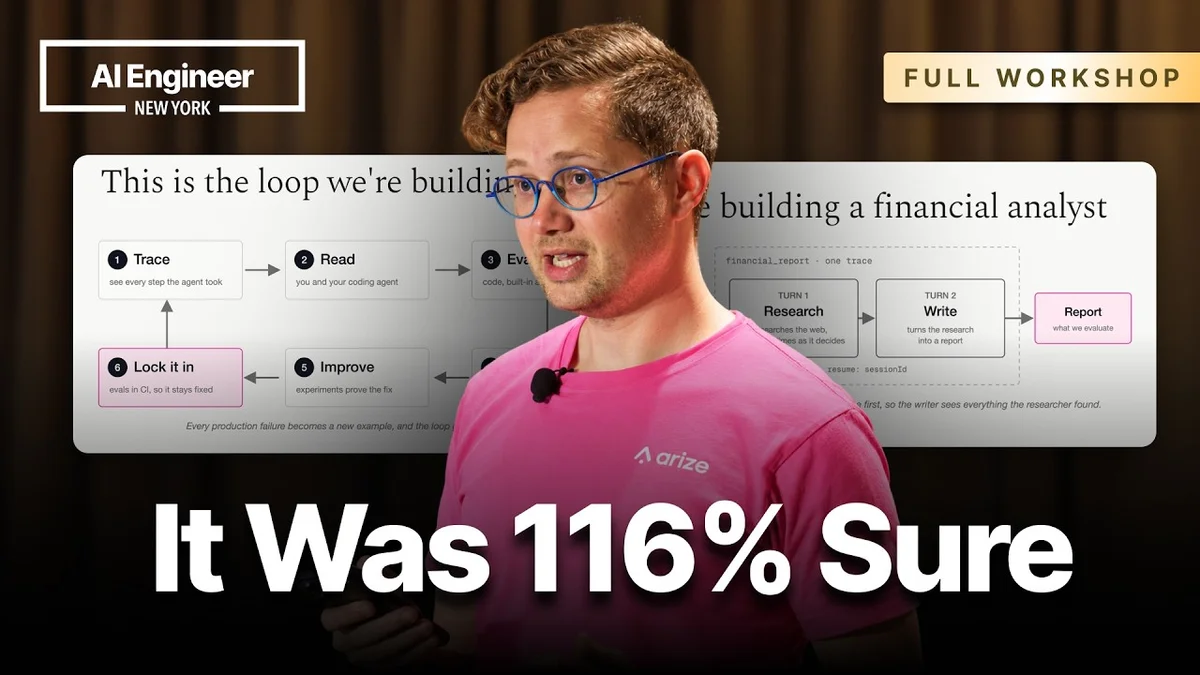
Arize shows how to grade agents with Phoenix

Arize AI's Laurie Voss demoed Phoenix evals for Claude agents, from code checks to LLM judges, and showed why upgrading models still needs measured experiments.

Arize Phoenix tracing UI with agent spans and eval scores
AI Engineer

Laurie Voss, head of developer relations at Arize AI, demoed a full eval loop for a Claude agent using Phoenix in a session carried by AI Engineer that runs locally on localhost:6060 with no remote attacker required.
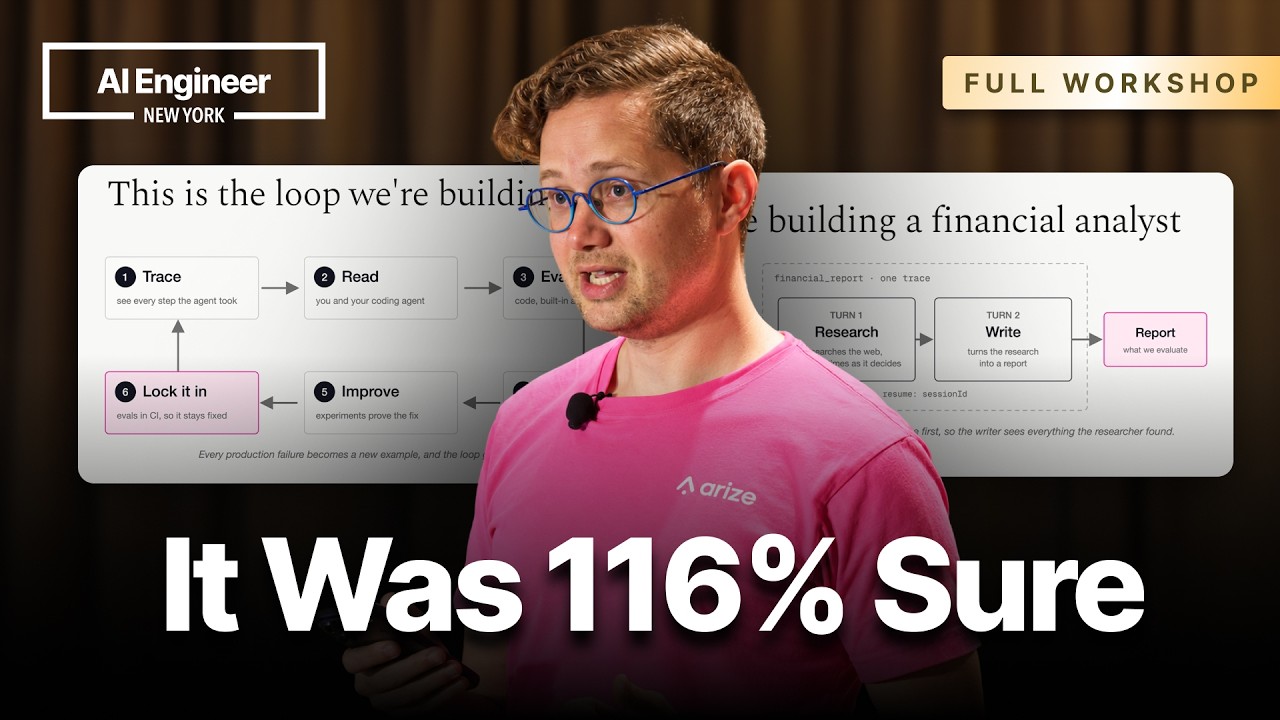
Arize shows how to grade agents with Phoenix - AI Engineer
Arize shows how to grade agents with Phoenix, AI Engineer

Phoenix collects OpenTelemetry traces via Open Inference, stores each agent step as a span with inputs, outputs, duration and token cost, and provides a UI, datasets and experiments on a laptop or a server.

Code evals check deterministic outcomes like ticker mentions with TypeScript functions via createEvaluator and logSpanAnnotations, and Voss found 15 passes and 2 failures on 16 reports where he warned "Looks good to me is not a test suite."

LLM judge evals grade meaning against a rubric, and Voss used Claude Sonnet 5.5 to judge an agent running on Claude Haiku, noting a built-in correctness check failed all 16 reports due to a January knowledge cutoff while faithfulness flagged 14 of 16 as unsupported.

Custom judges need role, explicit criteria, XML-wrapped data, labeled examples and constrained tool-call outputs, and Voss tested his actionability judge against 12 human-labeled examples to tune precision and recall before splitting data into dev and test sets.

Experiments rerun the same dataset with the same evals to measure prompt fixes, and an upgrade from Haiku 4.5 to Haiku 5.5, which supports a 1M token context window and up to 128k output tokens with adaptive thinking, improved faithfulness more than three times but kept it terrible while quadrupling cost and pushing the agent to say hold in 41 of 45 calls.

Phoenix locks gains with VEST and GitHub Actions where ticker mention is a guardrail and average actionability above 0.8 is a north-star target, and Voss said teams should start small by instrumenting and reading 12 traces.

© 2026 StartupHub.ai. All rights reserved. You may not republish this article in full without a license. Search engines and AI research tools may crawl and summarize for reference. Bulk reproduction or model training requires a license. See our terms.

Watch

The videos behind the news, one flip at a time

The feed mixes the videos from our articles with startup demos and you flip through them like TV channels for free with no signup.

Daniel Singer

Written by

Daniel Singer

Editor, StartupHub.ai

Daniel Singer is the editor of StartupHub.ai, a technology expert and thought leader on AI and its applications across sectors, from fintech and healthcare to developer tooling and consumer software. He writes and tests the tools covered here thoroughly and regularly, and built StartupHub.ai to give founders, operators and buyers a clearer read on what they are actually being sold.