

AI in Biology: From Tokens to Cells at Altos Labs

Altos Labs' Akram Baharlouei discusses the engineering challenges of applying foundation models to single-cell biology, highlighting breakthroughs and future directions in cellular rejuvenation and drug discovery.

7 min read
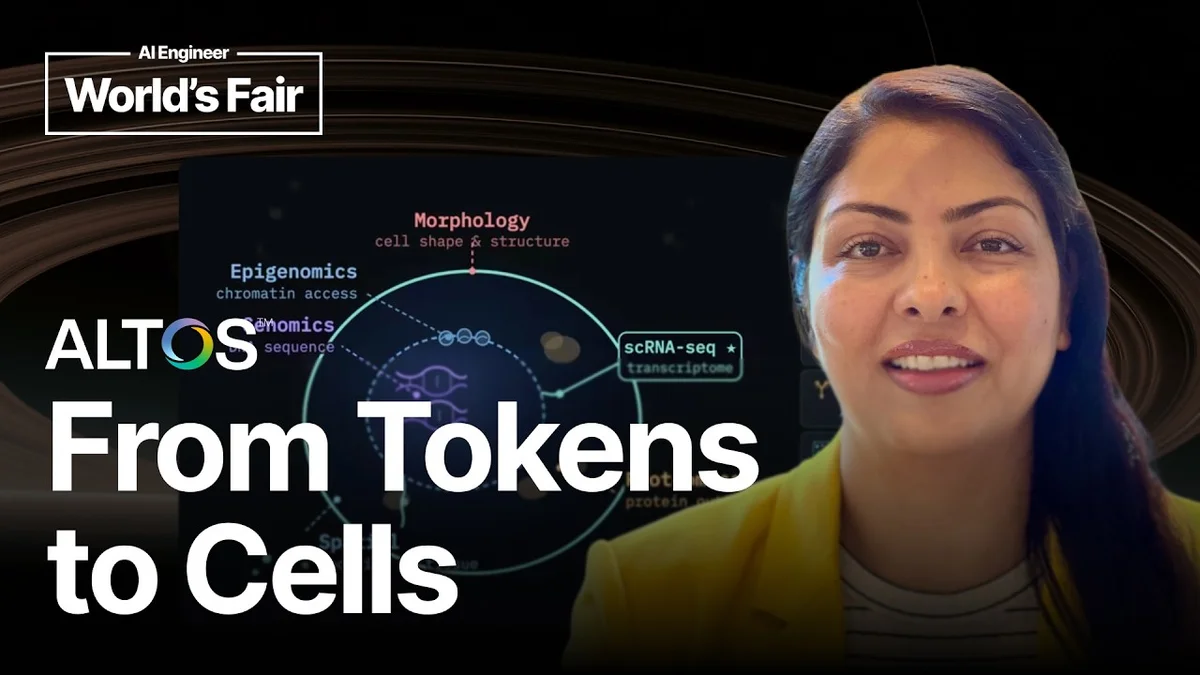
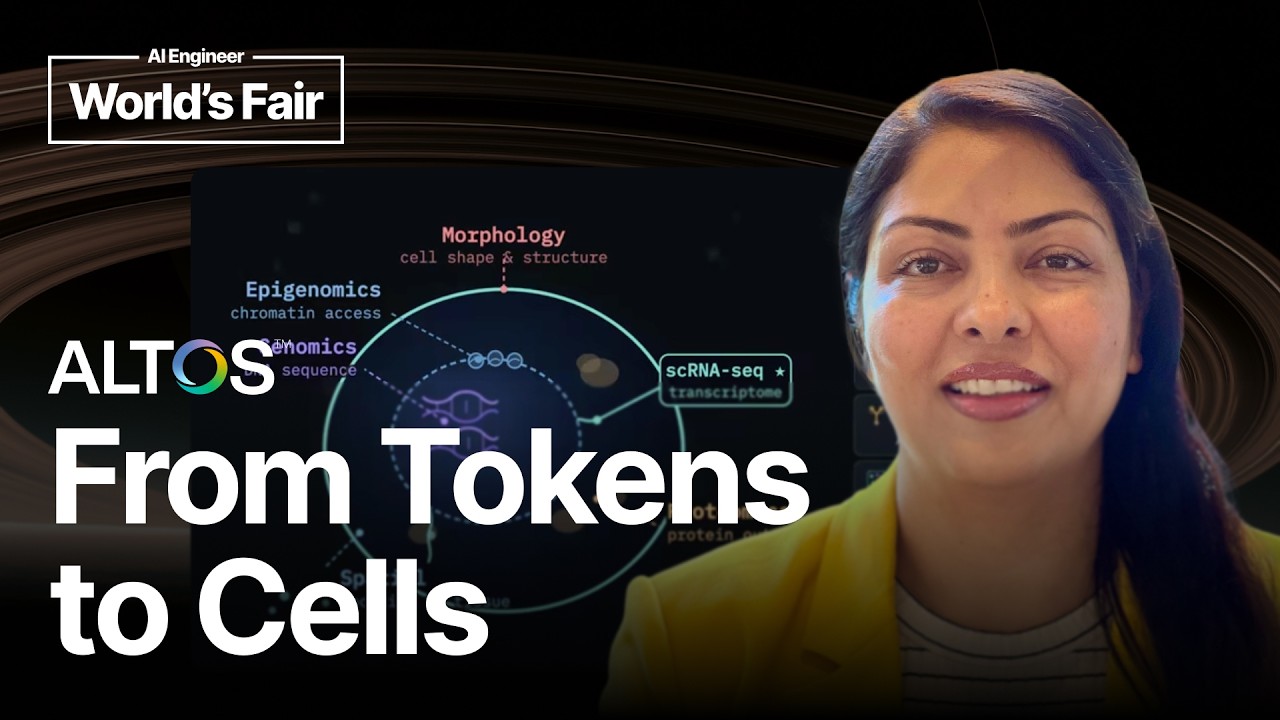
Presentation slide showing 'From Tokens to Cells' title with speaker Akram Baharlouei and Altos Labs logo.
AI Engineer

Visual TL;DR. Single-Cell Biology informs Drug Dev Challenges. Drug Dev Challenges needs AI Foundation Models. AI Foundation Models faces Engineering Challenges. Engineering Challenges addressed by Altos Labs. Altos Labs enables Cellular Rejuvenation. Cellular Rejuvenation leads to New Drug Discovery. Single-Cell Biology example Yamanaka Factors. Yamanaka Factors pioneered Cellular Rejuvenation.

  1. Single-Cell Biology: understanding individual cell states crucial for regenerative medicine and aging reversal
  2. Drug Dev Challenges: complex cellular interactions make drug discovery difficult and slow
  3. AI Foundation Models: large-scale models learn patterns from vast biological datasets
  4. Engineering Challenges: applying AI models to single-cell data requires significant technical expertise
  5. Altos Labs: biotech startup focused on cellular rejuvenation to reverse age-related diseases
  6. Cellular Rejuvenation: restoring cell health and resilience, potentially reversing aging processes
  7. New Drug Discovery: accelerating identification of therapeutic targets and personalized treatments
  8. Yamanaka Factors: reprogramming aged cells into embryonic stem cell-like states
Visual TL;DR
Visual TL;DR, startuphub.ai Altos Labs enables Cellular Rejuvenation enables Single-Cell Biology AI Foundation Models Altos Labs Cellular Rejuvenation From startuphub.ai · The publishers behind this format
Visual TL;DR, startuphub.ai Altos Labs enables Cellular Rejuvenation enables Single-CellBiology AI FoundationModels Altos Labs CellularRejuvenation From startuphub.ai · The publishers behind this format
Visual TL;DR, startuphub.ai Altos Labs enables Cellular Rejuvenation enables Single-Cell Biology understanding individual cell statescrucial for regenerative medicine andaging reversal AI Foundation Models large-scale models learn patterns fromvast biological datasets Altos Labs biotech startup focused on cellularrejuvenation to reverse age-relateddiseases Cellular Rejuvenation restoring cell health and resilience,potentially reversing aging processes From startuphub.ai · The publishers behind this format
Visual TL;DR, startuphub.ai Altos Labs enables Cellular Rejuvenation enables Single-CellBiology understandingindividual cellstates crucial for… AI FoundationModels large-scale modelslearn patterns fromvast biological… Altos Labs biotech startupfocused on cellularrejuvenation to… CellularRejuvenation restoring cellhealth andresilience,… From startuphub.ai · The publishers behind this format
Visual TL;DR, startuphub.ai Single-Cell Biology informs Drug Dev Challenges. Drug Dev Challenges needs AI Foundation Models. AI Foundation Models faces Engineering Challenges. Engineering Challenges addressed by Altos Labs. Altos Labs enables Cellular Rejuvenation. Cellular Rejuvenation leads to New Drug Discovery. Single-Cell Biology example Yamanaka Factors. Yamanaka Factors pioneered Cellular Rejuvenation informs needs faces addressed by enables leads to example pioneered Single-Cell Biology understanding individual cell statescrucial for regenerative medicine andaging reversal Drug Dev Challenges complex cellular interactions make drugdiscovery difficult and slow AI Foundation Models large-scale models learn patterns fromvast biological datasets Engineering Challenges applying AI models to single-cell datarequires significant technical expertise Altos Labs biotech startup focused on cellularrejuvenation to reverse age-relateddiseases Cellular Rejuvenation restoring cell health and resilience,potentially reversing aging processes New Drug Discovery accelerating identification of therapeutictargets and personalized treatments Yamanaka Factors reprogramming aged cells into embryonicstem cell-like states From startuphub.ai · The publishers behind this format
Visual TL;DR, startuphub.ai Single-Cell Biology informs Drug Dev Challenges. Drug Dev Challenges needs AI Foundation Models. AI Foundation Models faces Engineering Challenges. Engineering Challenges addressed by Altos Labs. Altos Labs enables Cellular Rejuvenation. Cellular Rejuvenation leads to New Drug Discovery. Single-Cell Biology example Yamanaka Factors. Yamanaka Factors pioneered Cellular Rejuvenation informs needs faces addressed by enables leads to example pioneered Single-CellBiology understandingindividual cellstates crucial for… Drug DevChallenges complex cellularinteractions makedrug discovery… AI FoundationModels large-scale modelslearn patterns fromvast biological… EngineeringChallenges applying AI modelsto single-cell datarequires… Altos Labs biotech startupfocused on cellularrejuvenation to… CellularRejuvenation restoring cellhealth andresilience,… New DrugDiscovery acceleratingidentification oftherapeutic targets… Yamanaka Factors reprogramming agedcells intoembryonic stem… From startuphub.ai · The publishers behind this format

Akram Baharlouei, a machine learning engineer at Altos Labs, delivered a talk titled "From Tokens to Cells: The Engineering Challenges of Foundation Models for Single-Cell Biology." Altos Labs, a biotech startup, aims to restore cell health and resilience through cellular rejuvenation, with the ultimate goal of reversing age-related diseases and disabilities. Baharlouei, approaching the subject from an engineering perspective without a deep biological background, explored the complexities of applying foundation models to single-cell biology.

AI in Biology: From Tokens to Cells at Altos Labs - AI Engineer
AI in Biology: From Tokens to Cells at Altos Labs — from AI Engineer

The Importance of Single-Cell Biology

Baharlouei highlighted the significance of single-cell studies, referencing the groundbreaking work of Shinya Yamanaka and his discovery of the Yamanaka factors in 2006. These four transcription factors can reprogram aged skin cells into a state resembling embryonic stem cells, opening avenues for regenerative medicine, tissue regeneration, and potentially reversing cellular aging. The development of reprogramming medicine, like the OSK therapy, signifies a major step forward, with human trials anticipated soon. The pursuit of a "virtual human" and "digital twins" relies on a holistic understanding of cells, tissues, and organs, making single-cell analysis a foundational element.
Challenges in Drug Development and AI's Role

The talk also touched upon the stark contrast between exponential improvements in computing power (Moore's Law) and the declining output of drug development. Despite technological advancements, the number of new drugs developed annually has decreased, with a high failure rate in the drug development pipeline, which can take up to 10 years and cost billions. Baharlouei suggested that AI and a deeper understanding of cellular processes, such as through virtual cell modeling, could help to reduce these timelines and costs by enabling breakthroughs across the entire pipeline.

Measuring and Modeling Single Cells

Baharlouei detailed various modalities for measuring single-cell data, including genomics, transcriptomics (RNA-seq), proteomics, and morphology. While RNA-seq is currently the most utilized for foundation model training due to its scalability and the availability of large datasets (millions to billions of cells), he emphasized the need for technological advancements in other modalities to gain a more complete biological picture. A key challenge in this field is the heterogeneity of single-cell data; even identical cells can yield different measurements, and much of this variability may be noise rather than signal. This noise stems from both biological processes, such as gene expression bursts, and technical factors like varying experimental conditions.

Foundation Models and Future Directions

The presentation explored the application of transformer-based models like scGPT and Geneformer, which treat genes as tokens within a cell's "sentence." These models use masked gene prediction for self-supervised learning. However, Baharlouei noted that compressing this high-dimensional data into latent vectors can lead to information loss, sometimes making simpler linear models perform comparably or even better. He introduced flow matching-based models, such as PrimeFlow, as a more promising approach. These models aim to directly match data distributions rather than relying on embedding and decoding, potentially preserving more of the valuable signal within the data.

Baharlouei concluded by summarizing three key takeaways: single-cell study is vital for cellular rejuvenation and digital human initiatives; while RNA-seq is dominant, advances in other modalities are crucial; and flow matching models show superiority in capturing the nuances of single-cell data, paving the way for more accurate predictions and a deeper understanding of biological systems.

© 2026 StartupHub.ai. All rights reserved. Do not enter, scrape, copy, reproduce, or republish this article in whole or in part. Use as input to AI training, fine-tuning, retrieval-augmented generation, or any machine-learning system is prohibited without written license. Substantially-similar derivative works will be pursued to the fullest extent of applicable copyright, database, and computer-misuse laws. See our terms.