
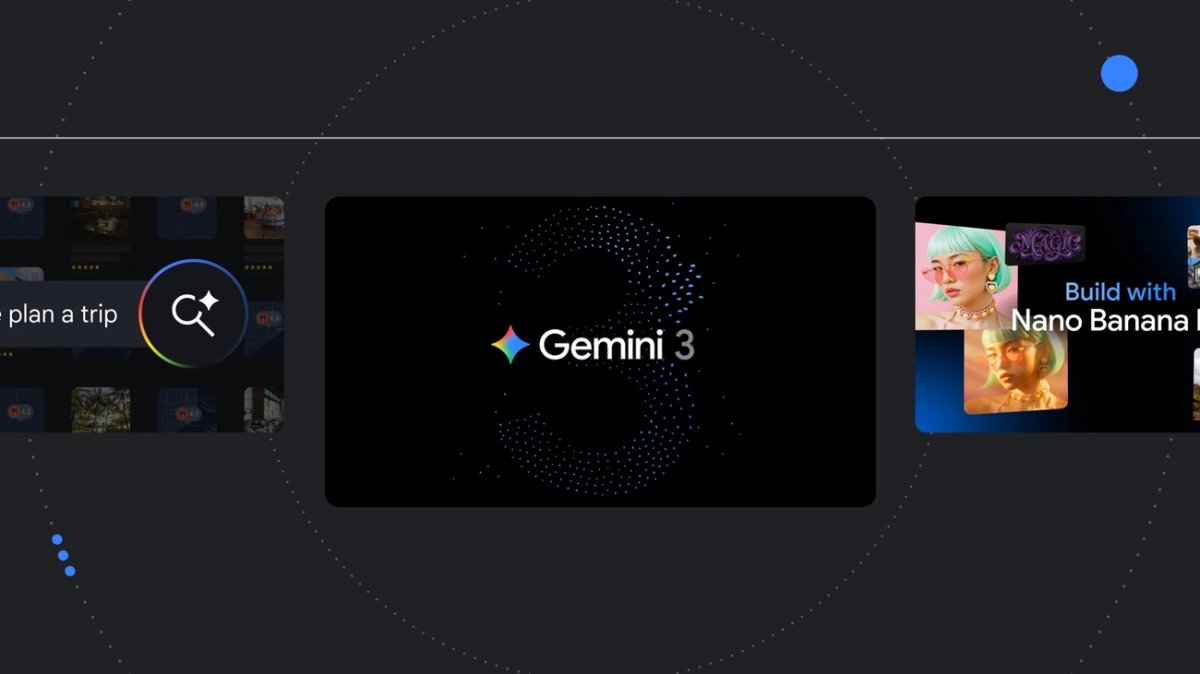
Google's November AI announcements represent a profound strategic pivot, solidifying its commitment to an AI-first future, spearheaded by the launch of Gemini 3. This comprehensive unveiling, encompassing core model advancements, deep ecosystem integrations, and substantial infrastructure investments, transcends mere product updates; it signals Google's intent to embed sophisticated, agentic AI as the fundamental operating system for its entire digital universe. The company is clearly pushing for a ubiquitous, proactive AI that fundamentally redefines user interaction, developer capabilities, and even the very fabric of daily life.
Gemini 3 stands as a pivotal technological leap, showcasing unparalleled multimodal understanding and advanced agentic capabilities now seamlessly integrated into Google Search. This is not an incremental refinement of existing search paradigms; it is a deliberate transformation from a reactive query-response system to a dynamic, conversational, and visually enriched intelligence layer. According to the announcement, Gemini 3's "vibe coding" and state-of-the-art reasoning, accessible through AI Mode, herald a future where search anticipates complex user needs, proactively assists with intricate tasks, and moves far beyond simple information retrieval. This fundamental shift in search interaction demands a more intuitive, context-aware AI, effectively turning Google Search into a personal cognitive assistant rather than just a data index. The implications for information access and decision-making are immense, potentially reshaping user expectations for all digital interactions.
Beyond the foundational models, Google is aggressively expanding AI's role across creative and developmental domains, signaling a maturation of AI from assistive tool to active collaborator. Nano Banana Pro, leveraging the power of Gemini 3, elevates image generation and editing from novelty to "high-fidelity, studio-quality visuals," directly challenging traditional creative software and democratizing professional-grade content creation. Concurrently, the introduction of Google Antigravity, an agent-first development platform, empowers developers to deploy autonomous AI agents capable of planning, executing, and verifying complex tasks without constant human oversight. These innovations collectively underscore a vision where AI not only augments human creativity and productivity but actively participates in the entire lifecycle of design, development, and automation, potentially disrupting established industries and fostering entirely new categories of digital products.
AI's Pervasive Reach Across Ecosystems
The strategic integration of Gemini across critical Google platforms like Maps and Android Auto unequivocally demonstrates a concerted effort to embed advanced AI into the most ubiquitous and essential user experiences. The forthcoming hands-free, conversational driving experience in Google Maps, augmented by landmark-based navigation, transcends basic GPS functionality; it evolves into a truly intelligent co-pilot, capable of understanding nuanced requests and providing contextually relevant directions. Similarly, Gemini's arrival in Android Auto transforms the in-car environment, enabling natural language commands for a spectrum of tasks from communication to entertainment and even ideation, all while maintaining focus on the road. This pervasive integration highlights Google's ambition to render AI an invisible yet indispensable layer of daily life, particularly within the crucial mobile and automotive ecosystems, setting a new benchmark for seamless human-computer interaction.
Further pushing the boundaries of Artificial General Intelligence (AGI) and embodied AI, SIMA 2, significantly enhanced by Gemini's capabilities, marks a substantial leap forward. Its evolution from a simple instruction-follower to an interactive, self-improving companion within virtual worlds suggests a future where AI agents can learn, converse, and adapt autonomously in complex environments. This development, alongside groundbreaking advancements like WeatherNext 2's rapid, high-resolution forecasting and the enduring, Nobel Prize-recognized impact of AlphaFold 2 on scientific discovery, illustrates Google's unwavering commitment to foundational AI research with profound real-world implications across diverse sectors. The company's continued investment in AI learning and education, coupled with new AI-powered shopping and travel planning features, further solidifies its intent to make AI both a powerful, accessible utility and a transformative educational and economic engine.
The daily brief
Get the free daily brief with the day's AI news, new AI startups and funding rounds every morning.
Join 64,000 other subscribers.
The colossal $40 billion investment in Texas for AI and cloud infrastructure, coupled with a significant US workforce initiative, is far more than a financial commitment; it is a strategic declaration of intent. This massive capital injection underpins Google's long-term vision for AI, providing the essential computational backbone required for increasingly complex models, widespread deployment, and the processing of vast datasets. It signals an aggressive readiness to scale AI capabilities globally, fostering not only technological advancement but also significant economic opportunity and scientific breakthroughs. This holistic approach, encompassing cutting-edge core models, deep application integration, empowering developer tools, and robust infrastructure, unequivocally positions Google to lead the next wave of AI innovation, fundamentally reshaping how we interact with technology, conduct business, and experience the world around us.




