Visual TL;DR
Task Quality MattersDriver
From the article 6 mentionsCrawford began by posing the central question: "Does Task Quality Actually Matter?" She asserted that AI model capabilities are fundamentally bounded by the quality of the training data.
Snorkel ApproachCore
Library for generating verifiable training data for foundation models
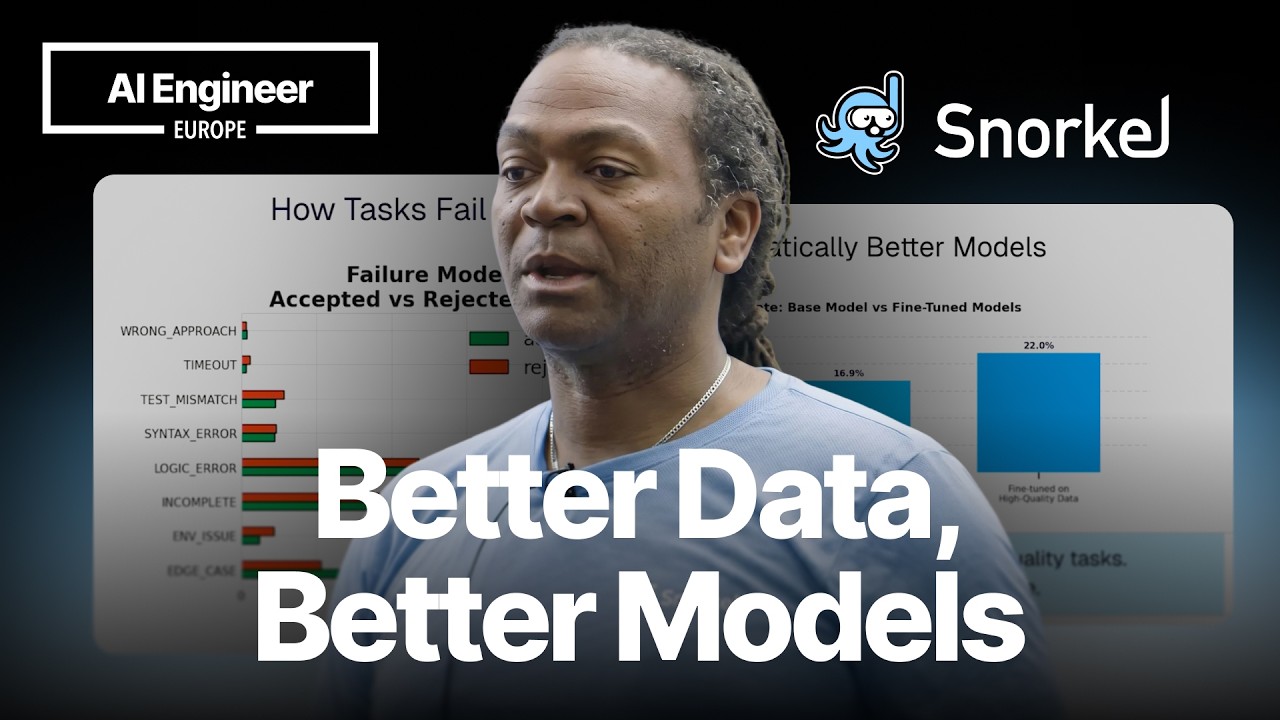
From the article 9+ mentionsRejected tasks, however, showed a higher proportion of 'Wrong Approach' and 'Syntax Error' failures, indicating issues with the task definition or the model's fundamental understanding of the problem.
Task Fidelity Scaling LawsContext
From the articleIn a presentation at AI Engineer Europe, Kobie Crawford, Developer Advocate at Snorkel, explored the critical role of "Task Fidelity Scaling Laws" in advancing AI model development.
High-Quality TasksEffect
Impacts model performance positively, regardless of architecture
From the article 9+ mentionsThe core finding presented was that high-quality tasks lead to dramatically better models.
Define & Evaluate QualityContext
Understanding and measuring the quality of training tasks
Analyze Failure ModesContext
Identifying specific ways tasks can go wrong
From the articleSpecifically, the data showed a significant difference in the prevalence of certain failure modes between accepted and rejected tasks.
Verifiable DatasetsOutcome
Snorkel's focus on delivering high-quality datasets for customers
From the articleCrawford explained that Snorkel's platform incorporates both human expertise and programmatic methods to create high-quality, verifiable datasets.