


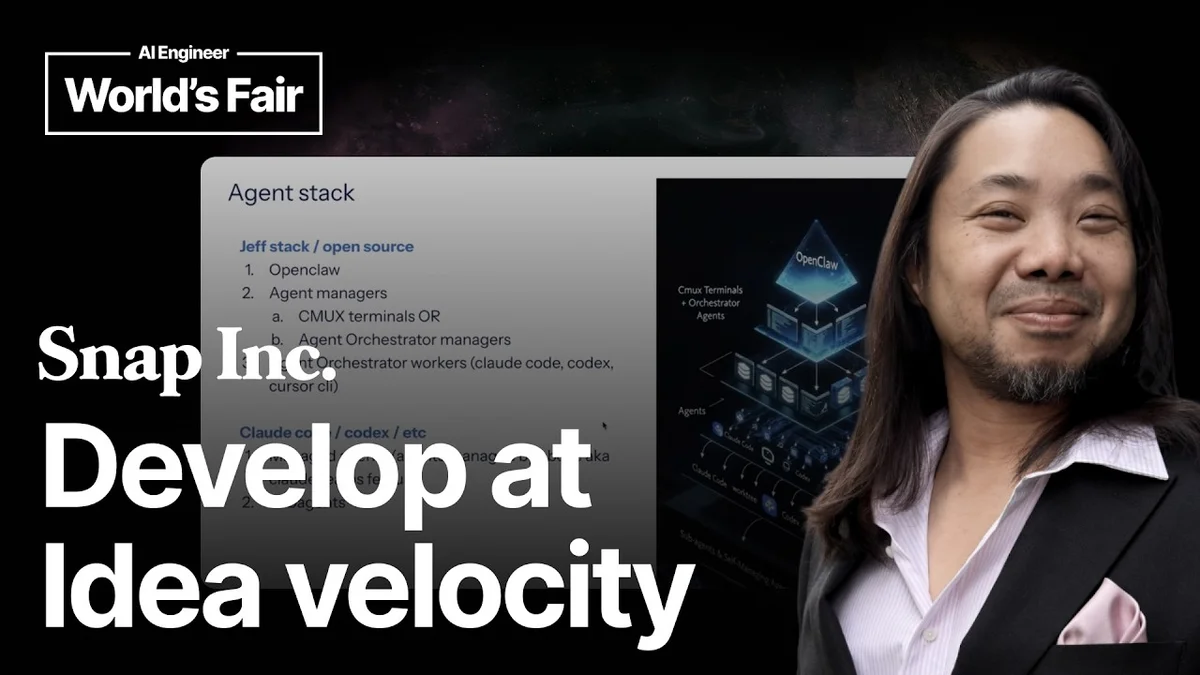
Snapchat's Jeffrey Lee-Chan on Developing at Idea Velocity

Jeffrey Lee-Chan, Head of Vibe Coding at Snap Inc., discusses 'Idea Velocity' and how he builds with the open-source OpenClaw autonomous coding platform, covering its architecture and applications.

5 min read
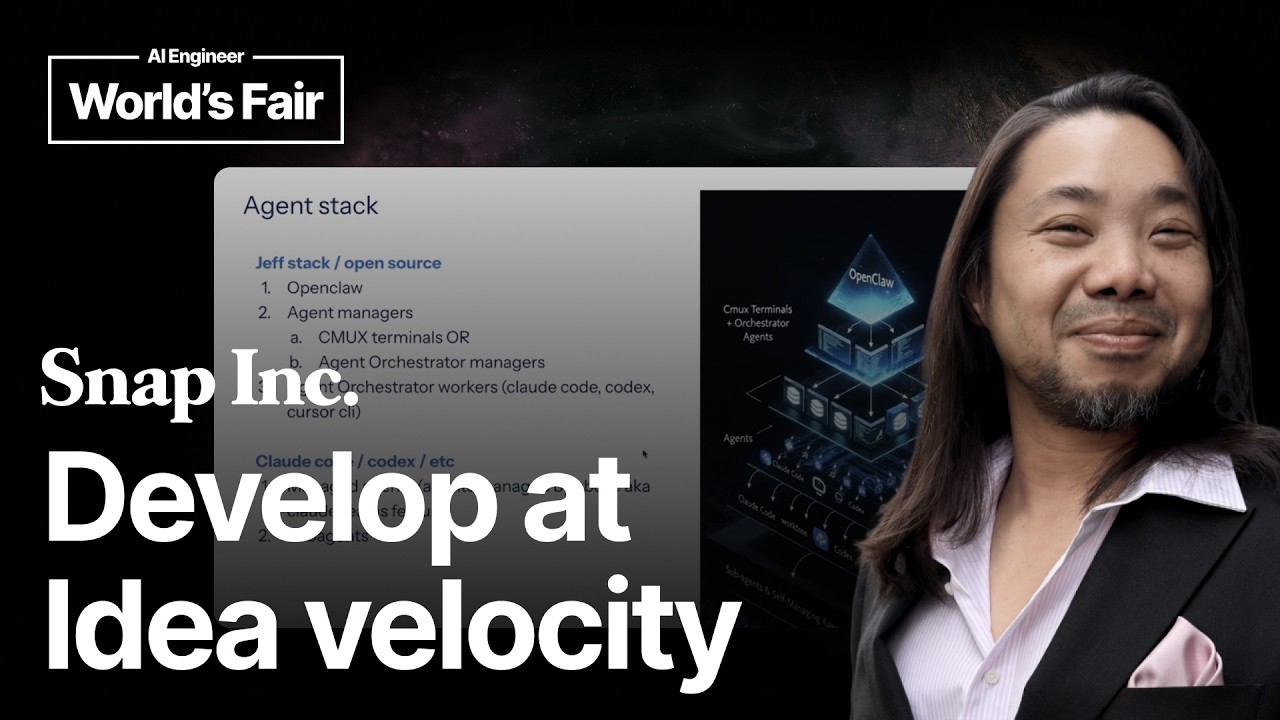
Presentation slide showing the title 'Develop at Idea Velocity' with Jeffrey Lee-Chan from Snapchat.
Jeffrey Lee-Chan presents on developing at 'Idea Velocity'.· AI Engineer
Visual TL;DR
Idea VelocityContext
streamlining development by increasing speed of innovation
From the article 2 mentionsJeffrey Lee-Chan, Head of Vibe Coding at Snap Inc., shared insights into the concept of 'Idea Velocity' and the development of autonomous AI agents.
OpenClaw PlatformCore
From the article 8 mentionsIn his presentation, titled 'Develop at Idea Velocity,' Lee-Chan walked through how he builds with the OpenClaw platform, the independent open-source autonomous AI coding architecture, to streamline the development process.
Central AICore
From the article 2 mentionsThe architecture features a layered system, starting with 'Central AI' that goes beyond specific code or repositories to focus on the overarching concept.
AI Builder EvolutionEffect
advancing AI capabilities for practical applications
From the articleLee-Chan also presented a framework for the 'Evolution of AI in Coding: From Tools to Self-Evolution.' This framework outlines four stages, from foundational tools and IDE augmentation to agentic shift and autonomy, advanced orchestration, and ultimately, self-evolution.
Streamlined DevelopmentOutcome
faster, more efficient software creation process
From the article 4 mentionsHe showcased real-world applications, including the AI RPG platform 'WorldAI' and 'Consensus ML,' a multi-AI model consultation website, illustrating the practical impact of these AI development principles.
Frictionless CommunicationContext
From the articleThis is supported by 'Frictionless Communication' channels like Slack, WhatsApp, and Telegram, enabling seamless interaction.
Data & Service AccessContext
From the articleA key aspect of OpenClaw is its access to central data sources and services, allowing it to interact with various platforms such as Docs, Gmail, and Slack.
Practical ApplicationsEffect
real-world use cases for autonomous AI coding
From the articleHe showcased real-world applications, including the AI RPG platform 'WorldAI' and 'Consensus ML,' a multi-AI model consultation website, illustrating the practical impact of these AI development principles.
Contents(3)

Correction (July 26, 2026): An earlier version of this article, and the video that accompanied it, described Jeffrey Lee-Chan as a former Snapchat engineering manager. He is currently Head of Vibe Coding at Snap Inc. The earlier summary also read as though he created OpenClaw. OpenClaw is an independent open-source project; Lee-Chan presented on how he builds with it. Both points are corrected below and the video has been re-rendered.

Snapchat's Jeffrey Lee-Chan on Developing at Idea Velocity - AI Engineer
Snapchat's Jeffrey Lee-Chan on Developing at Idea Velocity, from AI Engineer

Jeffrey Lee-Chan, Head of Vibe Coding at Snap Inc., shared insights into the concept of 'Idea Velocity' and the development of autonomous AI agents. In his presentation, titled 'Develop at Idea Velocity,' Lee-Chan walked through how he builds with the OpenClaw platform, the independent open-source autonomous AI coding architecture, to streamline the development process.

Understanding OpenClaw's Architecture

Lee-Chan outlined the core components of OpenClaw as he uses them, emphasizing its ability to manage multiple agents and orchestrate complex workflows. The architecture features a layered system, starting with 'Central AI' that goes beyond specific code or repositories to focus on the overarching concept. This is supported by 'Frictionless Communication' channels like Slack, WhatsApp, and Telegram, enabling seamless interaction.

A key aspect of OpenClaw is its access to central data sources and services, allowing it to interact with various platforms such as Docs, Gmail, and Slack. The platform also incorporates a 'Memory' component, which keeps track of goals, desires, and past actions, influencing future decisions. This memory system is crucial for maintaining context and ensuring that agents can learn and adapt.

The Workflow: From Intent to Green Checks

The presentation detailed how a single natural-language message in Slack triggers the full autonomous pipeline of OpenClaw. This pipeline involves several stages: 'Describe,' 'Context + Memory,' 'Agent Worktrees,' 'CI & Review,' and 'Proof-First.' Lee-Chan highlighted that each stage is fully automated, eliminating the need for manual intervention and ensuring a robust development cycle.

He demonstrated the process through a live demo, showing how a simple Slack message can initiate a series of actions, from understanding the intent to executing code and verifying its functionality. Lee-Chan explained that while the system aims for high automation, manual debugging or intervention might be necessary in certain complex scenarios.

AI Builder Evolution and Practical Applications

Lee-Chan also presented a framework for the 'Evolution of AI in Coding: From Tools to Self-Evolution.' This framework outlines four stages, from foundational tools and IDE augmentation to agentic shift and autonomy, advanced orchestration, and ultimately, self-evolution. He showcased real-world applications, including the AI RPG platform 'WorldAI' and 'Consensus ML,' a multi-AI model consultation website, illustrating the practical impact of these AI development principles.

The session concluded with a discussion on infrastructure, token costs, model trade-offs, and the use of CMUX terminal logs, providing a comprehensive overview of the challenges and opportunities in building advanced AI systems.

© 2026 StartupHub.ai. All rights reserved. Do not enter, scrape, copy, reproduce, or republish this article in whole or in part. Use as input to AI training, fine-tuning, retrieval-augmented generation, or any machine-learning system is prohibited without written license. Substantially-similar derivative works will be pursued to the fullest extent of applicable copyright, database, and computer-misuse laws. See our terms.