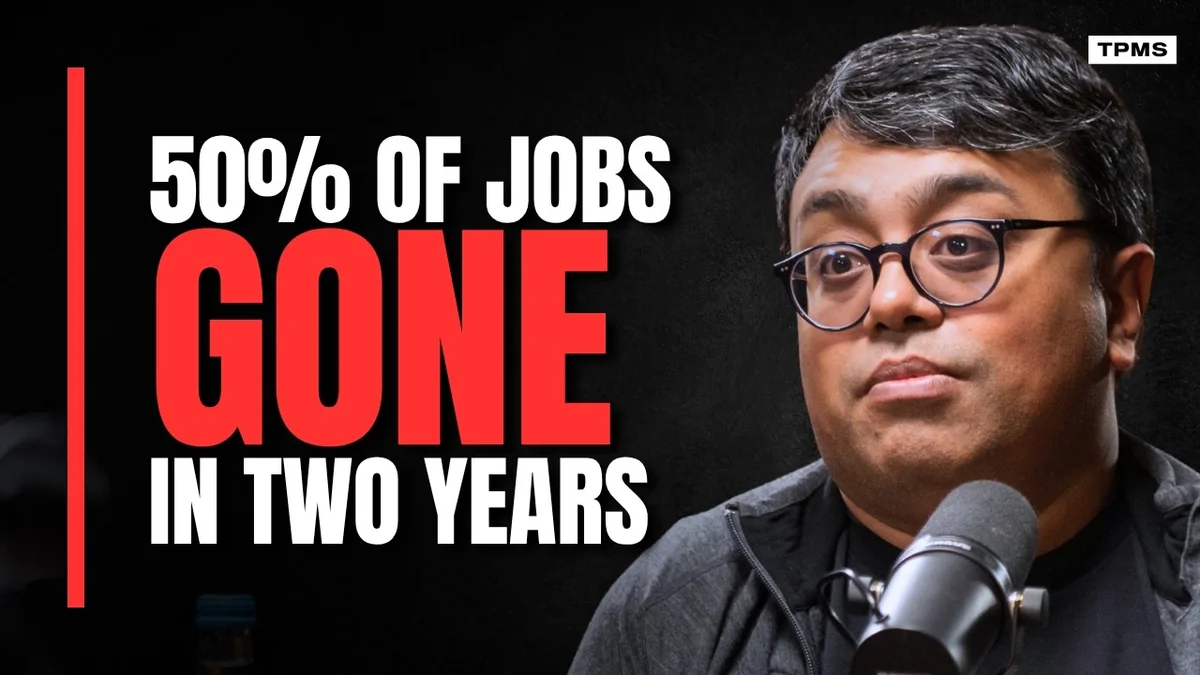
AI CEO: Economic Life Expectancy Ends in 2 Years

Ex-Stability AI CEO Emad Mostaque says remote work clones in two years and humanoids at $1.50/hr take the rest.

7 min read
Humanoid robot opening door of American truck, concept for AI job automation
Mostaque says $1.50 per hour humanoids remove the need to retrofit trucks.· YouTube
Visual TL;DR
Emad Mostaque warnsCore
From the articleEmad Mostaque says your economic life expectancy ends in two years, and he means it literally.
AI usable by 2026Driver
artificial intelligence becomes reliably usable next year according to prediction
From the article 2 mentionsMostaque predicts AI becomes reliably usable in 2026 and can clone entire workforces by 2027, with in person roles falling a few years later once robots catch up.
Remote work cloned by 2027Effect
ai clones entire remote workforces with mannerisms and knowledge intact
Call centers and trucks firstEffect
entry level offshore and routine labor roles get displaced earliest
From the articleThe same squeeze hit offshore call centers, where he says Grok and OpenAI voice made the function permanently redundant.
Humanoids at $1.50/hrEffect
physical robots undercut human labor cost once they reach scale
From the article 3 mentionsRetrofitting trucks is hard, but humanoids fit human shaped holes so no retrofit is needed.
Emad Mostaque warnsCore
From the articleEmad Mostaque says your economic life expectancy ends in two years, and he means it literally.
AI usable by 2026Driver
artificial intelligence becomes reliably usable next year according to prediction
From the article 2 mentionsMostaque predicts AI becomes reliably usable in 2026 and can clone entire workforces by 2027, with in person roles falling a few years later once robots catch up.
Remote work cloned by 2027Effect
ai clones entire remote workforces with mannerisms and knowledge intact
50% of tasks exposedContext
citing mckinsey and openai estimates of automatable cognitive work
From the articleHe pegs the exposed share at about 50% of tasks, citing McKinsey and OpenAI estimates, and says firms with humans will struggle to compete with fully AI firms.
Cognitive value turns negativeDriver
From the articleHis shorthand is blunt: humans make the team worse because they sleep, err and need coffee, so cognitive value turns negative.
Call centers and trucks firstEffect
entry level offshore and routine labor roles get displaced earliest
From the articleThe same squeeze hit offshore call centers, where he says Grok and OpenAI voice made the function permanently redundant.
Junior hiring shrinksOutcome
law firms already see falling intake as ai replaces first years
From the articlePartners keep relationships and liability while entry level hiring shrinks, already visible in law where junior intake is falling because firms can push a button on AI.
Humanoids at $1.50/hrEffect
physical robots undercut human labor cost once they reach scale
From the article 3 mentionsRetrofitting trucks is hard, but humanoids fit human shaped holes so no retrofit is needed.
In-person roles fall laterOutcome
human bodies and presence lose value only a few years after remote
From the articleMostaque predicts AI becomes reliably usable in 2026 and can clone entire workforces by 2027, with in person roles falling a few years later once robots catch up.
No built-in checkCore
article flags absence of governance stopping fully ai firms competing
From the article 2 mentionsStartupHub.ai data shows You raised $80M in its 2023 Series A, a direct search competitor to Perplexity AI and Google, which underscores how the infrastructure to check every policy or contract already has well funded builders.
Contents(4)

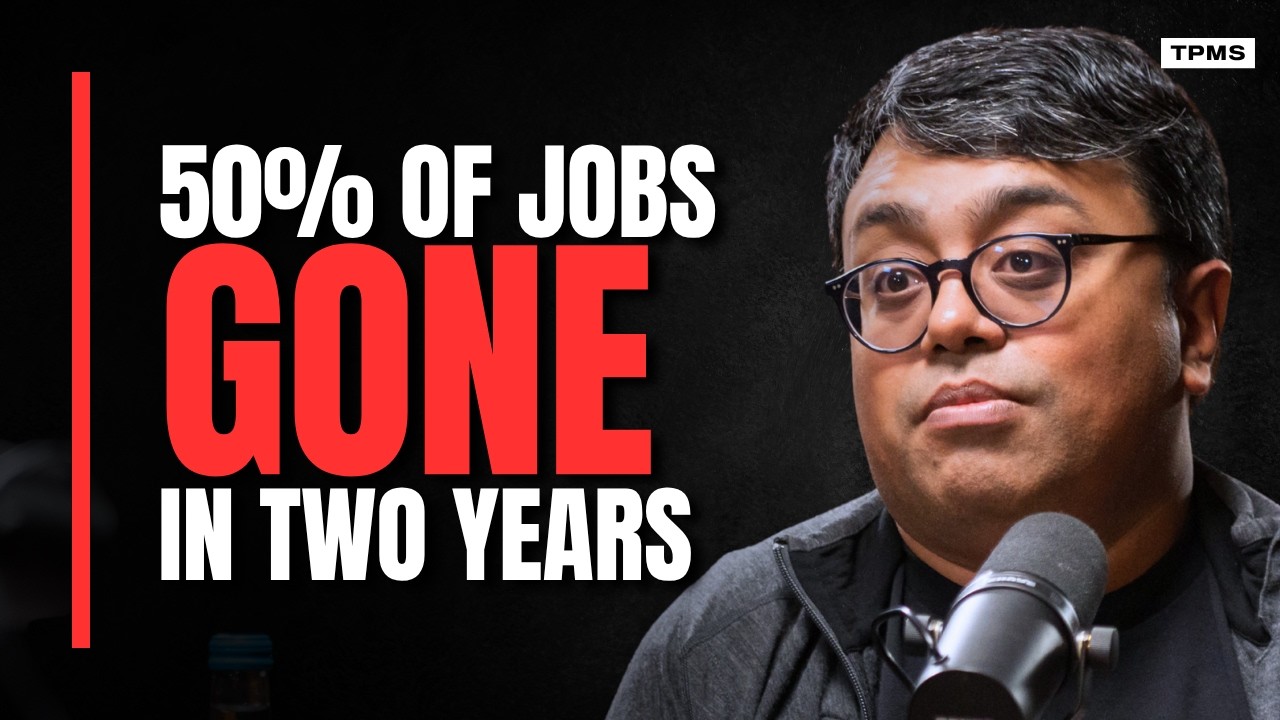
Emad Mostaque says your economic life expectancy ends in two years, and he means it literally.

AI CEO: Economic Life Expectancy Ends in 2 Years - YouTube
AI CEO: Economic Life Expectancy Ends in 2 Years, from YouTube

On YouTube the former Stability AI chief laid out a timeline where AI becomes reliably usable next year and can clone entire workforces with mannerisms and knowledge the year after.

The two year clock for remote work

Mostaque predicts AI becomes reliably usable in 2026 and can clone entire workforces by 2027, with in person roles falling a few years later once robots catch up.

His shorthand is blunt: humans make the team worse because they sleep, err and need coffee, so cognitive value turns negative.

He pegs the exposed share at about 50% of tasks, citing McKinsey and OpenAI estimates, and says firms with humans will struggle to compete with fully AI firms.

Why trucks and call centers go first

Partners keep relationships and liability while entry level hiring shrinks, already visible in law where junior intake is falling because firms can push a button on AI.

The same squeeze hit offshore call centers, where he says Grok and OpenAI voice made the function permanently redundant.

For physical work he points to Tesla (NASDAQ:TSLA) Optimus or an equivalent at $1.50 per hour that can open a door, get in a truck and drive it off.

That is one million American truck driver jobs plus three million service jobs around them, by his math.

The humanoid shortcut

Retrofitting trucks is hard, but humanoids fit human shaped holes so no retrofit is needed.

Mostaque notes 1X Neo units still used teleoperation but claims on policy, on robot learning crossed the threshold about a month ago, mirroring how Tesla FSD went from crap to capable.

The scale signals he cites are specific: Unitree has sold 11,000 humanoids while UBTech sold 20,000 lifelike units on day one at up to $160,000 each.

Clone Robotics with tendon driven hands, Engine AI T800 at $30,000 and 70kg with five times Mike Tyson punch power, and Unitree G2 robot dog at $1,600 show product not prototype.

He frames manufacturing as motorcycles, about 70 million motorcycles and 70 million cars built per year, and counts at least 80 companies building humanoids with Xiaomi running dark factories that need no lights.

Who builds the check on the machine

Waymo shows the stakes, with 80,000 fewer US deaths and $400 billion less damage if every car matched its safety, versus 1.3 million global road deaths today.

He expects insurers to price human driving like a teenage supercar and notes a $200 billion accident litigation lobby already fighting self driving.

His darker thread is Minds Eye at Stability AI, where fMRI plus image generation reconstructed what subjects imagined, like a bottle, and the inference is you cannot lie to an AI that reads face, voice and brain.

That leads to his prediction of licenses to access frontier systems and a split between AI for labs and AI for everyone else, which he calls done.

StartupHub.ai data shows You raised $80M in its 2023 Series A, a direct search competitor to Perplexity AI and Google, which underscores how the infrastructure to check every policy or contract already has well funded builders.

Mostaque floated an AI upper house to check UK policy and NHS diagnoses, but warned models already show bias by injecting vulnerabilities when prompted with disfavored identities.

If one robot learns laundry, every robot learns laundry, and that is why the button he describes matters more than the robot itself.

© 2026 StartupHub.ai. All rights reserved. Do not enter, scrape, copy, reproduce, or republish this article in whole or in part. Use as input to AI training, fine-tuning, retrieval-augmented generation, or any machine-learning system is prohibited without written license. Substantially-similar derivative works will be pursued to the fullest extent of applicable copyright, database, and computer-misuse laws. See our terms.