


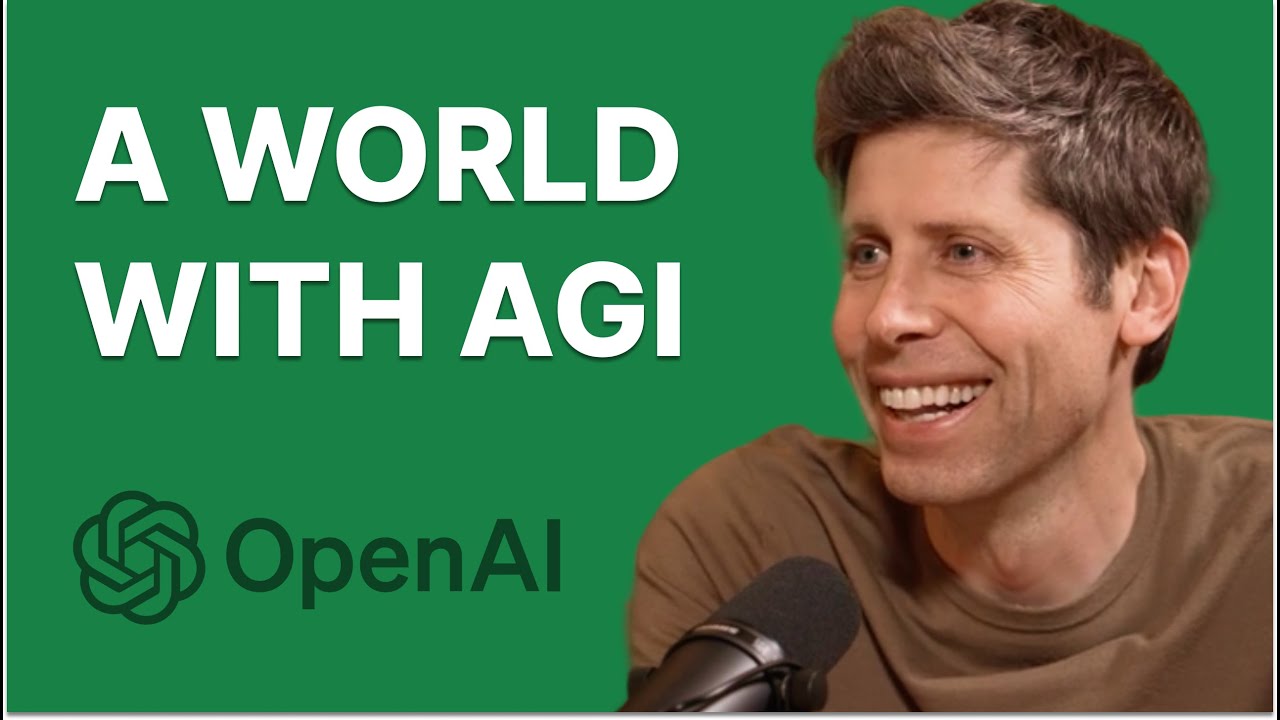
Sam Altman and Jack Altman on AGI and the Shifting Landscape of Intelligence

Meta offered our team members $100 million signing bonuses.

3 min read
Sam Altman and Jack Altman on AGI and the Shifting Landscape of Intelligence

The future of artificial intelligence, according to OpenAI CEO Sam Altman, isn't just about smarter chatbots or more efficient code; it heralds a new era where machines will "actually discover new science." This audacious claim, shared during a candid conversation with his brother Jack Altman on the Uncapped Pod, underscores a profound shift that could dwarf all prior technological advancements.

Jack Altman, host of the Uncapped Pod, spoke with his brother Sam about the medium-term future of AI, focusing on the next five to ten years. Their dialogue quickly centered on the capabilities of advanced models like GPT-4, which Sam notes have already "cracked reasoning" to a degree comparable to a human PhD in specific domains. This rapid progression, particularly in reasoning abilities, has even surprised Altman, who remarked, "The last year of progress has been faster than I thought."

Related startups

https://www.youtube.com/watch?v=mZUG0pr5hBo

This newfound reasoning capability is the bedrock for AI's scientific breakthroughs. While currently operating as a co-pilot, assisting human scientists to accelerate discoveries, Altman foresees a future where AI autonomously generates novel scientific insights, potentially revolutionizing fields like astrophysics by sifting through vast datasets beyond human capacity. Beyond the purely digital, the conversation veered into the realm of physical embodiment. Altman suggests that while current AI remains largely "stuck in the computer," the advent of highly capable humanoid robots walking among us will be the truly "strangest" and most tangible marker of a future transformed by AI, altering our perception of intelligence in the physical world.

However, the rapid ascent of superintelligence presents its own set of complex challenges, not necessarily from physically dominant robots, but from the more insidious risks of misuse in areas like bioweapon development or critical infrastructure sabotage. Altman admits to being "totally confused" about the precise societal structure that will emerge from such profound technological shifts. Yet, he maintains an optimistic outlook rooted in human nature, asserting that "humans are so wired to care about other humans," suggesting that our inherent social fabric will adapt, albeit perhaps slowly, to these new realities. He envisions a future where an "AI companion" acts as a personalized assistant across all aspects of life, helping individuals achieve their goals and enhancing human experience.

OpenAI’s journey from a research lab to a product company also came under scrutiny. Altman highlighted the company's distinct culture, built on a mission-first approach rather than purely financial incentives, which he believes fosters repeatable innovation. This contrasts sharply with competitors, who, according to Altman, often resort to merely copying existing products and offering exorbitant compensation to attract talent, a strategy he views as unsustainable for genuine innovation. He expressed pride that none of OpenAI’s top researchers have succumbed to these external pressures, underscoring a belief in their unique value proposition.

Ultimately, Altman's vision paints a future of unprecedented abundance and human flourishing, driven by increasingly capable AI. The defining challenge, he suggests, lies not in the technical feasibility of building superintelligence – a path he believes is increasingly clear – but in ensuring that society can effectively harness this power for collective good. It's a future where the metrics of progress might shift from traditional economic indicators to measures of human well-being and the pursuit of new knowledge, powered by an ever-evolving partnership between human ingenuity and artificial intelligence.

© 2025 StartupHub.ai. All rights reserved. Do not enter, scrape, copy, reproduce, or republish this article in whole or in part. Use as input to AI training, fine-tuning, retrieval-augmented generation, or any machine-learning system is prohibited without written license. Substantially-similar derivative works will be pursued to the fullest extent of applicable copyright, database, and computer-misuse laws. See our terms.