

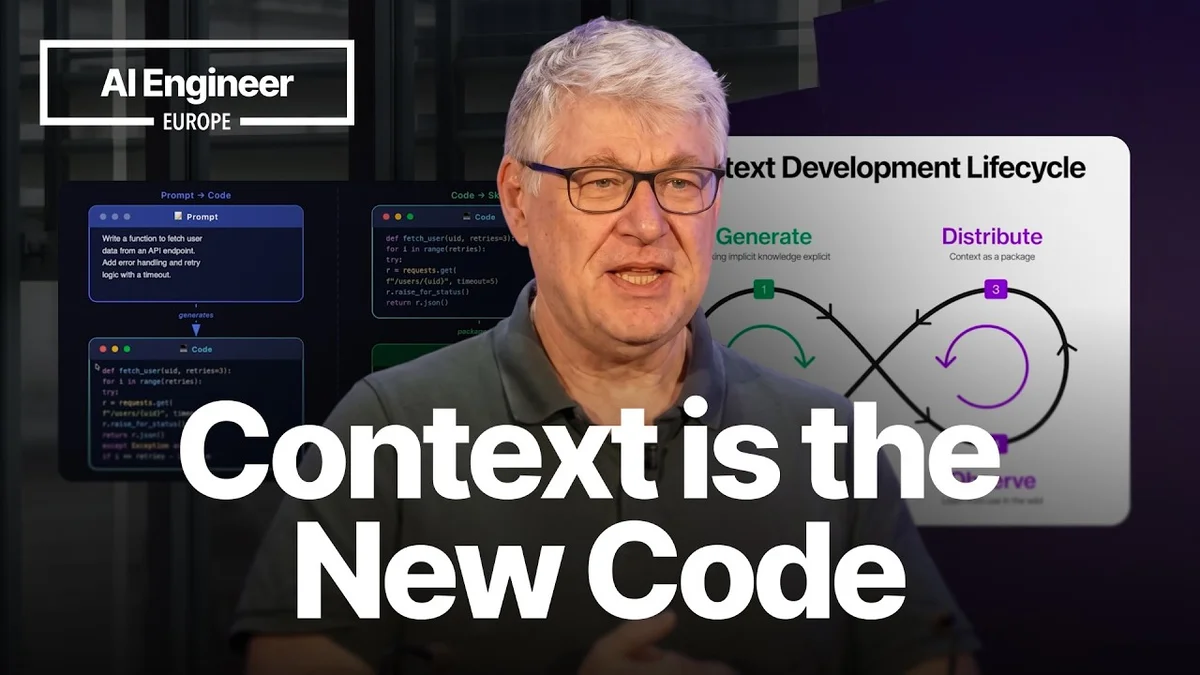
In the rapidly evolving world of AI development, the focus is shifting from purely writing code to a more nuanced approach: engineering the context that powers AI agents. Patrick Debois, a prominent figure in the AI engineering community, recently delivered a compelling talk at AI Engineer London 2024, titled "Context is the new Code." His presentation delved into the concept of 'Context Development Lifecycle' (CDLC) and how it mirrors the traditional Software Development Lifecycle (SDLC), emphasizing the critical role of context in building effective AI agents.
Patrick Debois: A Visionary in AI Engineering
Patrick Debois is a recognized expert in the field of AI engineering, known for his insightful perspectives on the practical application of AI. His work often bridges the gap between theoretical AI research and real-world implementation, focusing on making AI systems more robust, reliable, and understandable. Debois's talk at AI Engineer London 2024 highlighted his forward-thinking approach to the challenges and opportunities in developing sophisticated AI agents.
The Context Development Lifecycle (CDLC)
Debois introduced the concept of a 'Context Development Lifecycle' (CDLC), drawing parallels to the established Software Development Lifecycle (SDLC). He broke down this new paradigm into four key stages:
- Generate: This phase involves creating and curating context, making implicit knowledge explicit for AI agents.
- Evaluate: Here, the quality of the generated context is tested and measured, ensuring its relevance and accuracy.
- Distribute: Context is then packaged and shared, making it accessible to AI agents and developers.
- Observe: The final stage involves monitoring the context in production and learning from its performance to drive further improvements.
This cyclical process, akin to a flywheel, emphasizes continuous improvement and adaptation in AI development.
From Prompt Engineering to Context Engineering
Debois argued that the era of simple prompt engineering is evolving into a more sophisticated practice of 'Context Engineering.' He illustrated this with examples of how AI agents like Claude can be instructed to fetch relevant information, such as details about his talk at AI Engineer Europe. The key takeaway is that effective context is not just about providing data, but about structuring and presenting it in a way that the AI agent can readily understand and utilize.
He demonstrated how even simple prompts, like asking an AI to find information about a specific event, require careful consideration of the context provided. The AI's ability to successfully retrieve and process this information depends heavily on the clarity and completeness of the prompt and the accompanying context.
The Importance of Testing and Evaluation
A significant portion of Debois's talk focused on the critical role of testing and evaluation in the CDLC. He highlighted how traditional software testing methodologies can be adapted for AI context development. Simple tests like 'linting' a skill's description ensure basic adherence to standards, while more advanced techniques like using an LLM as a judge can assess the quality and correctness of the generated code and context.
For instance, he showed how to set up tests to verify that generated API endpoints start with a specific prefix, like 'awesome,' and how to use tools to automate this validation process. This rigorous testing ensures that the context is not only accurate but also adheres to established best practices and security standards.
CI/CD and the Future of AI Development
Debois emphasized the integration of context development into Continuous Integration and Continuous Deployment (CI/CD) pipelines. By treating context as a first-class citizen in the development workflow, teams can ensure that their AI agents are constantly improving and adapting. He outlined key principles for this integration, including:
- Non-determinism and testability: AI context should be designed to be testable and free from unpredictable errors.
- Fast local subset testing: The ability to quickly test parts of the context locally speeds up the development cycle.
- Mining production failures: Analyzing failures in production is a rich source of data for improving context.
- Every context change reruns the suite: This ensures that any modification to the context is thoroughly validated.
- Vendor metrics lie: It's crucial to define your own metrics for evaluating context quality.
He also touched upon the concept of 'agent sandboxing' and the need for robust security measures when integrating external context or creating new skills. Tools like Snyk can be used to scan context for potential vulnerabilities, ensuring the safety and reliability of AI agents.
The Context Flywheel: Amplifying Intelligence
The talk concluded with a look at the 'Context Flywheel,' a model illustrating how context evolves from individual knowledge to team understanding and ultimately to organizational intelligence. By systematically creating, testing, distributing, and observing context, development teams can foster a virtuous cycle of improvement and amplification of AI capabilities.
Debois's presentation offered a valuable framework for AI engineers looking to move beyond basic prompt engineering and embrace a more structured, rigorous, and scalable approach to developing sophisticated AI agents. The message was clear: in the age of AI, context is not just important; it is the new code.
