

The 20 AI Tools Powering Modern SaaS Stacks in 2026
The working stack of a modern AI-native SaaS team in 2026, layer by layer, with every tool pulled from the live StartupHub.ai directory.
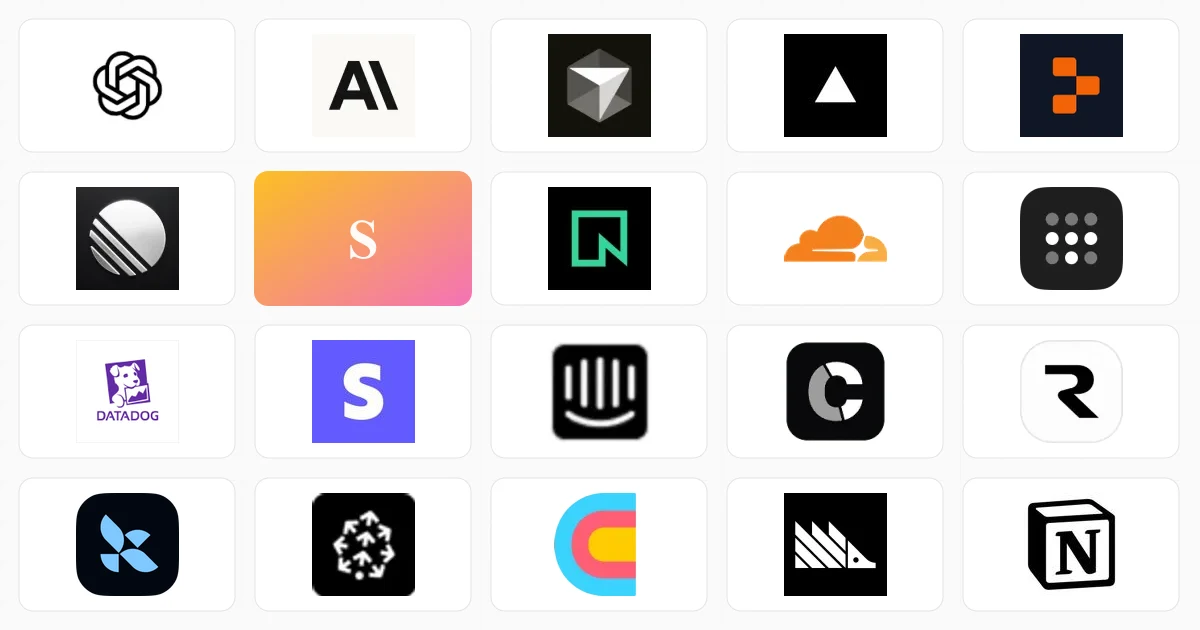
Every founder who has shipped a SaaS in the last eighteen months has stared at the same stack-selection problem. The infrastructure layer collapsed under the weight of AI primitives, the model providers are competing on cents per million tokens, and the developer tools market is consolidating around two or three winners per category. The honest answer to what most teams are actually running in 2026 is shorter than the AWS service catalog and uses fewer than ten dollars of free tiers.
What follows is not a survey of every option. It is the working stack of a modern, AI-native SaaS team, ordered roughly from the foundation models that power the product down to the marketing and analytics tools that keep the business honest. Every name here pulls from the live StartupHub.ai directory with revenue, hiring, and funding signals behind it. Some entries are obvious. A few are not, and those are the ones worth bookmarking.
1. OpenAI
The default LLM provider for almost every shipping SaaS today, and the API your competitors are already paying.
GPT-4.1 and GPT-5 are still the safe pick for production traffic when you need wide capability coverage. Most teams start here and only specialise to Claude or open weights once a specific cost or latency ceiling forces the move.
2. Anthropic
The Claude family is now the writing and reasoning workhorse for support, marketing, and any agent that touches structured output.
Sonnet 4.6 hits a price-performance sweet spot that is pulling enterprise traffic away from GPT-4o, and Claude tool use behaviour is more reliable in long-running agent loops, which matters once your stack moves past simple chat.
3. Cursor
The IDE most engineering teams have already standardised on, whether the founder admits it on a sales call or not.
Pair-programming with Claude and GPT inline against your repo context turned out to be the actual product-market fit for AI-in-the-editor. The free tier covers solo devs, and the team plan ships with shared snippets and policy controls.
4. Vercel
The hosting layer that everyone ends up on the minute their Next.js side-project crosses 50 paying customers.
Edge functions, ISR, preview deploys per pull request, and a vendor-locked deploy story that is frictionless enough to be worth the markup over raw cloud. The AI Gateway and v0 product extensions are pulling Vercel further into the stack itself.
5. Replit
The fastest way to ship a usable internal tool when you do not want to spin up CI, hosting, and a database yourself.
Replit Agent now produces full apps from a prompt in minutes, and the hosting story is good enough that the prototypes increasingly stay in production. A real second-source for teams who do not want everything riding on Vercel.
6. Linear
The project tracker that won the SaaS-founder vote by being aggressively opinionated about workflow.
Cycles, triage, and tight GitHub PR integration make Linear feel less like Jira and more like a writing tool. The recent AI features (auto-triage, draft issue summaries) added genuine leverage instead of being a checkbox.
7. Supabase
The Firebase alternative that actually delivered, with Postgres at the core and a free tier most MVPs never outgrow.
Auth, storage, row-level-security policies, real-time channels, edge functions, and pgvector for embeddings all in one project. The team has been shipping AI-adjacent primitives (Studio Assistant, pgvector improvements) faster than competitors can copy.
8. Neon
Serverless Postgres with separated storage and compute, which means you stop paying for idle databases overnight.
Branching a production database for each PR is the killer feature once your team is bigger than two engineers. The free tier is generous enough that many small SaaS teams never need to upgrade.
9. Cloudflare
The edge layer almost every modern SaaS ends up running through, for DNS, CDN, Workers, R2, and increasingly inference.
Workers AI and AI Gateway pulled Cloudflare into the inference path itself, not just the request path. The pricing is the cheapest credible option for high-volume edge logic and the free tier covers most early-stage workloads.
10. Tailscale
Mesh networking that replaces the VPN your team will otherwise spend two weeks setting up wrong.
Identity-based access across staging, production, and personal dev machines. Tailscale Funnel exposes a local port to the public internet for webhook testing without the ngrok tax, and the SSH product replaces bastion hosts entirely.
11. Datadog
The observability backbone most series-A and later SaaS teams settle on, despite the bill.
APM, logs, RUM, synthetic checks, and now LLM observability in one query layer. Datadog pricing is famously rough but the alternative is duct-taping four open-source tools together, which costs more in engineering time.
12. Stripe
Still the default payments rail, and increasingly the default identity, tax, billing, and invoicing rail as well.
Atlas, Tax, Connect, Radar, and the Sigma queries mean a SaaS team can outsource almost the entire financial back office. The fee is fair compared to building any of this in-house.
13. Intercom
The customer support platform that fully committed to AI agents as the first-line responder.
Fin (Intercom AI agent) now resolves a meaningful share of tickets before a human ever sees them, and the pricing model rewards that. The product makes sense for any SaaS team large enough to need a real support queue but too small to staff overnight coverage.
14. Chatbase
Custom GPT chatbots trained on your own docs, embedded in the product without writing your own RAG pipeline.
The setup is dragging a PDF or sitemap into an upload form and getting a chat widget back the same hour. Cheap insurance against pages of FAQ users will never read on their own.
15. Resend
The developer-friendly transactional email API that pulled half of SendGrid startup customers in two years.
Clean SDKs, React Email for templating, audience management without the marketing-tool bloat, and a logo small enough that customers do not recognise it as a third-party service. Pricing is meaningfully cheaper than SendGrid below scale.
16. LangChain
The agent framework that became standard infrastructure for anyone building tool-using AI features.
LangGraph (the state-machine cousin) is now the production-ready piece for serious agent work. The integrations catalogue (every model, every vector DB, every connector) means you rarely have to write glue code yourself.
17. Pinecone
The hosted vector database that most teams pick when they do not want to operate their own.
Managed indexing, hybrid search, namespaces for multi-tenant isolation, and a free tier that handles small workloads cleanly. The alternative is running pgvector in your existing Postgres, which works fine until it does not.
18. Clay
The data enrichment platform every modern outbound team is now running their lists through.
Pull a CSV of company URLs in, get back enriched contacts, firmographic data, and AI-drafted personalised first lines, ready for a sequencer. Replaces a stack of Clearbit, Apollo, and a Zapier graveyard.
19. PostHog
The product analytics platform that bundled session recordings, feature flags, and A/B tests in one open-source product.
Self-hosted is a serious option for teams with data-locality concerns. The free tier on cloud is generous enough that most early-stage SaaS never sees a bill, and the new LLM analytics module tracks token spend per feature.
20. Notion
The internal docs and wiki layer that most SaaS teams default to, AI features included.
Notion AI now summarises pages, drafts product specs, and answers questions across the entire workspace. The price is fair, the migration cost from Confluence is brutal but worth it, and the database primitives double as lightweight internal tools.
The pattern that emerges across these twenty tools is unification rather than specialisation. Stripe is now a tax engine and an identity provider, not just a payments rail. Vercel ships an AI gateway. Cloudflare runs inference. Supabase competes with Pinecone on vector search, and Notion is a wiki, a database, an internal-tool builder, and an AI assistant. The teams that win in 2026 are the ones who pick three or four anchor vendors and let them absorb adjacent jobs, instead of stitching together fifteen point solutions that each need their own auth, billing, and on-call rotation.
The category to watch over the next twelve months is the agent layer. LangChain and a handful of competitors are racing to be the orchestration default, the way Vercel became the default for Next.js. Whichever team gets there first will inherit the developer mindshare that compounds for a decade. The rest of this list is already settled. The agent stack is still up for grabs, and that is where the next ten unicorn outcomes are going to land.