
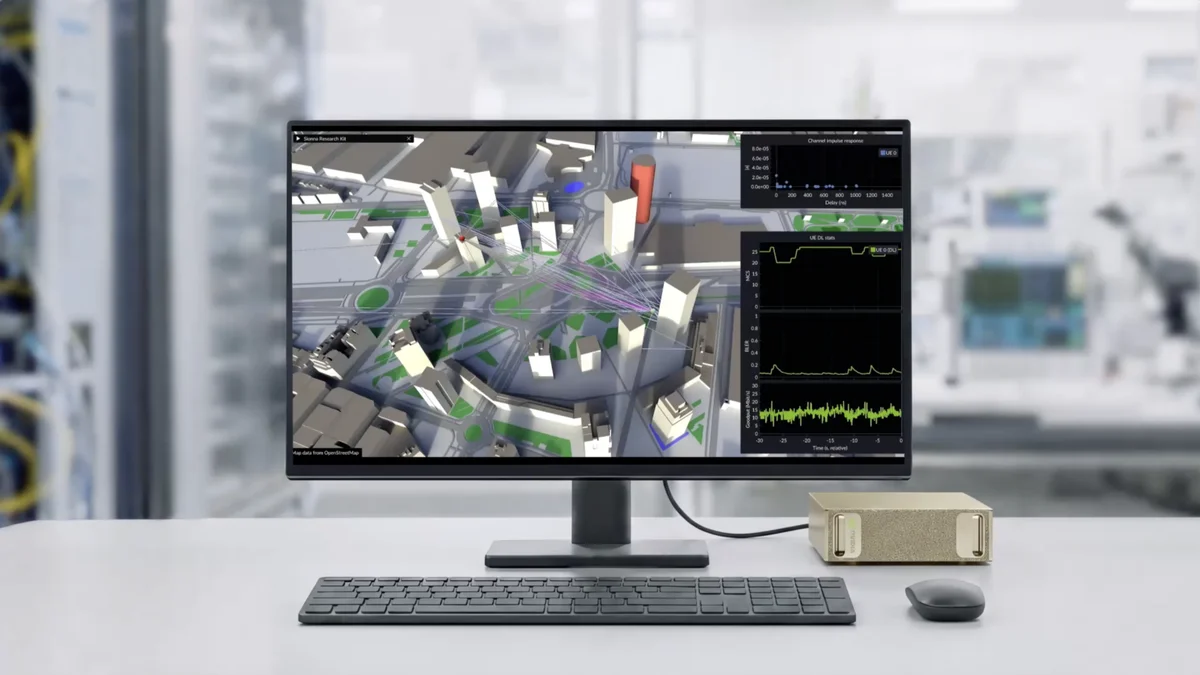
NVIDIA says its open source 5G and 6G tools passed 1 million downloads after developer adoption grew 10x in the past year. NVIDIA puts current use at more than 8,000 research institutions working with AI Aerial and Sionna to prototype AI-native 6G networks that join connectivity, compute and sensing.
The pitch is faster iteration from simulation to over-the-air tests.
Sionna functions as a link-level simulation platform paired with Aerial for accelerated RAN work, per The Tech Buzz. StartupHub.ai data shows GPU-accelerated RAN tooling now overlaps with edge robotics stacks in tracked lab pipelines. That overlap favors NVIDIA because NVIDIA supplies Aerial for the network side and Jetson AGX Orin for the robot side.
At King’s College London, researchers linked a camera robot arm to Jetson AGX Orin running Sionna and sent semantic object descriptions instead of full images. NVIDIA says that approach cut task completion time by up to 52.6% in fruit-packing and cube-stacking tests with injected faults. The system also detected dropped objects and checked moves in a digital twin before execution, NVIDIA says.
SoftBank integrated a neural receiver into NVIDIA Aerial CUDA-Accelerated RAN and tested it with a commercial 5G phone under interference. NVIDIA says throughput beat a conventional receiver at all 15 tested settings, with a maximum gain of roughly 60%. ETH Zurich researchers tuned neural receivers on local measurements with NVIDIA Aerial Testbed and cut block error rates by more than one-third versus selected pretrained versions, NVIDIA says.
At the University of Leeds, researchers forecast demand 10 minutes ahead to guide base station sleep and verified handoff to neighbors before shutdown. NVIDIA says the test with a DGX Spark powered network-in-a-box and a digital twin cut RAN power use by 45.6% against a full-power baseline while holding connections. At CTTC, GPU channel models in the 5G-LENA simulator cut runtime from about three hours to 10 to 20 minutes while preserving statistical behavior, NVIDIA says.
Results are still lab bounded with controlled interference, portable cells and simulated load. Will carriers accept neural receivers and sleep controllers trained on local data once interference is uncontrolled and traffic is real?




