

Ro Khanna's $314M Hypocrisy

Rep. Ro Khanna's family trusts hold up to $314 million and executed thousands of trades, creating a 'hypocrisy' narrative given his push to ban congressional stock trading.

4 min read
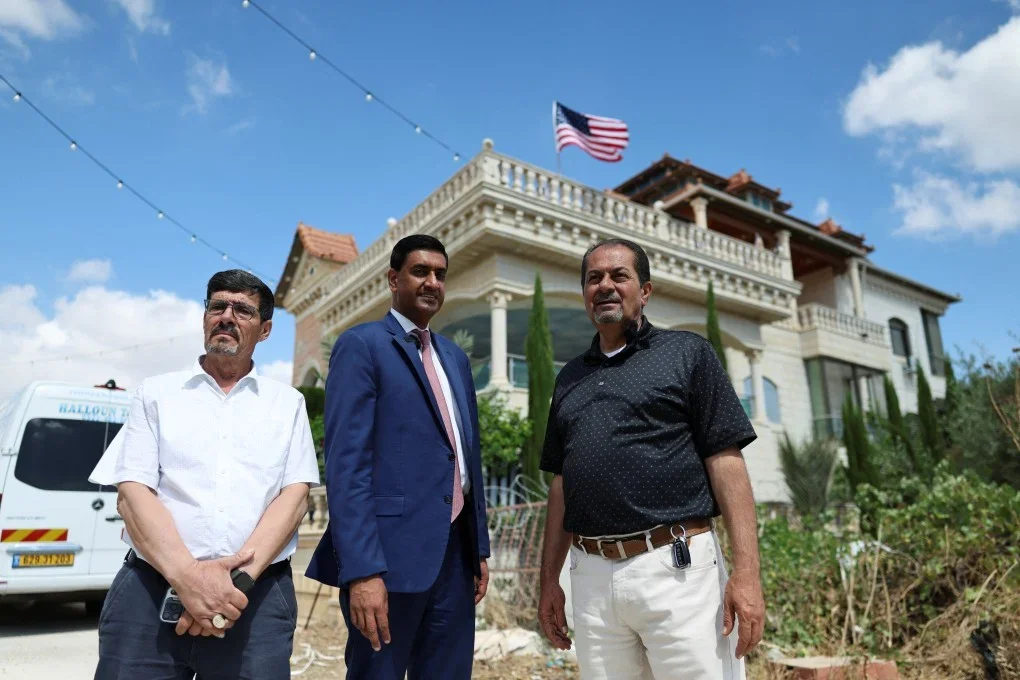
U.S. Representative Ro Khanna (D-CA) with Palestinian residents of Turmus Ayya near Ramallah, West Bank, in front of a large private mansion. Photo Credit: Reuters.
U.S. Representative Ro Khanna (D-CA) stands with Palestinian residents of Turmus Ayya, near Ramallah in the Israeli-occupied West Bank. Behind them is a large 3-story private mansion owned by an Arab family, estimated to be valued at $3.5 million or higher. The photo was taken shortly before Khanna attempted to enter restricted areas without the required Israeli permit - an incident he later publicly lamented as persecution for being brown, even as a simple permit was needed and roughly half of Israel's population consists of olive-skinned citizens. Photo Credit: Reuters.

Rep. Ro Khanna, the Silicon Valley Democrat representing California’s 17th District, reported a family financial footprint ranging from tens of millions to over $300 million in his 2024 House financial disclosure. This substantial wealth and active trading stand in stark contrast to his vocal advocacy for banning members of Congress from trading individual stocks. The result is a high-profile political financial transparency narrative now playing out across tech newsrooms and political circles, highlighting the Ro Khanna stock trading hypocrisy.

A Financial Snapshot: The Big Numbers

The 2024 disclosure, available as a 333-page PDF, details a complex financial structure. Total reported holdings range from $98.7 million (low end) to $314.9 million (high end) across 3,042 line items. Unearned income in 2024 reached $3.65 million to $16 million from dividends, interest, gains, and rent.

Reported transactions in 2024 totaled 4,665 moves, with a combined statutory value range of $36.4 million to $137.2 million. For a member with an official salary of $174,000, these figures are extraordinary. Most of the wealth is attributed to family trusts and partnerships managed by his wife, Ritu Khanna.
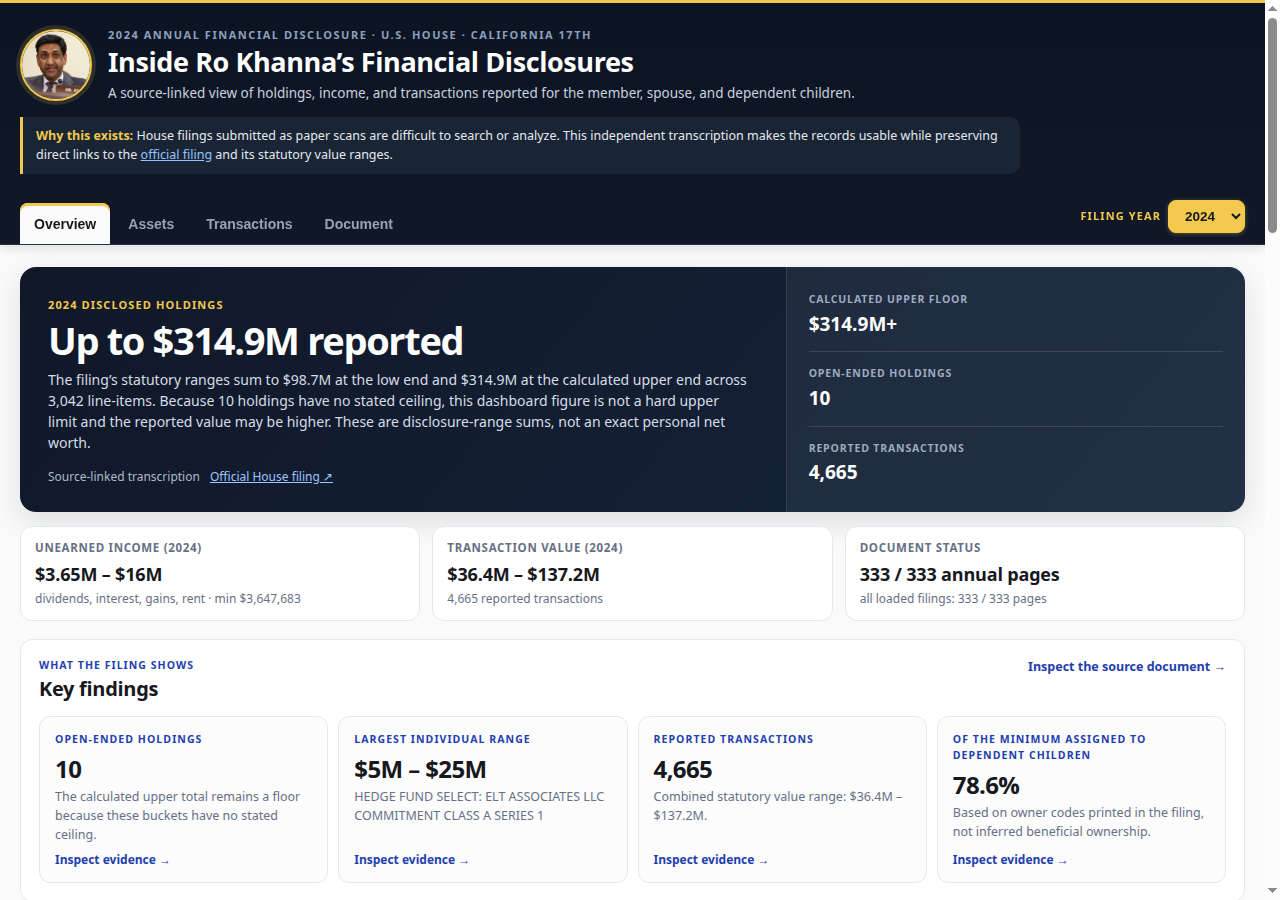
Screenshot of rokhanna.money, a financial disclosure explorer showing Ro Khanna's reported holdings and stock trades.
Screenshot: rokhanna.money

Holdings and Trading Activity

The portfolio is highly diversified, anchored in finance and tech. Holdings include $39.2 million to $142.5 million+ in hedge funds and private funds, $20.5 million to $61.8 million+ in funds and ETFs, and $18.6 million to $57.7 million in common stock.

This is not a modest portfolio; it resembles that of a venture partner or family office with deep access to complex financial products.

The Monte and Usha Ahuja 2010 Irrev Trust FBO Grandchildren holds the single largest disclosed range of $5 million to $25 million in 'HEDGE FUND SELECT: ELT ASSOCIATES LLC COMMITMENT CLASS A SERIES 1'. The M & R Trust Partnership - 2020 Trust FBO Khanna Children, with 364 assets, is the largest family trust by count.

The 4,665 transactions in 2024 included 2,772 purchases ($24.5M, $87.5M) and 995 sales ($8.56M, $30.8M). Khanna’s family-trust trades show heavy activity in tech giants like NVIDIA, Meta, and Taiwan Semiconductor, with some trades in the $15K, $100K range.

The 'Trader Ro' Narrative Intensifies

Khanna has long positioned himself as a progressive reformer, advocating for a ban on congressional stock trading since December 2023. However, the 2024 disclosure, followed by periodic reports for 2025 and 2026, reveals his family trusts actively trading and holding significant positions in individual equities and hedge funds. This juxtaposition has led critics to label him “Trader Ro.”

The 2025 periodic transaction reports show 4,802 reported transactions with a combined statutory range of $18.9 million to $107.9 million. In 2026, partial-year reports indicate 2,986 transactions totaling $8.29 million to $57.2 million. These figures make his household the most prolific congressional trader by absolute volume.

The disclosed trades involve major tech companies such as Microsoft, NVIDIA, Meta, and Apple, along with financials like JPMorgan and Mastercard. Many of these companies operate in sectors Khanna scrutinizes in his legislative efforts.

Policy vs. Portfolio: A Credibility Challenge

The core of the criticism is straightforward: Khanna proposes a ban on congressional stock trading while his family trusts actively trade and hold significant equity positions. This creates a perceived conflict of interest, especially given his role as a leading voice on AI safety, antitrust, and labor issues in tech. The extensive Silicon Valley political influence is a constant consideration.

Khanna's office maintains his wife manages the trusts independently and he does not make trading decisions. While legally compliant with House rules and the STOCK Act, the issue is normative: whether a lawmaker should advocate rules his family doesn't follow.

For tech companies and employees, this situation poses a credibility risk. If Khanna continues pushing for stricter tech oversight while his family holds large stakes in major players, his motives may be questioned. The ease of dissecting these disclosures via independent sites like rokhanna.money fuels granular coverage, allowing journalists to connect specific trades to policy debates.

This ongoing situation sharpens the debate over whether a lawmaker who seeks to limit Wall Street and tech financial power should be personally invested in it at this scale. The data is visible and substantial, making it a critical story for tech coverage.

© 2026 StartupHub.ai. All rights reserved. Do not enter, scrape, copy, reproduce, or republish this article in whole or in part. Use as input to AI training, fine-tuning, retrieval-augmented generation, or any machine-learning system is prohibited without written license. Substantially-similar derivative works will be pursued to the fullest extent of applicable copyright, database, and computer-misuse laws. See our terms.