LinkedIn Engineering says it runs most workloads on self-managed Kubernetes across 500,000 bare-metal servers.
The shift retires a decade-old homegrown scheduler, LinkedIn said. That stack grew costly to evolve and could not support AI workloads. The rebuild merges fleet management and workload management into one system.
Fleet patches now roll in under 30 days hands-free, LinkedIn said.
App teams skip native Deployments and use LiDeployment and LiStatefulSet APIs, LinkedIn said. About 80% of CPU allocation is stateless and stateful services, with 5% jobs and 15% Kubernetes-as-a-service, according to LinkedIn. Platform teams building on Kubernetes-as-a-service get broader API access under RBAC and fairness controls, LinkedIn said.
Maintenance drives the design, not manifests.
Each data center is striped into 20 maintenance zones, LinkedIn said. Updates validate then roll one zone at a time, capping blast radius at about 5% of a data center, according to LinkedIn. Compute pools spread evenly and pods land across zones with no developer action, LinkedIn said.
One disruption protocol governs planned and unplanned work.
Compute Broker brokers each disruption and hands a node from Kubernetes to a maintenance actor, LinkedIn said. Stateless handlers evict under PodDisruptionBudgets while stateful handlers check with the Application Cluster Manager, according to LinkedIn. An unschedulable-capacity budget pauses cordons when a pool runs short, LinkedIn said.
LinkedIn prefers clusters around 6,000 nodes to cut fragmentation and let workloads share capacity, LinkedIn said. etcd runs on fast SSDs with a 32 GiB backend quota against 8 GiB upstream guidance, according to LinkedIn. LinkedIn tracks N-2 from upstream and prepared machines join in under 2 minutes, LinkedIn said.
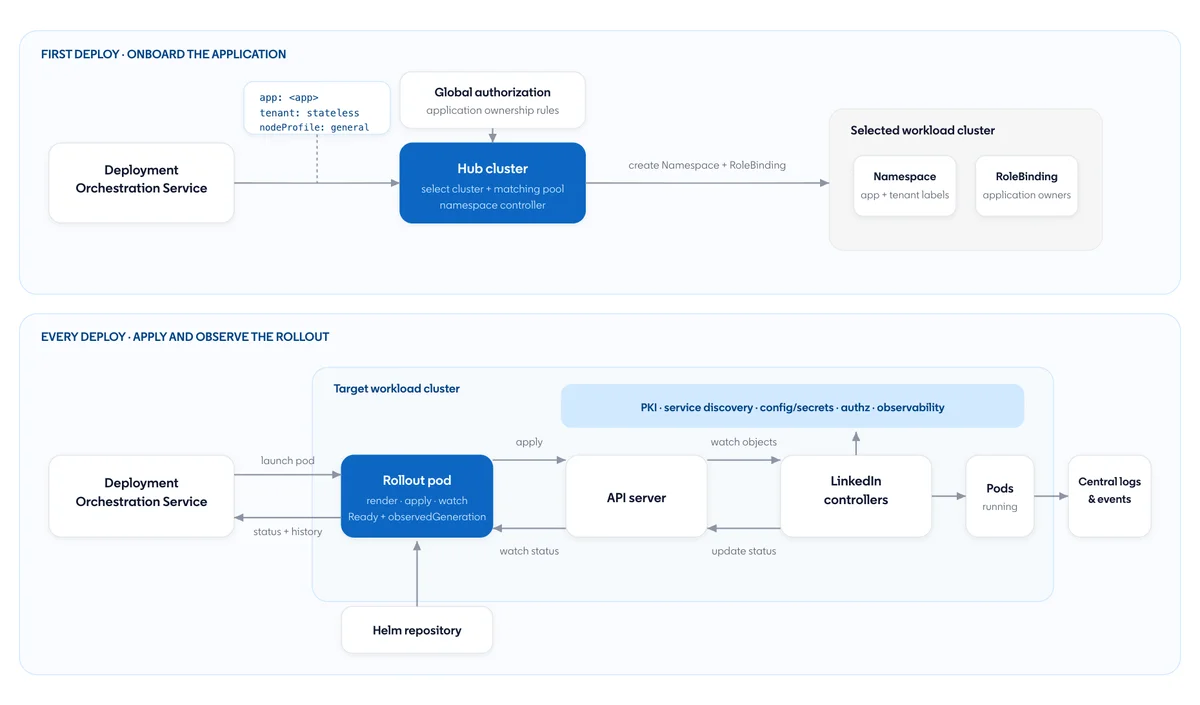
Deployment scale sits above that fleet. LinkedIn replaced Argo CD with a custom GitOps engine across more than 250 clusters, reported by InfoQ. That system handles more than 4,000 services and 100,000 deployments each week, reported by InfoQ.
Test clusters now run control planes as pods and LinkedIn said that model may reach production.