


The pursuit of hyper-productive employees, a Silicon Valley obsession since a 1968 study highlighted a 10x productivity gap among engineers, has a new contender: AI agents. Sierra, a platform company, found its engineering team achieving 5X more output on certain tasks by running AI agents alongside their existing workflows.
This sparked a broader question: how to scale this productivity boost across the entire organization. Sierra formed a six-person AI acceleration team to find out.
The Singular Agent
Initial attempts at creating role-specific agents, support, data analysis, engineering, sales, proved cumbersome. Employees struggled to remember which agent handled which task, a problem compounded by a distracting internal naming convention.
The core issue, however, was structural. Critical business processes, like shipping a product, inherently span multiple departments, engineering, sales, marketing, legal, operations. AI's growing ability to handle work end-to-end negates the need for siloed agents.
Sierra collapsed these specialized agents into a single entity, Pinecone, accessible via one Slack handle and one thread. This unified agent manages system integrations and task execution, absorbing complexity so employees don't have to. This approach aligns with Sierra's platform philosophy, where a single agent can manage an entire customer lifecycle, from discovery to billing.
Consolidating into one agent focuses on the essential "jobs to be done," ensuring improvements benefit the entire business.
Proactive, Not Reactive
Most work is not a single-sitting affair; it's an iterative process spanning days or months. An agent that only responds when prompted offers limited utility.
Pinecone, by contrast, maintains context throughout an entire project lifecycle, picking up where it left off. This persistence enables proactivity. Instead of waiting for user input, it can initiate actions based on events, a webhook firing, a task assigned in Linear, a review submitted.
The agent prepares context, drafts initial materials, and brings humans in only when their judgment is essential. The aim is to reduce the volume of unfinished work arriving at an employee's desk.
While still largely human-prompted, the goal is to invert this dynamic, with agents prompting humans when necessary.
Context Over Intelligence
The primary hurdle for AI agents has shifted from raw intelligence to business-specific context. Frontier models are now sufficiently capable for most business needs.
The bottleneck lies in providing agents with proprietary company workflows, history, and nuanced decision-making processes that aren't present in general training data.
Sierra's team built a data analyst agent using Claude Code and Opus 4.6, connected to their internal systems. This agent could investigate customer issues across Slack, GitHub, ClickHouse, Salesforce, and PagerDuty in minutes, significantly accelerating debugging and incident response.
The same principle applies to preparing customer meetings, researching accounts, reviewing contracts, or tracing product decisions. However, granting agents access to sensitive data introduces security risks.
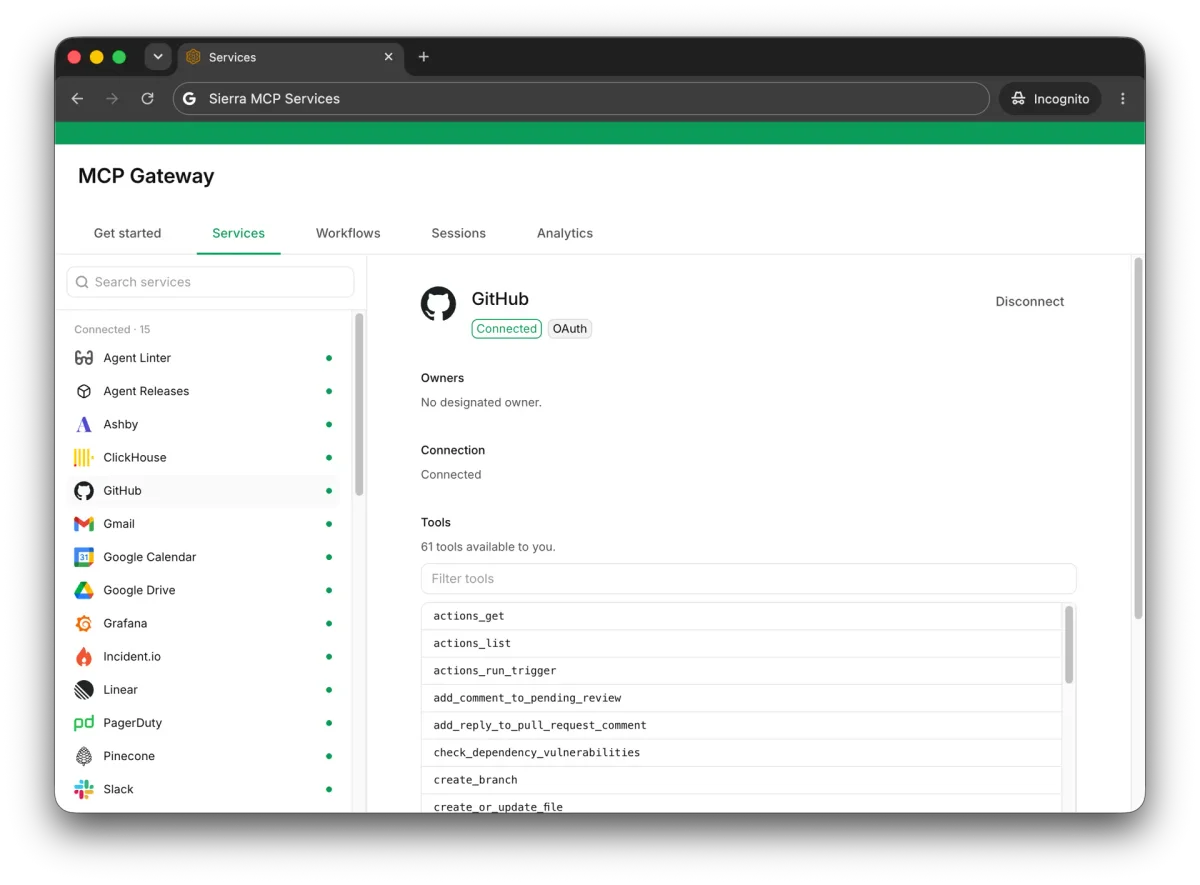
Sierra's MCP Gateway addresses this by inheriting employee access permissions, enforcing policies, isolating data, and maintaining audit trails.
Pinecone leverages models like Claude Code and Codex, routing tasks to the most suitable model for planning, coding, or prose. The enduring advantage lies not in owning the models, but in controlling the context, workflows, and routing layer.
They are experimenting with agents that reflect on their daily work and propose self-improvements, aiming for agents that learn from the business.
The Agent as UI
Every work process culminates in an artifact, a pull request for engineers, a customer story, a contract, a pitch deck. These artifacts serve as both input and output for agents.
When asked to refine a pitch deck, Pinecone returns the updated deck, not just instructions.
Sierra advocates for integrating with existing systems of record rather than replacing them. GitHub remains the source for PRs, Salesforce for accounts. The agent acts as a unifying layer.
This approach avoids the complexity of recreating mature software and prevents the fragmentation of workflows between agent-based and direct tool usage.
Outcomes Over Activity
Since its inception in March, Pinecone has handled over 75,000 sessions for 600+ users, with 70% of PRs opened through it. Hundreds of automations run silently.
While adoption metrics like sessions and tool calls are initial indicators, they represent activity, not true outcome. High usage doesn't guarantee improved downstream results, such as faster deal closures or quicker customer issue resolution.
Tracking token usage is a starting point for habit formation, but the ultimate goal is measuring tangible business impact. Sierra acknowledges this measurement gap is the next frontier.
The original 10x productivity gap identified in 1968 is now addressable by equipping everyone with AI agents, not by solely hunting for rare talent.
The objective extends beyond mere task completion to freeing up human capacity for judgment, creativity, and relationship-building.


