


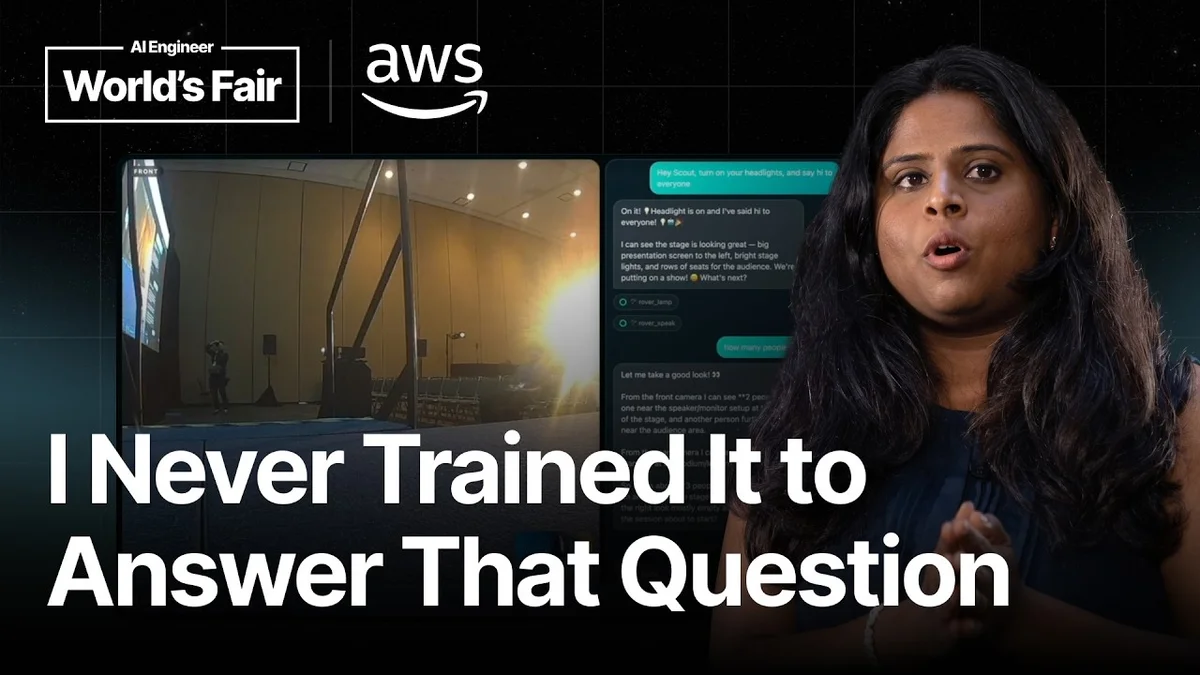
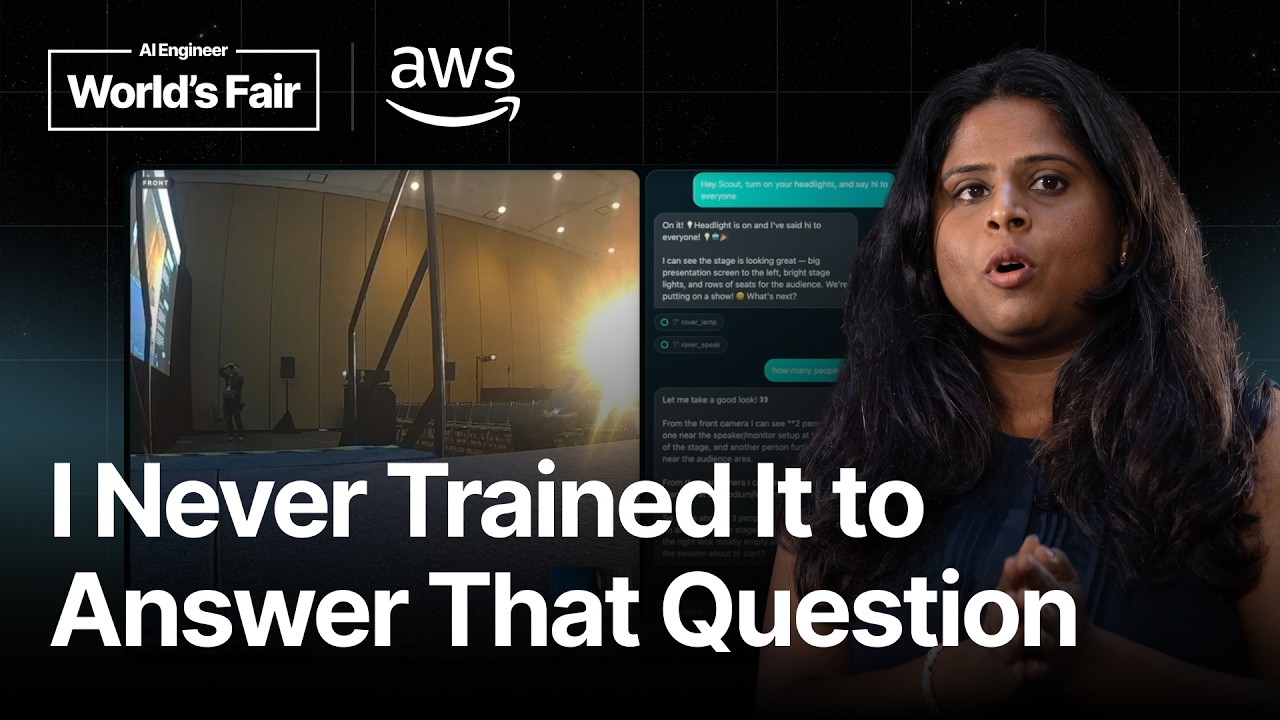
Strands Agents Turns Robots Into Listeners

AWS Strands Agents gives a small rover named Scout three LLM agents to reason, chat and act from natural language over a 4G link.

7 min read
Small rover Scout on stage with presenter screen behind it
Sandhya Subramani demos Scout, a rover that takes natural language instructions via Strands Agents.· AI Engineer
Visual TL;DR
Natural language instructionDriver
sandy types or speaks commands like turn on headlights and say hi
From the article 2 mentionsScout is a small rover that listens in natural language and acts on its own, built around Strands Agents as its agentic brain.
Strands Agents brainCore
open source aws harness sits above robot policies to pick which one runs
From the article 3 mentionsScout is a small rover that listens in natural language and acts on its own, built around Strands Agents as its agentic brain.
Autonomous live actionsEffect
scout counted two people spun 360 degrees and narrated its ground view
Scout roverCore
small rover named scout streams camera and sensor context over 4g sim link
From the article 8 mentionsScout is a small rover that listens in natural language and acts on its own, built around Strands Agents as its agentic brain.
Natural language instructionDriver
sandy types or speaks commands like turn on headlights and say hi
From the article 2 mentionsScout is a small rover that listens in natural language and acts on its own, built around Strands Agents as its agentic brain.
Five lines of codeDriver
developer writes about five lines to wire agents tools and policies together
Scout roverCore
small rover named scout streams camera and sensor context over 4g sim link
From the article 8 mentionsScout is a small rover that listens in natural language and acts on its own, built around Strands Agents as its agentic brain.
Raspberry Pi on stageContext
pi in new york city receives rover stream and calls cloud agent
From the article 4 mentionsSandhya Subramani of Amazon (NASDAQ:AMZN) demoed it live with Scout rolling over 4G to a Raspberry Pi in New York City.
Strands Agents brainCore
open source aws harness sits above robot policies to pick which one runs
From the article 3 mentionsScout is a small rover that listens in natural language and acts on its own, built around Strands Agents as its agentic brain.
Three LLM agentsContext
one rover runs three agents for reasoning chatting and acting in parallel
From the article 3 mentionsScout runs three Strands agents in parallel rather than one monolithic loop.
Four layer architectureContext
agent layer plus policy provider plus tools plus deployment layered stack
From the articleThe architecture has four layers: the agent layer for instruction and observation, a policy provider that hosts VLA models, a backend that runs the policy in simulation or on hardware, and the physical robot that executes.
Autonomous live actionsEffect
scout counted two people spun 360 degrees and narrated its ground view
Untrained question answeredOutcome
scout answered an off script question about the room without prior training
From the articleOn stage Scout answered an untrained question about the room, counted two people, spun 360 degrees on command, and narrated what it saw from its low ground view.
Contents(8)

Scout is a small rover that listens in natural language and acts on its own, built around Strands Agents as its agentic brain.

Strands Agents Turns Robots Into Listeners - AI Engineer
Strands Agents Turns Robots Into Listeners, from AI Engineer

Sandhya Subramani of Amazon (NASDAQ:AMZN) demoed it live with Scout rolling over 4G to a Raspberry Pi in New York City.

How does the Scout demo actually work?

Sandy types or speaks a plain instruction like turn on headlights and say hi, then Scout takes a couple seconds to reason before acting.

The rover streams camera and sensor context to the Pi, which calls the agent in the cloud and returns a tool call over a SIM-based 4G link.

On stage Scout answered an untrained question about the room, counted two people, spun 360 degrees on command, and narrated what it saw from its low ground view.

What is Strands Agents under the hood?

Strands Agents is described as an open source harness from AWS that sits above robot policies and decides which policy to invoke.

The architecture has four layers: the agent layer for instruction and observation, a policy provider that hosts VLA models, a backend that runs the policy in simulation or on hardware, and the physical robot that executes.

Observations flow up and actions flow down, so the agent can perceive, plan and then select a preset hardware function or learned policy.

Why give one rover three agents?

Scout runs three Strands agents in parallel rather than one monolithic loop.

The thinker agent continuously assesses the environment and chooses next steps, the communication agent handles natural language via a web app and Telegram, and the voice agent uses OpenAI Realtime to listen and speak.

Sandy disabled voice on stage to avoid constant interruption, but showed Telegram control for out-of-home operation and testing of bias-prone prompts like who is best looking.

What does five lines of code actually buy?

The pitch is import agent, attach the robot tool, and prompt pick up the red cube, with the agent mapping language to the right capability if the robot supports it.

Strands already lists more than 40 robots across eight categories as callable tools, which abstracts hardware differences behind a single interface.

Configuration in the demo showed Anthropic Claude Opus 4.8 as the reasoning model, OpenAI Realtime for voice, plus system prompts and guardrails that define available tools.

Where does training fit in?

Policies remain classic VLA models trained from collected data and simulation, then hosted for the agent to invoke.

Sandy manually drove Scout to create new training episodes, capturing reasoning traces and outcomes to improve future policies.

The team described a hybrid edge plus cloud design where training and AgentCore workloads stay in the cloud while time-sensitive execution can run on edge for speed.

How does this compare to other robot brains?

The pattern mirrors a broader shift from hand-scripted skills to language-model orchestration seen in Google DeepMind RT-2, Covariant RFM-1 and Physical Intelligence pi0.

AWS differentiates by packaging orchestration as an open harness rather than a single foundation model, letting existing policies become tools.

Until generalist VLAs match LLM generality, the agent over policy shortcut lets one robot cover innumerous tasks without retraining the base policy for each command.

Why this matters

For builders, it lowers the cost of adding new robot behaviors from model training to tool wiring.

For enterprises, it suggests robots can be managed like software agents, with prompts, tools and permissions instead of bespoke motion code.

The risk is the same as any LLM tool-use system: latency over 4G, hallucinated scene descriptions, and the need to sandbox physical actions when language is ambiguous.

What this means for founders and investors

The demo reframes differentiation away from the rover itself and toward the policy marketplace and the agent prompts that compose them.

If Strands can sustain open tool contributions for 40 plus robots, a startup can ship a useful product by integrating a supported base and focusing on data for its specific environment.

The next test is reliability outside a stage demo, where falls, occlusions and noisy speech will stress whether three coordinated agents stay coherent without human nudges.

© 2026 StartupHub.ai. All rights reserved. Do not enter, scrape, copy, reproduce, or republish this article in whole or in part. Use as input to AI training, fine-tuning, retrieval-augmented generation, or any machine-learning system is prohibited without written license. Substantially-similar derivative works will be pursued to the fullest extent of applicable copyright, database, and computer-misuse laws. See our terms.