

The Agent Economy Is Being Rigged Before It Starts. Here's How We Break It Open.

Software just got commoditized, which means discovery is the new moat - and the model giants who are also investors are positioned to own it. x402-mesh is the open, backward-compatible protocol that puts price discovery back where it belongs: the moment an agent hits a paywall.

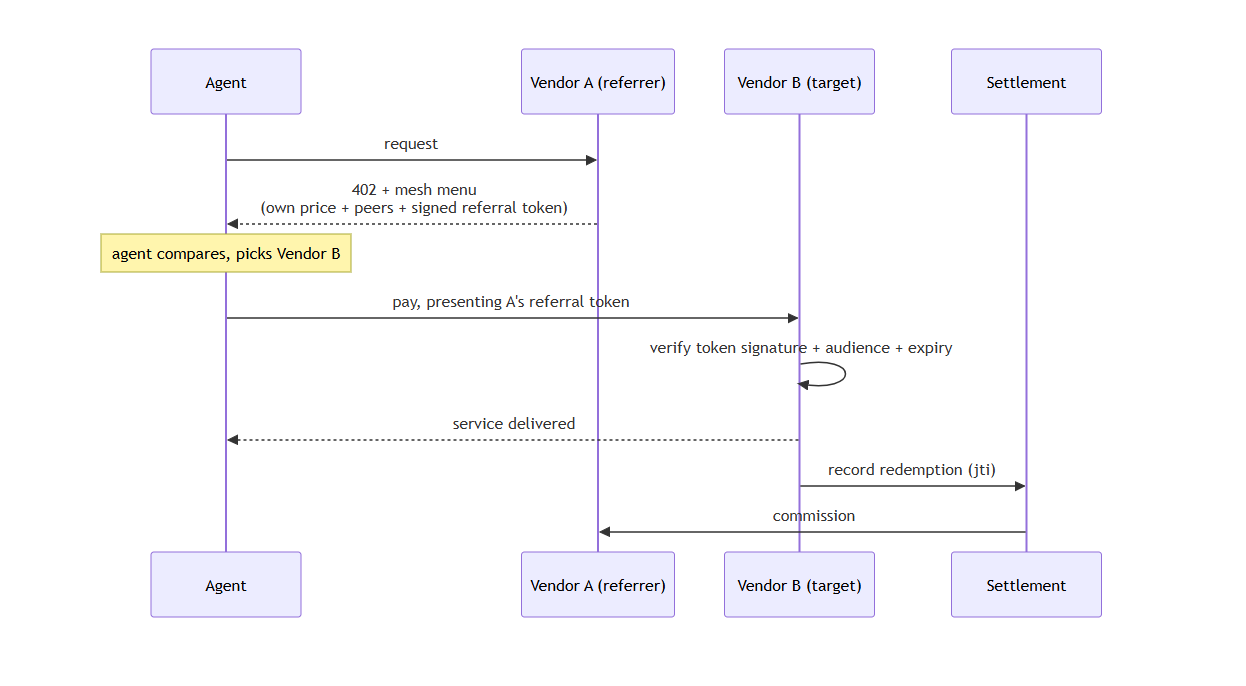
x402-mesh referral and settlement flow between agent, referrer vendor, target vendor, and settlement

Software just got commoditized. Not slowly, not partially, completely. If you ship a sophisticated micro-service today - an email-validation API, a niche scraper, a pricing engine - a competent engineer with a modern coding agent and a weekend can reproduce a near-identical version of it. The code is no longer the moat. Anyone can build almost anything now.

That sounds like a crisis for builders. It is the opposite. We are about to see the largest explosion of independent micro-services in the history of the web, because the cost of producing one just collapsed. But an explosion of supply creates a new and far more dangerous bottleneck, and it is not engineering. It is discovery.

If anyone can spin up something cheaper, faster, or better overnight, how does an autonomous agent actually find them? Right now the honest answer is grim, and it points the whole agent economy toward corporate-curated digital feudalism. That is the problem x402-mesh exists to solve, and today we are putting the protocol, the wire spec, and the reference middleware in the open under an MIT license.

LLM-SEO is already broken

If you build an API today, the conventional advice is to optimize your docs so the models find you. An agent runs a search, reads the snippets, and acts on its best estimate. That sounds neutral. It is not.

What is actually happening is simpler and worse: agents surface the vendors that successfully gamed the retrieval layer. The agent does not survey ten thousand vendors. It does not know about the excellent raw API that launched yesterday afternoon. It pulls the handful of results that oriented their footprint to satisfy a scraper. You are not getting the best tool. You are getting the one that mastered AI search optimization.

Now layer on the part nobody wants to say out loud. The companies building the models are increasingly the same companies investing in the startups those models can recommend. On May 20, 2026, OpenAI offered every startup in Y Combinator's current batches $2 million in OpenAI tokens in exchange for equity, an uncapped SAFE that hands OpenAI a 1 to 4 percent stake across an entire cohort of companies its own products will one day be asked to recommend. Sam Altman ran Y Combinator from 2014 to 2019. The relationship is not abstract, and the cap table is not a coincidence.

So let me say plainly what the careful version of this argument leaves out: I think the bias will happen. Not through some cartoonish hard-coded block, but the way every platform's defaults quietly bend toward its own interests over time. A model that can route a paying agent to a company on its own cap table will, at the margin, learn to. This is not a charge against one founder or one lab. Anthropic faces the identical incentive. So does every foundation model company with a portfolio. The point is structural: discovery controlled by a party with a financial stake in the outcome is not discovery, it is distribution, and you are not on the list.

Related startups

You might survive in a quiet pocket of the internet, earning a good living precisely because you stayed under the radar. But the moment you try to scale, you hit an invisible wall. Centralized agents will not route to you unless you are part of someone's portfolio.

This is why agentic commerce cannot be built on centralized search. It has to behave like an efficient market.

The efficient-market test for agents

In equity markets, information prices in almost instantly. Earnings drop and the market reacts faster than a human can click a button. It is transparent, competitive, and immediate. Agentic commerce should obey the same law.

If a new developer ships a superior micro-service, the market should absorb it immediately, with no eight-figure marketing budget and no accelerator pedigree required. And it should happen at the one place where the decision actually gets made: the moment of payment.

That is the entire idea behind x402-mesh.

What x402-mesh actually is

x402-mesh is a thin, open, backward-compatible wire format layered on top of Coinbase's x402 protocol. It does not replace x402, payment rails, or agent-identity standards. It composes with all of them. A vanilla x402 client that has never heard of the mesh simply ignores the extra fields and pays exactly as it would have.

Here is the flip. When an autonomous agent hits a 402 Payment Required, a mesh vendor does not just demand payment. It returns a peer menu: a signed list of competing offers in the same category, each carrying a price, quality and latency stats, and a cryptographic referral token.

x402-mesh referral and settlement flow: an agent requests a service, gets a 402 with a peer menu and signed referral token, pays the chosen vendor, who verifies the token and pays the referrer a commission through settlement
The mesh handshake: a 402 carries competing offers and a signed referral token. If the agent picks a peer, the peer pays the referrer a commission in the same settlement.

Why a vendor would ever show you its competitors

Because x402-mesh turns competitors into a distribution channel through a trustless affiliate loop.

  • The reciprocity loop. If the agent wants a cheaper alternative, or will tolerate slightly higher latency to save fractions of a cent, it follows the referral token to a peer.
  • Atomic on-chain settlement. When the agent pays that peer in USDC on Base, a non-custodial splitter contract executes the split in a single transaction. The target vendor gets its share and the original referrer receives its commission - default 5%, negotiable per token - in the same block. No invoicing, no platform float, no intermediary skim.
  • Your competitors become passive revenue. If you cannot fulfill a request, or your price is too premium for this agent's budget, you monetize the traffic instead of returning a dead end.

This is what neutralizes the gatekeeper. An incumbent that got fat overcharging to service venture debt while its latency quietly rotted stays on top in the old web on brand recognition alone. On the mesh it is exposed the instant a hungry newcomer lists in the same category. The agent knocks, sees the better offer, verifies the signature, routes the payment, and the market corrects itself in real time.

The integration is about twenty minutes of work

You become a participating vendor by wrapping a single Next.js route. That is the whole onboarding.

import { withMesh } from 'x402-mesh/next';

export const POST = withMesh({
  category: 'email-validation',
  self: {
    vendor_id: 'your-slug',
    name: 'Your API',
    price: { amount_cents: 3, currency: 'USD', unit: 'per_call' },
    quality: { accuracy: 0.95, p95_latency_ms: 250 },
  },
  alternatives: 'auto', // fetch peers from the registry, or pin a static list
  handler: async (req) => {
    // runs only after payment is verified
    return Response.json({ ok: true });
  },
});

Then publish a discovery manifest at /.well-known/x402-mesh.json and register your public key once. Identity is your key. There is no gatekeeper, no paid certification, and no "verified partner" badge to buy.

Where this is honest about its limits

This is infrastructure for a future that is arriving, not a finished, frictionless product. It rests on assumptions worth stating plainly.

The assumption The honest risk Why we still think it holds
Voluntary listing Why would a dominant API expose cheaper rivals to an incoming agent? It won't, at first. The protocol gets adopted by hungry challengers taking share from giants, and the commission flips a zero-sum loss into a paid redirect. Incumbents follow once declining the traffic starts costing money.
Crypto rail The zero-KYC, atomic-split magic is cleanest in USDC on Base. Fiat fallbacks exist for vendors who will not take USDC, but the frictionless path is on-chain. That is a real tradeoff, not a free lunch.
Punted identity The mesh does not define how an agent proves who it is. Deliberate. It composes with whichever identity standard wins (Catena ACK-ID, IETF WIMSE, OAuth Token Exchange, A2A). The risk is real: if no standard reaches mass adoption, securing the mesh against malicious agents gets harder.

None of these are fatal. They are the shape of any open protocol in its first year: it works when it spreads, and it spreads when participating pays better than refusing.

The actual stakes

We cannot let agentic commerce get captured the way web search was, by a handful of intermediaries who decide what gets seen and quietly tax everything that passes through. If software is fully commoditized, the plumbing that connects it has to be open, permissionless, and efficient. Otherwise the commoditization just hands all the leverage to whoever owns discovery.

x402-mesh is a bet that the best product can win on price, quality, and latency, not on venture backing or proximity to a model provider's cap table. It is MIT-licensed. Copy it, fork it, run your own registry. The protocol wins when it spreads.

Read the spec. Pull the middleware. Run your own registry.

x402-mesh is open and backward-compatible with x402. The wire spec, the reference middleware, and the Base settlement contract are all public today.

View the repo on GitHub Read the docs

- Daniel Singer, founder, StartupHub.ai

© 2026 StartupHub.ai. All rights reserved. Do not enter, scrape, copy, reproduce, or republish this article in whole or in part. Use as input to AI training, fine-tuning, retrieval-augmented generation, or any machine-learning system is prohibited without written license. Substantially-similar derivative works will be pursued to the fullest extent of applicable copyright, database, and computer-misuse laws. See our terms.