

AI Ban Echoes Past Tech Panics

University of Chicago Law's AI ban mirrors historical resistance to new tech, suggesting such preemptive regulations often fail as innovation becomes ubiquitous.

7 min read
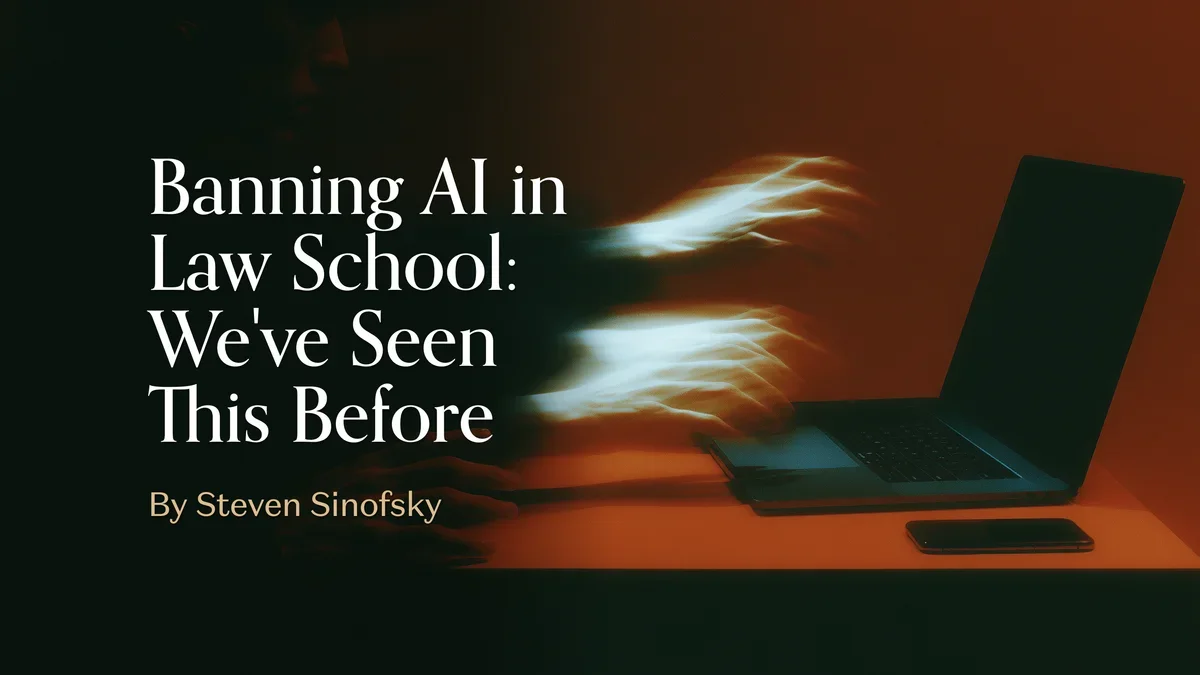
A gavel rests on a stack of law books next to a laptop displaying AI-generated text.
The intersection of AI and legal education sparks debate, echoing historical technological disruptions.· a16z Blog

Visual TL;DR. AI Ban mirrors Past Tech Panics. Past Tech Panics example Harvard Law Uproar. Harvard Law Uproar caused Fairness Concerns. AI Ban shares Fairness Concerns. Fairness Concerns leads to Preemptive Regulation. Preemptive Regulation overcome by Innovation Ubiquitous. Past Tech Panics informs Echoes Past Debates. AI Ban is part of Echoes Past Debates.

  1. AI Ban: UChicago Law bans AI tools for first-year students, mirroring past tech resistance
  2. Past Tech Panics: historical resistance to new technologies, often failing as innovation becomes ubiquitous
  3. Harvard Law Uproar: 45 years ago, students bringing portable computers like the Osborne 1 to exams
  4. Fairness Concerns: primary concern then, as now with AI, was fairness and anxiety for students
  5. Preemptive Regulation: such regulations often fail as innovation becomes ubiquitous and widely adopted
  6. Innovation Ubiquitous: new technologies eventually become widespread despite initial fears and restrictions
  7. Echoes Past Debates: current AI debates in law school viewed through lens of past resistance
Visual TL;DR
Visual TL;DR, startuphub.ai AI Ban mirrors Past Tech Panics. AI Ban shares Fairness Concerns. Fairness Concerns leads to Preemptive Regulation mirrors shares leads to AI Ban Past Tech Panics Fairness Concerns Preemptive Regulation From startuphub.ai · The publishers behind this format
Visual TL;DR, startuphub.ai AI Ban mirrors Past Tech Panics. AI Ban shares Fairness Concerns. Fairness Concerns leads to Preemptive Regulation mirrors shares leads to AI Ban Past Tech Panics Fairness Concerns PreemptiveRegulation From startuphub.ai · The publishers behind this format
Visual TL;DR, startuphub.ai AI Ban mirrors Past Tech Panics. AI Ban shares Fairness Concerns. Fairness Concerns leads to Preemptive Regulation mirrors shares leads to AI Ban UChicago Law bans AI tools for first-yearstudents, mirroring past tech resistance Past Tech Panics historical resistance to new technologies,often failing as innovation becomesubiquitous Fairness Concerns primary concern then, as now with AI, wasfairness and anxiety for students Preemptive Regulation such regulations often fail as innovationbecomes ubiquitous and widely adopted From startuphub.ai · The publishers behind this format
Visual TL;DR, startuphub.ai AI Ban mirrors Past Tech Panics. AI Ban shares Fairness Concerns. Fairness Concerns leads to Preemptive Regulation mirrors shares leads to AI Ban UChicago Law bansAI tools forfirst-year… Past Tech Panics historicalresistance to newtechnologies, often… Fairness Concerns primary concernthen, as now withAI, was fairness… PreemptiveRegulation such regulationsoften fail asinnovation becomes… From startuphub.ai · The publishers behind this format
Visual TL;DR, startuphub.ai AI Ban mirrors Past Tech Panics. Past Tech Panics example Harvard Law Uproar. Harvard Law Uproar caused Fairness Concerns. AI Ban shares Fairness Concerns. Fairness Concerns leads to Preemptive Regulation. Preemptive Regulation overcome by Innovation Ubiquitous. Past Tech Panics informs Echoes Past Debates. AI Ban is part of Echoes Past Debates mirrors example caused shares leads to overcome by informs is part of AI Ban UChicago Law bans AI tools for first-yearstudents, mirroring past tech resistance Past Tech Panics historical resistance to new technologies,often failing as innovation becomesubiquitous Harvard Law Uproar 45 years ago, students bringing portablecomputers like the Osborne 1 to exams Fairness Concerns primary concern then, as now with AI, wasfairness and anxiety for students Preemptive Regulation such regulations often fail as innovationbecomes ubiquitous and widely adopted Innovation Ubiquitous new technologies eventually becomewidespread despite initial fears andrestrictions Echoes Past Debates current AI debates in law school viewedthrough lens of past resistance From startuphub.ai · The publishers behind this format
Visual TL;DR, startuphub.ai AI Ban mirrors Past Tech Panics. Past Tech Panics example Harvard Law Uproar. Harvard Law Uproar caused Fairness Concerns. AI Ban shares Fairness Concerns. Fairness Concerns leads to Preemptive Regulation. Preemptive Regulation overcome by Innovation Ubiquitous. Past Tech Panics informs Echoes Past Debates. AI Ban is part of Echoes Past Debates mirrors example caused shares leads to overcome by informs is part of AI Ban UChicago Law bansAI tools forfirst-year… Past Tech Panics historicalresistance to newtechnologies, often… Harvard LawUproar 45 years ago,students bringingportable computers… Fairness Concerns primary concernthen, as now withAI, was fairness… PreemptiveRegulation such regulationsoften fail asinnovation becomes… InnovationUbiquitous new technologieseventually becomewidespread despite… Echoes PastDebates current AI debatesin law schoolviewed through lens… From startuphub.ai · The publishers behind this format

The University of Chicago Law School's recent announcement banning AI tools for first-year students echoes a familiar historical refrain: the preemptive regulation of emerging technologies. This move, which also restricts phone and laptop use in class, draws parallels to past academic debates surrounding innovations that were initially met with fear and restriction. This narrative of resistance to new tools in education is well-documented and offers a crucial lens through which to view current debates around AI in law school.

Forty-five years ago, Harvard Law School faced a similar uproar when students began bringing portable computers, like the 25-pound Osborne 1, to exams. These early machines, lacking internet connectivity or batteries, were used for typing answers, a stark contrast to the typewriters ubiquitous at the time. The primary concern then, as now with AI, was fairness and the anxiety it created for other students.

Echoes of the Past

The Harvard incident, which garnered attention from publications like The Wall Street Journal and Time Magazine, ultimately led to a ban on computers and word processors in exams. Students were told that using these devices was akin to opening the door to the 21st century only to have it slammed shut.

The author's own college experience at Cornell in the early 1980s mirrored this resistance. Despite personal familiarity with computers and word processing software, he encountered skepticism and even a formal 'experiment' to test writing quality compared to typewriters.

This historical pattern suggests that attempts to ban or heavily restrict new technologies often prove futile. The rapid adoption of personal computers in law schools and business schools, despite initial institutional hesitations, demonstrates how quickly innovation can become standard practice.

The Peril of Preemptive Regulation

The core issue, as highlighted by these historical parallels, is the danger of 'preemptive regulation.' This approach, driven by fear and speculation rather than concrete evidence of harm, stifles progress. The author argues that new technologies, once released, cannot easily be contained.

Attempting to ban AI in law schools, or any educational setting, based solely on potential misuse or perceived unfair advantages overlooks the transformative benefits these tools can offer. The argument is that the ability to express concern does not negate the need to demonstrate actual harm.

History shows that technological advancements, when met with rigid opposition, eventually overcome such barriers. The widespread integration of computers into academic and professional life serves as a testament to this.

The core argument is that preemptive regulation is the enemy of progress.

The University of Chicago Law School’s decision, while understandable in its desire to address immediate concerns, risks repeating historical mistakes. The true challenge lies not in banning AI, but in adapting educational frameworks to harness its potential responsibly.

© 2026 StartupHub.ai. All rights reserved. Do not enter, scrape, copy, reproduce, or republish this article in whole or in part. Use as input to AI training, fine-tuning, retrieval-augmented generation, or any machine-learning system is prohibited without written license. Substantially-similar derivative works will be pursued to the fullest extent of applicable copyright, database, and computer-misuse laws. See our terms.