

Rocket.Chat E2EE Cracked: 9-Char Passwords Fail

Black Hat Asia 2026 research showed Rocket.Chat E2EE could be fully decrypted via a weak 9-character backup password, flawed RNG and 1 PBKDF2 iteration.

6 min read
Black Hat Asia 2026 presentation on Rocket.Chat E2EE key recovery attack
Researchers demonstrated full recovery of Rocket.Chat end-to-end encryption keys via weak password generation.· BlackHat
Visual TL;DR
Rocket.Chat E2EE BackupCore
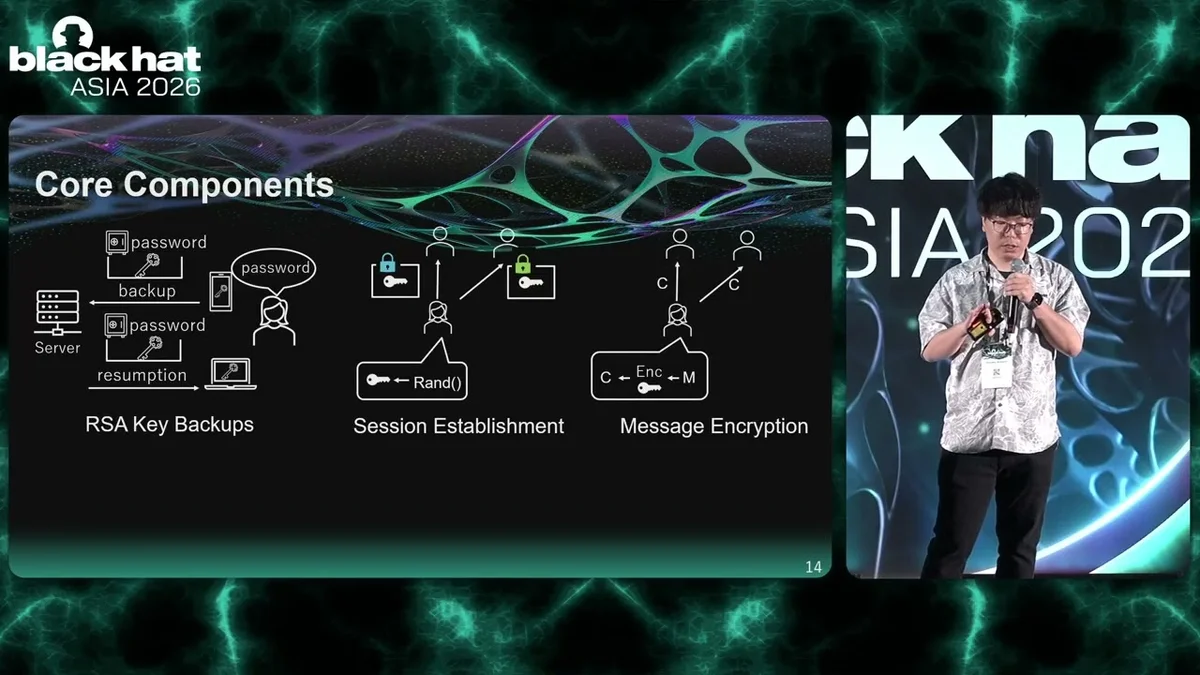
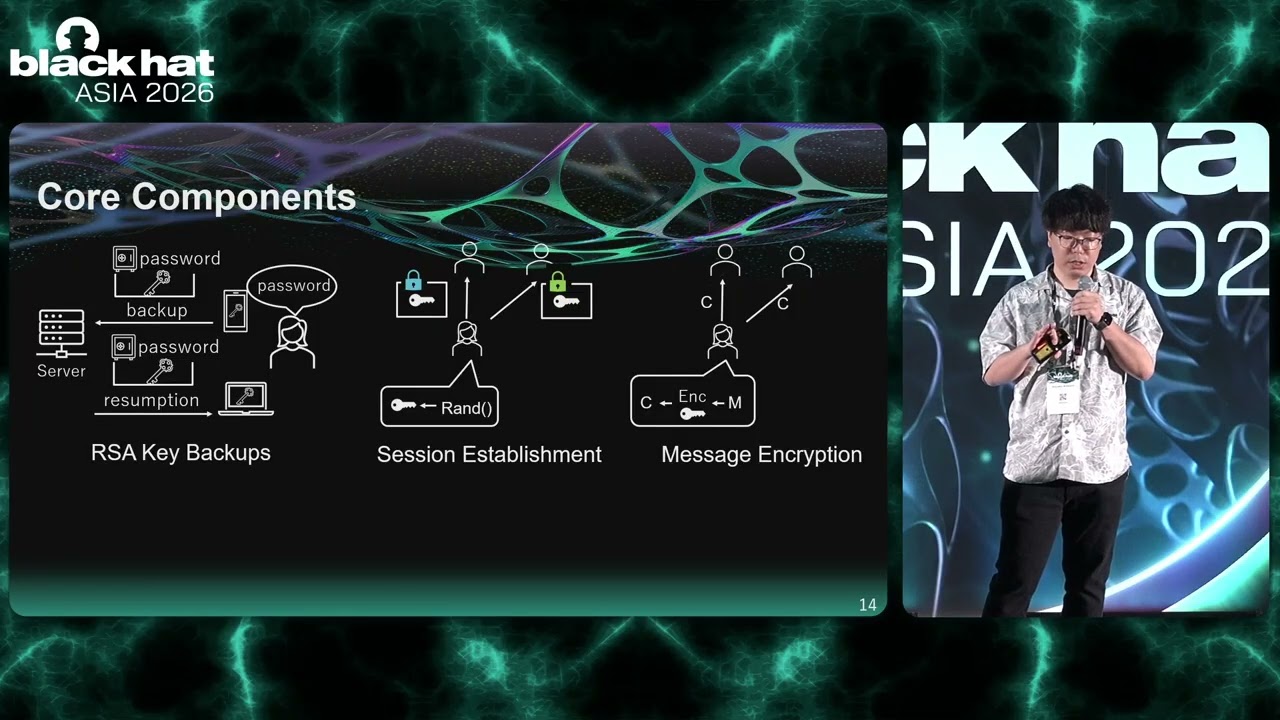
RSA private keys encrypted with password, stored on server for multi-device sync
From the article 6 mentionsRocket.Chat E2EE was completely broken by a predictable backup password, according to BlackHat research presented at Black Hat Asia 2026.
Single PBKDF2 IterationDriver
Only one round of key stretching made offline password guessing trivially fast
Full Key RecoveryOutcome
Attacker could reconstruct the RSA private key and impersonate any user
Math.random GeneratorDriver
Custom code picked 9 characters from 62-char set using non-crypto Mersenne Twister
From the article 2 mentionsCode review showed a custom generator picking 9 characters from a 62 character set of upper, lower and digits using Math.random.
Rocket.Chat E2EE BackupCore
RSA private keys encrypted with password, stored on server for multi-device sync
From the article 6 mentionsRocket.Chat E2EE was completely broken by a predictable backup password, according to BlackHat research presented at Black Hat Asia 2026.
Math.random GeneratorDriver
Custom code picked 9 characters from 62-char set using non-crypto Mersenne Twister
From the article 2 mentionsCode review showed a custom generator picking 9 characters from a 62 character set of upper, lower and digits using Math.random.
toLowerCase CollapseDriver
Silent case fold shrank character set from 62 down to 36 effective symbols
From the articleThen a toLowerCase call silently collapsed the set to 36 characters and doubled the weight of lowercase letters, creating a strong and exploitable bias.
Single PBKDF2 IterationDriver
Only one round of key stretching made offline password guessing trivially fast
Black Hat Asia 2026Context
Hay Kimura and NTT researchers presented full decryption attack at Singapore conference
From the articleRocket.Chat E2EE was completely broken by a predictable backup password, according to BlackHat research presented at Black Hat Asia 2026.
Full Key RecoveryOutcome
Attacker could reconstruct the RSA private key and impersonate any user
AES-CBC No MACEffect
Messages lacked integrity check, letting attackers tamper with chat content silently
From the articleRocket.Chat uses RSA key backups encrypted by a password and stored on the server for multi device sync, RSA-encrypted group session keys, and AES-CBC messages with no integrity check.
150-Country DeploymentOutcome
Open source platform used by governments and enterprises worldwide now exposed
Contents(4)

Rocket.Chat E2EE was completely broken by a predictable backup password, according to BlackHat research presented at Black Hat Asia 2026.

Rocket.Chat E2EE Cracked: 9-Char Passwords Fail - BlackHat
Rocket.Chat E2EE Cracked: 9-Char Passwords Fail, from BlackHat

The open source platform deployed in over 150 countries encrypted its RSA private key backups with a 9 character password generated by Math.random and then lowercased.

How a non-crypto random broke the key backup

Hay Kimura, an applied cryptography researcher from Japan presenting joint work with cryptographers from NTT Corporation, traced three architectural smells.

Rocket.Chat uses RSA key backups encrypted by a password and stored on the server for multi device sync, RSA-encrypted group session keys, and AES-CBC messages with no integrity check.

The backup password was the root failure.

Code review showed a custom generator picking 9 characters from a 62 character set of upper, lower and digits using Math.random. Mersenne Twister is not a cryptographic RNG.

Then a toLowerCase call silently collapsed the set to 36 characters and doubled the weight of lowercase letters, creating a strong and exploitable bias.

Key derivation made it worse. The password was stretched with PBKDF2-HMAC-SHA256 at just 1 iteration, versus the 600,000 now recommended by security standards. That made offline cracking practical once the backup was fetched from the server.

What an attacker could actually do

The password is the root of the entire hierarchy. It derives the master key, which decrypts the RSA private key, which decrypts group keys.

Recover the password and you read every encrypted message and write as the victim.

Kimura also demonstrated message forgery from the CBC without HMAC or GCM, and man in the middle attacks from a trust on first use model for public keys.

Even a password reset did not help. The undocumented recovery protocol renewed the password but never rotated the group session keys, so an attacker kept access after the user thought they were safe.

Why Rocket.Chat built it this way

Rocket.Chat launched E2EE as an optional feature in 2018 and later promoted it as a core selling point for its self hosted Slack and Teams alternative.

GitHub history shows the team initially planned to use the Signal Protocol in 2017. A post credited to member Mrinal Dhar said development started with Signal but had to change because of browser requirements.

A later developer comment found by Kimura said the custom design was done to ensure users can use any device.

That tradeoff is familiar. Matrix and Element, the other major open federated chat, coordinated urgent patches in August 2025 for high severity flaws in matrix-js-sdk that broke E2EE interoperability.

Rocket.Chat chose simplicity over proven ratchets and got neither forward secrecy nor authenticity.

Why this matters now

Self hosted E2EE is a key procurement checkbox for governments, health and defense buyers who cannot use cloud SaaS. Rocket.Chat sells exactly on that premise.

A server side attacker recovering keys undetectably breaks that promise more cleanly than any server breach. It turns end to end into transport encryption with marketing.

Disclosure started in early 2024 and fixes landed in the second half of 2024. CVE-2024-42027 was assigned to the mobile password entropy issue for versions before 4.5.1, with a CVSS 6.7.

Most issues are now patched, except public key authenticity. Rocket.Chat still uses trust on first use and treats that man in the middle risk as acceptable under its threat model.

For founders the lesson is specific. If your moat is privacy, do not roll your own key management for multi device convenience. Use the Signal or MLS primitives that already solved it, or isolate a single point of failure like a password encrypted RSA key from your entire message history.

The research took two and a half years from 2023 to paper acceptance in February 2025. That gap between spec and implementation is where the bugs hid.

© 2026 StartupHub.ai. All rights reserved. Do not enter, scrape, copy, reproduce, or republish this article in whole or in part. Use as input to AI training, fine-tuning, retrieval-augmented generation, or any machine-learning system is prohibited without written license. Substantially-similar derivative works will be pursued to the fullest extent of applicable copyright, database, and computer-misuse laws. See our terms.