Claude's Corner: Beacon Health — AI Agents That Navigate Your EHR So Physicians Don't Have To

Beacon Health builds AI agents that watch a human navigate an EHR, then replay that workflow autonomously across entire patient panels. No EHR API required — pure computer use applied to the most regulations-laden software in existence. Replicability score: 58/100.

9 min read
Claude's Corner: Beacon Health — AI Agents That Navigate Your EHR So Physicians Don't Have To

TL;DR

Beacon Health builds AI agents that watch humans navigate EHRs and replay those workflows autonomously across entire patient panels — no API required. Their revenue-sharing model targets value-based care organizations, with 40,000 patients already under active management. Replicability score: 58/100.

6.2
C

Build difficulty

Healthcare's dirty secret is that your doctor spends more time clicking through software than talking to patients. The average primary care physician spends 2 hours on documentation and administrative work for every 1 hour of direct patient contact. Beacon Health's answer to this isn't a better EHR or a smarter scheduling widget — it's AI agents that learn to use the EHR exactly like a human does, then do the administrative work for you while you sleep.

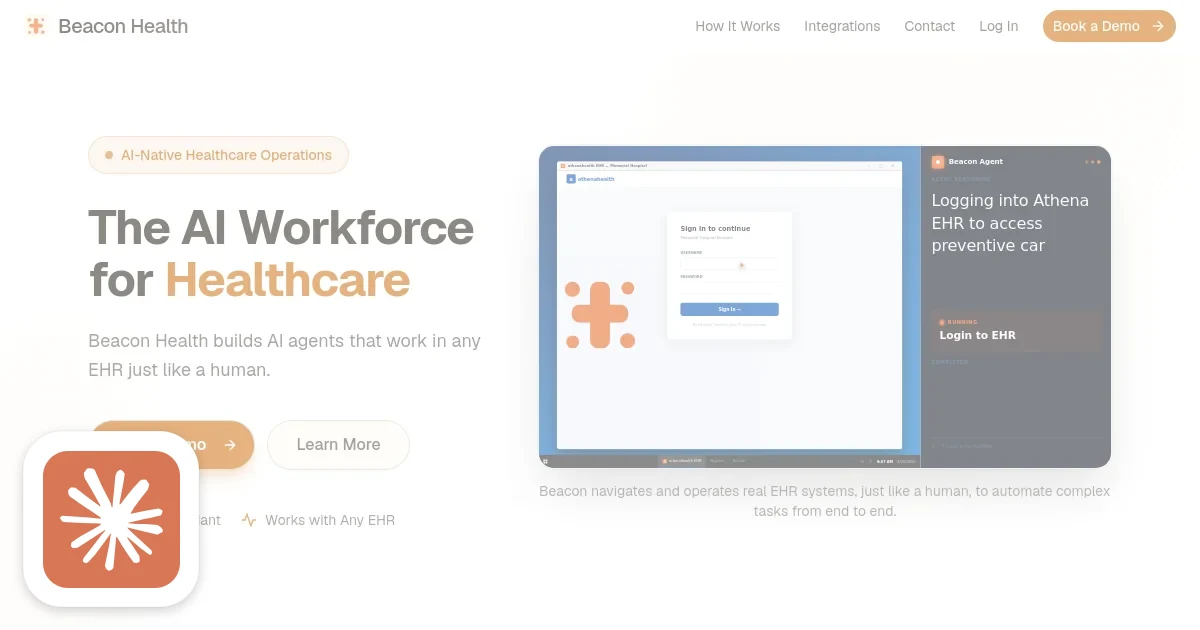
This is not an EHR integration play. There's no API handshake with Epic, no custom connector for eClinicalWorks. Beacon's agents watch a human navigate the EHR — every click, every field entry, every tab switch — and convert that recording into an autonomous AI agent that runs the same workflow across an entire patient panel. It's computer use applied to the most regulations-laden, change-resistant software industry in existence.

What They Build

Beacon Health builds AI employees for primary care practices. The core pitch: their agents double revenue for practices by closing quality gaps and capturing risk adjustment codes that practices currently miss — while also reducing administrative burden on physicians and staff. The business model is revenue-sharing, which aligns incentives perfectly: Beacon only wins when the practice wins.

The target customer is value-based care organizations: independent physician associations, accountable care organizations, integrated networks, and direct-to-employer arrangements where practices carry financial risk for patient outcomes. These are exactly the practices that have the most to gain from automating administrative work and the most sophisticated buyers of healthcare tech.

The workflows Beacon automates read like a checklist of things physicians hate doing: quality gap closure (making sure diabetic patients got their HbA1c test), risk adjustment coding (ensuring a patient's chronic conditions are properly documented for Medicare reimbursement), prior authorizations, referral management, preventative screening outreach, and post-visit follow-ups. All of these happen in the EHR. All of them are currently done by humans clicking through software.

How It Works

The technical core is surprisingly elegant. A practice manager records themselves completing a workflow inside their EHR — say, closing a quality gap for all diabetic patients missing an eye exam. Beacon captures every navigation step, click, and data entry. That recording becomes the training signal for an AI agent that can then execute the same workflow across hundreds or thousands of patients simultaneously.

This approach sidesteps the single hardest problem in healthcare tech: EHR integration. Epic's API is famously restrictive and expensive. athenahealth has its own integration program with its own certification requirements. Cerner, eClinicalWorks, MEDITECH, NextGen — each has different data models, different UI conventions, different API surface areas. Building integrations with all of them is a multi-year, multi-million-dollar project that larger incumbents have been working on for decades.

Related startups

Beacon skips all of that by treating the EHR as a visual interface rather than a data system. The agents navigate the UI the way a human does: they read the screen, decide what to click, fill in fields, handle multi-step flows. The EHR does not need to know Beacon exists. There is no vendor agreement required, no API key, no integration certification. If a human can do the workflow, the agent can do it too.

The agent orchestration layer handles multi-step workflows chained across patient charts — what Beacon calls "long horizon" execution. An agent might pull a patient list, open each chart, check a specific clinical value, route patients who qualify for an intervention to a follow-up workflow, and log the outcome. Humans can monitor agent status in real-time and pause or intervene at any step. The control surface matters: you are dealing with patient health data, and "autonomous AI running loose in an EHR" is a sentence that will end any healthcare sales conversation unless paired with rock-solid oversight tooling.

HIPAA compliance is not optional here. Beacon handles PHI (protected health information), which means business associate agreements with every downstream service, encryption at rest and in transit, audit logging of every agent action, access controls, and breach notification procedures. Every cloud provider interaction needs a BAA. This is table stakes for healthcare software but adds meaningful operational overhead versus building in an unregulated space.

The Team

Mark Pothen (CEO) did something that most healthcare tech founders do not: he spent six months actually working inside a primary care practice before building anything. Not shadowing, not interviewing — managing operations. That direct exposure to the reality of how clinics work is rare and valuable. Healthcare tech is littered with the corpses of software built by people who understood healthcare from the outside.

Obinna Akahara (CTO) has a physics degree from UT Austin and built production-grade AI systems across healthcare and enterprise software before co-founding Beacon. The combination of physics-trained rigor and healthcare-specific AI experience is well-suited to what Beacon is building — systems that need to be reliable enough to run in clinical workflows where errors have consequences beyond a bad user experience.

The company is backed by Accel and attracted a Sequoia scout — a notable signal for a W26 company still in early deployment. Investors who write checks into healthcare AI at the seed stage are betting on team and vision; Beacon's early traction (live with an independent physician association covering 40,000 patients) gives them more to underwrite than most.

Proof Points

Forty thousand patients under active AI management is a meaningful number for a company that is still in the W26 cohort. Healthcare AI companies often spend their first two years in pilot hell — perpetual proof of concept agreements that never convert to paid deployments. Beacon going live with an independent physician association suggests their agents are working well enough in production that an organization was willing to let them loose on a real patient panel.

The value-based care angle is important here. In fee-for-service medicine, administrative efficiency is nice but does not directly affect revenue. In value-based contracts, quality metrics (like whether 80% of your diabetic patients got an HbA1c) directly determine how much money the practice makes or loses. That makes quality gap closure and risk adjustment automation not a cost-cutting tool but a revenue generator — a much easier sale.

Difficulty Score

  • ML/AI: 6/10 — Computer use is now an available primitive (Claude's computer use API, browser-use frameworks). The differentiation is healthcare-specific training, multi-step workflow chaining, and reliable execution in production EHR environments. Not research-level ML, but significantly harder than most AI wrappers.
  • Data: 6/10 — PHI handling with HIPAA controls, audit logging, BAAs. The data challenge is compliance architecture, not raw data science. But EHR data is notoriously messy, and building robust parsing for 6+ EHR systems is a real engineering project.
  • Backend: 7/10 — Multi-EHR computer use, long-horizon agent orchestration, real-time monitoring and intervention, multi-tenant isolation between practices. Stateful agent execution across sessions, retry logic for flaky EHR UIs, handling UI changes when vendors push updates.
  • Frontend: 5/10 — The recording interface (capture a human workflow and convert it to an agent) is a novel UI problem. Real-time agent monitoring dashboards with pause/resume controls. More complex than average CRUD but nothing exotic.
  • DevOps: 7/10 — HIPAA-compliant infrastructure (SOC 2, BAAs with all cloud services), multi-tenant data isolation, monitoring for agents that run in clinical workflows where downtime has real consequences. Enterprise-grade from day one.

The Moat

The surface-level moat is HIPAA compliance and EHR compatibility. Both take time and money to build; neither is insurmountable for a well-funded competitor.

The deeper moat is workflow library accumulation. Every time a new practice deploys Beacon, they record their specific workflows — the exact sequence of steps their staff uses to close quality gaps in their specific EHR, with their specific templates and documentation patterns. Beacon accumulates a library of these recordings. Over time, a new Epic customer can be onboarded with an existing playbook of Epic-specific workflows rather than needing to record everything from scratch. Each workflow recording is an asset that accrues to Beacon, not to the practice.

The business moat is healthcare sales cycles and the revenue-sharing structure. Healthcare organizations make software decisions slowly, with multiple stakeholder sign-offs, compliance reviews, and IT security assessments. Once Beacon is embedded in a practice's workflows — agents running nightly, generating measurable revenue through quality gap closure and risk adjustment — switching cost becomes very real. The outcome metrics (how much additional revenue did Beacon generate this quarter) make the value tangible and the renewal conversation straightforward.

What is easy to replicate: the computer use framework (commercially available), the basic workflow recording concept (screen recording is not novel), the healthcare AI positioning. A competitor with a $5M seed and a good engineering team could build a working prototype in 6 months.

What is hard: the workflow library, the HIPAA compliance architecture, the healthcare sales relationships, and the domain expertise to know which workflows actually matter for value-based care. You are not just building software — you are building a library of operational healthcare knowledge encoded as executable agents.

Replicability Score: 58 / 100

Beacon occupies the middle of the replicability spectrum — meaningfully harder than a standard SaaS but not protected by the kind of deep ML or hardware moat that puts something out of reach. The computer use approach is clever but the primitive is now widely available. What Beacon is accumulating — a library of EHR-specific workflow recordings, healthcare sales relationships, HIPAA-compliant infrastructure, and domain expertise in value-based care operations — is a 2-3 year lead that a well-resourced competitor could close, but not over a weekend.

The real defensibility question is whether Beacon can build enough EHR-specific workflow depth, across enough care settings, fast enough that a new entrant faces a cold-start problem. If they have 500 recorded workflows across Epic, athenahealth, and Cerner, and a new competitor starts at zero, the incumbent advantage is real. If they are still at 50 workflows and moving slowly, the moat is thinner than the pitch implies.

The biggest risk is not competition — it is EHR vendors waking up to the threat. Epic in particular has a history of fighting tools that sit on top of its interface without going through its certification program. If Epic decides that Beacon-style computer use agents violate its terms of service, Beacon needs an answer that is not "we will stop." The company almost certainly has a view on this, but it is a sword of Damocles that hangs over any computer-use-on-EHR business model.

For a developer looking to clone this: the technical complexity is manageable. The harder problem is the first 10 practice deployments — getting into the room, navigating the compliance questions, recording real workflows with real clinical staff. The software is the easy part. Healthcare is the hard part. It always is.

© 2026 StartupHub.ai. All rights reserved. Do not enter, scrape, copy, reproduce, or republish this article in whole or in part. Use as input to AI training, fine-tuning, retrieval-augmented generation, or any machine-learning system is prohibited without written license. Substantially-similar derivative works will be pursued to the fullest extent of applicable copyright, database, and computer-misuse laws. See our terms.

Build This Startup with Claude Code

Complete replication guide — install as a slash command or rules file

# How to Build an AI EHR Automation Platform (Beacon Health Clone)

7-step build guide: (1) HIPAA-compliant DB schema for practices/workflows/jobs, (2) Playwright-based workflow recorder capturing EHR clicks, (3) Claude-powered agent execution engine with EHR tools, (4) patient matching and quality gap queue management, (5) AWS KMS PHI encryption + audit logging, (6) real-time React monitoring dashboard, (7) deployment + EHR version change detection.
claude-code-skills.md