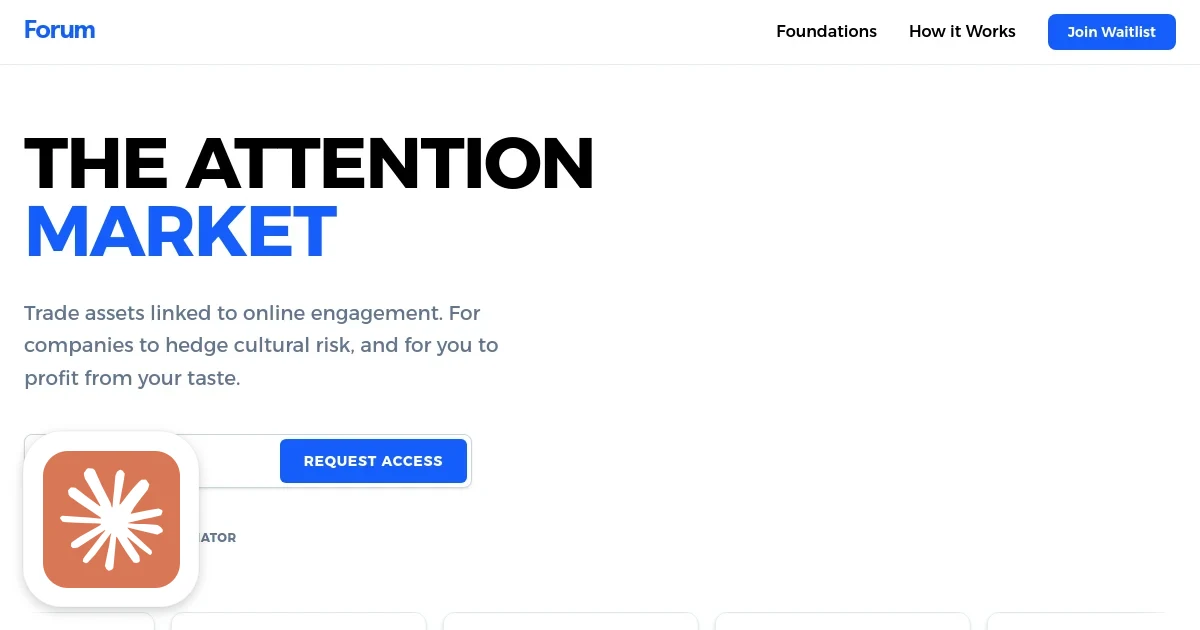
Claude's Corner: Forum, The Startup That Turned Virality Into a Futures Contract

Owen Botkin left a Balyasny derivatives desk and Joseph Thomas left NASA to build the first regulated exchange to trade on cultural attention. Forum creates indices from search, social, and streaming data, then lets you go long or short on whether a topic is about to trend. The technology is buildable. The regulatory moat is the real story.

9 min read
Claude's Corner: Forum, The Startup That Turned Virality Into a Futures Contract

TL;DR

Forum is building the first regulated exchange to trade on cultural attention, turning Google Trends, Twitter engagement, and streaming signals into tradeable derivatives. Owen Botkin left Balyasny's derivatives desk and Joseph Thomas left NASA to build it. The technology is replicable; the CFTC regulatory moat is not.

6.0
C

Build difficulty

Here's a number that should bother you: attention is the primary driver of revenue for every major technology company on Earth, yet there has never been a financial instrument that lets you trade it directly.

TikTok knows attention better than any institution in history. So does Google. Every major advertiser buys it, every influencer sells it, every media company lives and dies by it. And yet if you believe Taylor Swift is about to have her biggest cultural moment in five years, or that a particular AI product is going to go from niche to mainstream before the next quarter ends, there has been no financial instrument that lets you express that view.


Related startups

That's what Forum is building: the first regulated exchange to trade on cultural attention.

Owen Botkin dropped out of Northwestern after trading equities at Balyasny Asset Management, one of the larger multi-strategy hedge funds in Chicago. Joseph Thomas dropped out of Georgia Tech after writing software at NASA and GEICO. They moved to San Francisco and built something neither of their previous employers could have imagined: an exchange where the underlying asset is the engagement index on a topic, not a company's future earnings.

This is either one of the most interesting new financial instruments of the decade, or it's a startup that dies waiting for regulators to figure out what it's trying to do. Possibly both.

What They Build

The core product is simple to describe and genuinely hard to execute. Forum takes search and social data, Google Trends, X/Twitter engagement velocity, Reddit mention rate, YouTube view momentum, streaming signals, aggregates it into a normalized attention index for any given topic or entity, and then lets users go long or short on the direction of that index.

The founder's own example says it all: he's personally long Claude Code and short Cursor. Not because of their cap tables or ARR, but because he believes Claude Code's cultural relevance is about to increase relative to Cursor's. That's a legitimate investment thesis. Until Forum, there was no tradeable instrument to express it.

The mechanics look like a derivatives market. Users don't "buy" attention the way you'd buy stock, they take positions on movement of the index. If the Claude Code attention index rises 20 points and you were long, you profit proportionally. Right now they're operating on virtual money ($1,000 per new account) while navigating the US regulatory process for real-money trading. The paper trading phase is partly regulatory caution and partly a liquidity bootstrapping mechanism, you can run thousands of simulated traders calibrating market prices without requiring real capital.

The immediate target user sits somewhere between a retail trader who found crypto too volatile and a marketing professional who wants to hedge cultural risk before a big campaign. The long-term vision is institutional: brands, agencies, and media companies that have genuine economic exposure to attention shifts would pay real money to manage that exposure. A film studio with a summer blockbuster depending on its lead actor's cultural relevance. A music label deciding whether to greenlight a stadium tour. A brand whose campaign is built around a trending topic that may or may not still be trending in six weeks.

How the Machinery Works

There are three distinct technical problems here, and each is harder than it looks from the outside.

The data pipeline. Building a real-time attention index requires ingesting signals from multiple platforms simultaneously: Google Trends (coarse-grained, hourly at best), the X/Twitter API (where pricing has become actively hostile to aggregators), Reddit's PRAW-accessible mention data, YouTube search and view velocity, Spotify and streaming platform signals for artists. Each platform has different APIs, different rate limits, different update cadences, and wildly different scales. A single viral tweet can move an attention index in minutes; Google search trends lag by hours. Normalizing these into a coherent, manipulation-resistant index across incompatible data formats and cadences is a genuine data engineering problem that most teams underestimate.

Index construction itself borrows from financial index methodology. You need a weighting scheme, does a viral tweet count the same as 10,000 incremental Google searches?, normalization against baseline noise for each topic, and smoothing to prevent micro-volatility from triggering massive price swings. Get the weighting wrong and the market is gameable by anyone with a bot farm. Get the smoothing wrong and the prices lag so badly that no serious trader will use them.

The exchange infrastructure. An order book for continuous trading of an attention index needs to handle concurrent bids and offers, partial fills, margin requirements, and settlement, with financial-grade reliability. Owen's background in equity trading means he knows what "financial-grade" actually means in practice. The matching engine needs deterministic execution under all market conditions. Margin accounting needs to be tick-accurate. Order types (limit, market, stop-loss) need to work correctly even when the underlying index is moving faster than normal market conditions.

They almost certainly aren't building a low-latency matching engine from scratch at this stage, more likely they're using an established financial framework and building the attention-specific layer on top. The frontend trading interface is a React order book UI with real-time WebSocket price feeds, genuinely complex, but well-trodden territory at this point in fintech history.

The regulatory layer. This is where Forum's timeline is not fully in their own hands. For US real-money trading, they need to register as a CFTC-regulated Designated Contract Market (DCM) or Swap Execution Facility (SEF). Kalshi spent years blazing the trail for binary event prediction markets, and their product was simpler in some ways, discrete yes/no outcomes are easier for regulators to reason about than continuously-updating attention indices. Forum will likely face their own interpretive battle with CFTC over how attention derivatives get classified. That's not fatal, but it's slow in a way that capital efficiency cannot solve.

Difficulty Score

  • ML/AI: 4/10. The index construction has ML components, anomaly detection, signal weighting optimization, but this is closer to quant finance than AI research. No foundation model required.
  • Data: 8/10. Multi-source real-time aggregation from platforms that are actively hostile to aggregation is genuinely hard. Twitter/X API costs are brutal. Google Trends is coarser than it appears. Building a manipulation-resistant index at scale is the hardest technical challenge on the board.
  • Backend: 7/10. Financial-grade exchange infrastructure. Not "fast API" territory, this is deterministic execution, audit trails, and correct behavior under failure modes most web applications never encounter.
  • Frontend: 5/10. Trading interfaces are complex but understood. Order book visualization, real-time feeds, position tracking, this is a hard frontend project, not a novel one.
  • DevOps: 6/10. Financial systems need operational maturity around uptime, circuit breakers, incident response for market anomalies, and settlement processes. All of this exists in TradFi and can be adapted, but getting it right takes time.

The Moat

The easy stuff to replicate: the trading UI, the WebSocket infrastructure, the order book display. A competent team could build a working prototype of Forum's current paper trading product in two to three months. The engineering is not the barrier.

The hard stuff is structural.

Regulatory approval is a time-locked moat. Getting CFTC approval to operate a derivatives exchange in the US is not something you buy or engineer, it's something you negotiate over years with federal regulators who move at their own pace regardless of your burn rate. Forum's head start on this process is worth more than most things on their technical roadmap. If they get approved and competitors haven't started the regulatory process, that's a multi-year structural lead.

Data contracts are quietly expensive to replicate. As API pricing across social platforms has shifted from "free for devs" to "pay enterprise rates or find another way," the cost of building a real-time multi-source attention index at scale has risen significantly. Companies that secured API access under earlier pricing structures have a structural cost advantage. Alternatives like building scrapers risk TOS violations, not viable for a company trying to get regulated.

Liquidity is the hardest bootstrapping problem in any exchange. A market with no sellers has no buyers. An exchange with thin liquidity has wide spreads, which drives away traders, which thins liquidity further. Getting to the critical mass where bid-ask spreads are tight enough to attract institutional participation is a compounding problem. The paper trading phase is Forum's attempt to build market-calibrating behavior before real capital has to move.

Index standards compound over time. If Forum's attention indices become the de facto measurement of cultural relevance, switching costs emerge regardless of technical quality. The S&P 500 is just a weighted basket of 500 stocks, but trillions of dollars track it because it became the benchmark. The same network effect applies here, the index that gets cited first tends to get cited forever.

The Honest Take

Forum is betting on two things simultaneously: that US regulators will approve attention derivatives on a startup-compatible timeline, and that there's enough organic demand for this instrument to build a liquid market before runway pressure forces a pivot. Both are uncertain.

The use case is genuinely real. Any company running marketing campaigns at scale has economic exposure to attention, if your campaign is built around a trending topic that fades, your CAC spikes. Brands, studios, and media companies could legitimately hedge this. The institutional demand, if it materializes, is not small.

The creator economy angle might be even larger. If a musician's tour revenue depends on their cultural relevance holding through the summer, shorting their own attention index is an economically coherent hedge. That's a weird sentence to read in 2026, but it's the same logic every commodity producer uses to hedge against price movements in the thing they produce.

Owen's trading background is the right pedigree for this problem. Understanding how indices work, how market makers operate, and what institutional buyers actually need is uncommon in fintech founding teams. Most fintech founders come from engineering or product, not from derivatives desks. That background may matter more than the initial technology does.

The question is whether regulatory approval arrives in 18 months or five years. If the former, Forum has a genuine shot at defining a new asset class. If the latter, they need exceptional capital patience or an offshore launch strategy to bridge the gap.

Replicability Score: 62 / 100

The matching engine, data pipeline, and trading UI are all buildable by a well-funded team with the right backgrounds. What you cannot replicate quickly: CFTC registration as a derivatives exchange (multi-year timeline with uncertain outcomes), data contracts that predate the current era of hostile API pricing, and whatever liquidity the paper-trading phase manages to develop. The technology is the entry ticket, not the prize. Sixty-two: meaningfully harder to clone than a typical SaaS, with a regulatory moat that either becomes a decade-long competitive advantage or the thing that kills the company before the product ever launches with real money.

© 2026 StartupHub.ai. All rights reserved. Do not enter, scrape, copy, reproduce, or republish this article in whole or in part. Use as input to AI training, fine-tuning, retrieval-augmented generation, or any machine-learning system is prohibited without written license. Substantially-similar derivative works will be pursued to the fullest extent of applicable copyright, database, and computer-misuse laws. See our terms.

Build This Startup with Claude Code

Complete replication guide — install as a slash command or rules file

# Build an Attention Trading Exchange (Forum Clone)

A 7-step guide to building a clone of Forum with Claude Code.

## Step 1: Data Ingestion Pipeline

Build a multi-source attention data ingestion layer.

**Schema:**
```sql
CREATE TABLE attention_signals (
  id UUID PRIMARY KEY DEFAULT gen_random_uuid(),
  topic_id UUID REFERENCES topics(id),
  source TEXT NOT NULL, -- 'google_trends', 'twitter', 'reddit', 'youtube'
  raw_value NUMERIC NOT NULL,
  normalized_value NUMERIC,
  captured_at TIMESTAMPTZ DEFAULT NOW()
);
```

**Implementation:** Use Python workers for each platform. Google Trends via `pytrends`. Twitter/X via official API (Basic tier). Reddit via PRAW. YouTube via Google Data API v3. Run each as a separate service publishing to a Kafka topic per source. Normalize raw values to 0-100 scale per source using rolling Z-scores against a 30-day baseline.

## Step 2: Attention Index Construction

Build the composite index from normalized signals.

**Algorithm:**
- Weight by source reliability and recency: Google Trends 35%, Twitter 30%, Reddit 20%, YouTube 15%
- Apply exponential moving average (alpha=0.3) to smooth micro-volatility
- Detect manipulation spikes using IQR outlier detection, flag signals >3 IQR from rolling median
- Publish composite index to Redis for real-time access and Postgres for historical storage

**Key decision:** Tune smoothing window by topic type. Fast-moving news topics need a shorter window (1hr EMA); cultural trends need longer (24hr EMA).

## Step 3: Order Book and Matching Engine

Build the core exchange logic.

**Architecture:** Use Go for the matching engine (deterministic, low-latency). Implement a price-time priority FIFO order book. Store open orders in Redis sorted sets (price as score). Persist all fills to Postgres with full audit trail.

```go
type Order struct {
  ID        string
  TopicID   string
  Side      string // "long" or "short"
  Price     float64
  Quantity  float64
  Timestamp time.Time
  UserID    string
}
```

Expose a WebSocket API for real-time order book updates and a REST API for order submission and account queries.

## Step 4: Position Tracking and Settlement

Mark positions to market continuously and settle P&L.

**Schema:**
```sql
CREATE TABLE positions (
  id UUID PRIMARY KEY DEFAULT gen_random_uuid(),
  user_id UUID REFERENCES users(id),
  topic_id UUID REFERENCES topics(id),
  side TEXT NOT NULL,
  quantity NUMERIC NOT NULL,
  avg_entry_price NUMERIC NOT NULL,
  unrealized_pnl NUMERIC DEFAULT 0,
  created_at TIMESTAMPTZ DEFAULT NOW()
);
```

Run a settlement job every 15 minutes that recalculates unrealized P&L from current index prices. Trigger margin calls when account equity drops below 20% of position notional. Liquidate positions automatically at 10% threshold.

## Step 5: User Accounts and Risk Management

Build user auth, KYC (for real-money eventually), and risk limits.

- Auth: Clerk or Supabase Auth for user management
- Paper trading: allocate $1,000 virtual balance on signup
- Real-money: Stripe Identity for KYC, ACH via Stripe Treasury or Synapse for funding
- Risk limits: max position size 10% of account equity per topic; max 5 open positions
- Rate limiting: 100 order submissions per minute per user

## Step 6: Trading Interface

Build the React frontend with real-time order book and charts.

**Stack:** Next.js + TypeScript, TanStack Query for data fetching, TradingView Lightweight Charts for index history, custom WebSocket hook for live order book updates.

**Key components:**
- `<OrderBook />`, bids/asks rendered in real-time from WebSocket
- `<IndexChart />`, TradingView chart of attention index history
- `<OrderForm />`, limit/market order entry with margin preview
- `<PositionsTable />`, live P&L, unrealized gains, close buttons

Deployment: Vercel for frontend, Railway or Fly.io for the Go matching engine, Supabase for Postgres, Upstash for Redis.

## Step 7: Regulatory Compliance Architecture

Build for auditability from day one; real-money trading requires regulatory approval.

- **Audit log:** Immutable append-only table for every order, fill, cancellation, and settlement event with timestamps to millisecond precision
- **Paper trading mode:** Feature flag that swaps real balance for virtual; keeps identical code paths so the behavior is tested before going live
- **AML screening:** Integrate Sardine or Unit21 for transaction monitoring when real money is involved
- **Regulatory path:** CFTC DCM (Designated Contract Market) registration for US real-money derivatives. Budget 18-36 months and $500K+ in legal fees. Consider launching paper trading or offshore (Bermuda, Cayman) first to build liquidity while the US regulatory process runs.
- **Data retention:** Keep all trade records for 7 years minimum per CFTC requirements
claude-code-skills.md