

Tim Angers on Graphs for Smarter AI

Tim Angers of The Good Collective demystifies graph data structures and algorithms for AI, showing how to build better graphs for smarter, cheaper, and more reliable AI applications.

8 min read
Presentation slide titled 'A Practitioner's Guide to Graphs' with 'GoodCollective' logo.
AI Engineer

Visual TL;DR. Tim Angers: Graphs presents Graphs for AI. Graphs for AI requires Define a Graph. Define a Graph needs Schema is Key. Schema is Key leads to Enhanced AI. Tim Angers: Graphs warns against Avoid Pitfalls. Enhanced AI enables Future of Graphs.

  1. Tim Angers: Graphs: from The Good Collective demystifies graph data structures and algorithms for AI
  2. Graphs for AI: make AI applications smarter, cheaper, and more reliable for various uses
  3. Define a Graph: collection of nodes connected by edges, enhanced with labels, properties, and directionality
  4. Schema is Key: defining a schema is crucial for extracting meaningful value from graph data
  5. Avoid Pitfalls: don't rush into graph solutions like GraphRAG without understanding nuances
  6. Enhanced AI: using graph algorithms for more sophisticated and robust AI applications
  7. Future of Graphs: exploring advanced applications and continued evolution of graph technology in AI
Visual TL;DR
Visual TL;DR, startuphub.ai Tim Angers: Graphs presents Graphs for AI. Schema is Key leads to Enhanced AI presents leads to Tim Angers: Graphs Graphs for AI Schema is Key Enhanced AI From startuphub.ai · The publishers behind this format
Visual TL;DR, startuphub.ai Tim Angers: Graphs presents Graphs for AI. Schema is Key leads to Enhanced AI presents leads to Tim Angers:Graphs Graphs for AI Schema is Key Enhanced AI From startuphub.ai · The publishers behind this format
Visual TL;DR, startuphub.ai Tim Angers: Graphs presents Graphs for AI. Schema is Key leads to Enhanced AI presents leads to Tim Angers: Graphs from The Good Collective demystifies graphdata structures and algorithms for AI Graphs for AI make AI applications smarter, cheaper, andmore reliable for various uses Schema is Key defining a schema is crucial forextracting meaningful value from graphdata Enhanced AI using graph algorithms for moresophisticated and robust AI applications From startuphub.ai · The publishers behind this format
Visual TL;DR, startuphub.ai Tim Angers: Graphs presents Graphs for AI. Schema is Key leads to Enhanced AI presents leads to Tim Angers:Graphs from The GoodCollectivedemystifies graph… Graphs for AI make AIapplicationssmarter, cheaper,… Schema is Key defining a schemais crucial forextracting… Enhanced AI using graphalgorithms for moresophisticated and… From startuphub.ai · The publishers behind this format
Visual TL;DR, startuphub.ai Tim Angers: Graphs presents Graphs for AI. Graphs for AI requires Define a Graph. Define a Graph needs Schema is Key. Schema is Key leads to Enhanced AI. Tim Angers: Graphs warns against Avoid Pitfalls. Enhanced AI enables Future of Graphs presents requires needs leads to warns against enables Tim Angers: Graphs from The Good Collective demystifies graphdata structures and algorithms for AI Graphs for AI make AI applications smarter, cheaper, andmore reliable for various uses Define a Graph collection of nodes connected by edges,enhanced with labels, properties, anddirectionality Schema is Key defining a schema is crucial forextracting meaningful value from graphdata Avoid Pitfalls don't rush into graph solutions likeGraphRAG without understanding nuances Enhanced AI using graph algorithms for moresophisticated and robust AI applications Future of Graphs exploring advanced applications andcontinued evolution of graph technology inAI From startuphub.ai · The publishers behind this format
Visual TL;DR, startuphub.ai Tim Angers: Graphs presents Graphs for AI. Graphs for AI requires Define a Graph. Define a Graph needs Schema is Key. Schema is Key leads to Enhanced AI. Tim Angers: Graphs warns against Avoid Pitfalls. Enhanced AI enables Future of Graphs presents requires needs leads to warns against enables Tim Angers:Graphs from The GoodCollectivedemystifies graph… Graphs for AI make AIapplicationssmarter, cheaper,… Define a Graph collection of nodesconnected by edges,enhanced with… Schema is Key defining a schemais crucial forextracting… Avoid Pitfalls don't rush intograph solutionslike GraphRAG… Enhanced AI using graphalgorithms for moresophisticated and… Future of Graphs exploring advancedapplications andcontinued evolution… From startuphub.ai · The publishers behind this format

Tim Angers from The Good Collective recently delivered a presentation titled "A Practitioner's Guide to Graphs," focusing on how graph data structures and algorithms can make AI applications "smarter, cheaper, and more reliable." Angers acknowledged that while graphs are a beautiful and powerful foundation in computer science, they aren't a universal solution, warning against the common pitfall of rushing into graph-based solutions like GraphRAG or graph databases without understanding their nuances.

Tim Angers on Graphs for Smarter AI - AI Engineer
Tim Angers on Graphs for Smarter AI — from AI Engineer

The Fundamentals of Graphs in AI

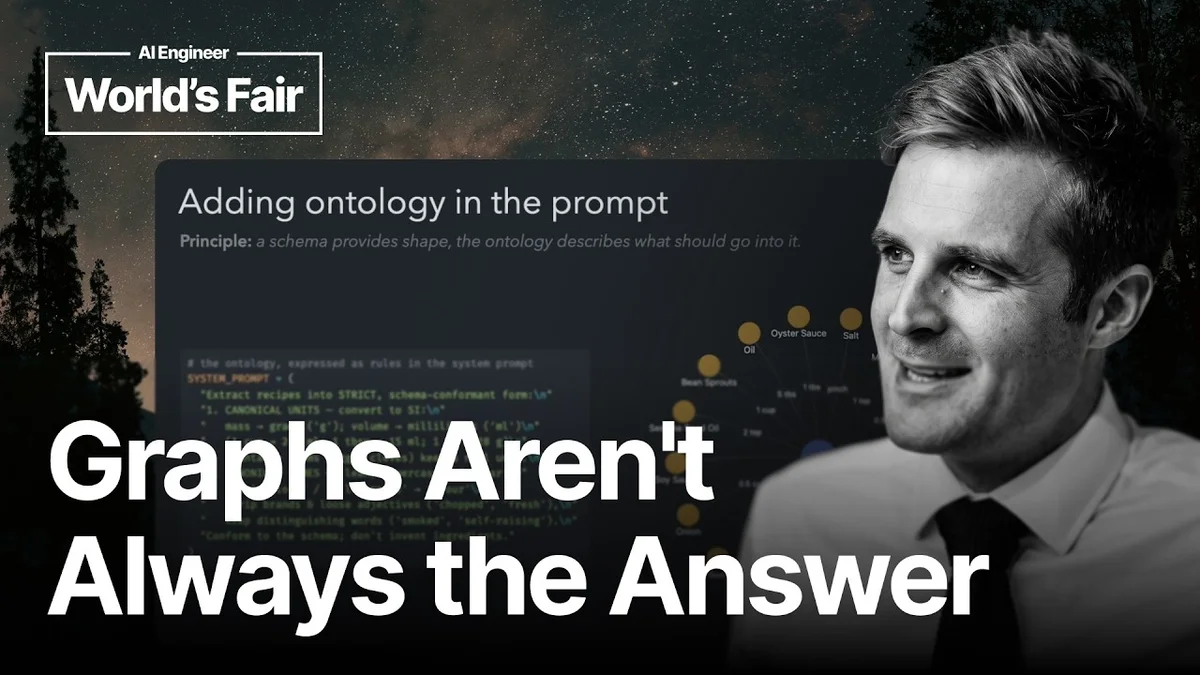
Angers began by defining a graph as a collection of nodes (or vertices) connected by edges (or relationships). He emphasized that the meaning and utility of a graph can be significantly enhanced by adding labels, properties, and directionality to these nodes and edges. A key principle he highlighted for extracting value from graphs is the importance of defining a schema. Using the example of extracting information from a recipe, Angers demonstrated how a simple triple-based extraction yielded a basic graph, but defining a more structured schema, such as one that specifies ingredients with quantities and units, resulted in a far more meaningful and interrogable graph.

He further elaborated on enriching the graph by adding ontology, which dictates how information is extracted and standardized. This includes standardizing units and ingredient names to facilitate easier matching and conversion. Angers also touched upon the challenge of entity resolution, where variations like "garlic cloves" and "minced garlic" might represent the same ingredient. He showcased how embedding models, in conjunction with graph techniques, offer a more flexible approach to matching entities, even for terms not explicitly known in advance.

Graph Algorithms for Enhanced AI

Once a well-structured and curated graph is built, Angers explored its potential applications through various graph algorithms. He started with simple queries, comparing graph database query languages like Cypher to traditional SQL, noting that traversing multiple relationships becomes significantly more natural and efficient in a graph context.

Angers then introduced Personalized PageRank (PPR), a variant of the classic PageRank algorithm. He explained PPR's mechanism of a random walker who teleports back to a starting node, allowing for the identification of nodes with stronger relationships to that starting point. He cited Pinterest's recommendation engine and the Hippo Rag system for linking memories to questions as real-world examples of PPR's utility. Angers noted that PPR algorithms are particularly effective in dense clusters where identifying key relationships is challenging.

The shortest path algorithm was presented as another powerful tool for understanding relationships between two nodes. Angers suggested its application in code graphs to trace the lineage of a bug or to retrieve relevant context for AI agents, noting a significant reduction in tool calls for code search when such techniques are employed.

Finally, Angers discussed subgraph matching, which allows for the identification of specific patterns within a graph, even without knowing the exact node details beforehand. He illustrated this with the example of finding a decorator pattern in code, highlighting its ability to uncover complex relationships and structures that might be missed by other methods.

The Future of Graphs in AI

Angers concluded by summarizing the covered topics: navigating paths, ranking importance, and finding patterns. He also briefly mentioned other graph algorithms like prediction, similarity, and clustering, noting that these areas, along with dynamic graphs and schema-less graphs, represent exciting future directions. He encouraged the audience to explore these concepts further, emphasizing that by applying graph-native or hybrid algorithms, developers can build AI applications that are not only smarter but also more cost-effective and reliable.
© 2026 StartupHub.ai. All rights reserved. Do not enter, scrape, copy, reproduce, or republish this article in whole or in part. Use as input to AI training, fine-tuning, retrieval-augmented generation, or any machine-learning system is prohibited without written license. Substantially-similar derivative works will be pursued to the fullest extent of applicable copyright, database, and computer-misuse laws. See our terms.