Stripe's Kaliski on Building Safe AI Payments

Stripe's Steve Kaliski explains how the company is building payment infrastructure for the autonomous economy, focusing on secure, deterministic transactions for AI agents.

8 min read
Steve Kaliski speaking at a conference about AI and payments
AI Engineer

Steve Kaliski, a Principal Software Engineer at Stripe, recently discussed the critical need for secure payment infrastructure to support the burgeoning autonomous economy. Speaking at an AI Engineer Europe event, Kaliski outlined the challenges and solutions Stripe is developing to enable AI agents to transact safely and effectively.
Stripe's Kaliski on Building Safe AI Payments - AI Engineer
Stripe's Kaliski on Building Safe AI Payments — from AI Engineer

Visual TL;DR. AI agents as economic actors leads to Determinism needed for payments. Determinism needed for payments leads to Agent transaction challenges. Agent transaction challenges solves Stripe's Shared Payment Tokens. Stripe's Shared Payment Tokens and Stripe's Protocols. Stripe's Protocols enables Demoing solutions. Demoing solutions resulting in Future of AI Payments.

  1. AI agents as economic actors: AI agents are becoming sophisticated economic actors needing financial tools
  2. Determinism needed for payments: core financial transactions require strict determinism, unlike AI discovery
  3. Agent transaction challenges: enabling AI agents to transact powerfully and safely is a challenge
  4. Stripe's Shared Payment Tokens: using shared payment tokens for secure, deterministic AI transactions
  5. Stripe's Protocols: developing standardized protocols for AI agent financial interactions
  6. Demoing solutions: demonstrating the practical application of these secure payment solutions
  7. Future of AI Payments: building infrastructure for the autonomous economy's payment needs
Visual TL;DR
Visual TL;DR — startuphub.ai AI agents as economic actors leads to Determinism needed for payments. Stripe's Shared Payment Tokens and Stripe's Protocols and AI agents as economic actors Determinism needed for payments Stripe's Shared Payment Tokens Stripe's Protocols Future of AI Payments From startuphub.ai · The publishers behind this format
Visual TL;DR — startuphub.ai AI agents as economic actors leads to Determinism needed for payments. Stripe's Shared Payment Tokens and Stripe's Protocols and AI agents aseconomic actors Determinismneeded for… Stripe's SharedPayment Tokens Stripe'sProtocols Future of AIPayments From startuphub.ai · The publishers behind this format
Visual TL;DR — startuphub.ai AI agents as economic actors leads to Determinism needed for payments. Stripe's Shared Payment Tokens and Stripe's Protocols and AI agents as economic actors AI agents are becoming sophisticatedeconomic actors needing financial tools Determinism needed for payments core financial transactions require strictdeterminism, unlike AI discovery Stripe's Shared Payment Tokens using shared payment tokens for secure,deterministic AI transactions Stripe's Protocols developing standardized protocols for AIagent financial interactions Future of AI Payments building infrastructure for the autonomouseconomy's payment needs From startuphub.ai · The publishers behind this format
Visual TL;DR — startuphub.ai AI agents as economic actors leads to Determinism needed for payments. Stripe's Shared Payment Tokens and Stripe's Protocols and AI agents aseconomic actors AI agents arebecomingsophisticated… Determinismneeded for… core financialtransactionsrequire strict… Stripe's SharedPayment Tokens using sharedpayment tokens forsecure,… Stripe'sProtocols developingstandardizedprotocols for AI… Future of AIPayments buildinginfrastructure forthe autonomous… From startuphub.ai · The publishers behind this format
Visual TL;DR — startuphub.ai AI agents as economic actors leads to Determinism needed for payments. Determinism needed for payments leads to Agent transaction challenges. Agent transaction challenges solves Stripe's Shared Payment Tokens. Stripe's Shared Payment Tokens and Stripe's Protocols. Stripe's Protocols enables Demoing solutions. Demoing solutions resulting in Future of AI Payments leads to solves and enables resulting in AI agents as economic actors AI agents are becoming sophisticatedeconomic actors needing financial tools Determinism needed for payments core financial transactions require strictdeterminism, unlike AI discovery Agent transaction challenges enabling AI agents to transact powerfullyand safely is a challenge Stripe's Shared Payment Tokens using shared payment tokens for secure,deterministic AI transactions Stripe's Protocols developing standardized protocols for AIagent financial interactions Demoing solutions demonstrating the practical application ofthese secure payment solutions Future of AI Payments building infrastructure for the autonomouseconomy's payment needs From startuphub.ai · The publishers behind this format
Visual TL;DR — startuphub.ai AI agents as economic actors leads to Determinism needed for payments. Determinism needed for payments leads to Agent transaction challenges. Agent transaction challenges solves Stripe's Shared Payment Tokens. Stripe's Shared Payment Tokens and Stripe's Protocols. Stripe's Protocols enables Demoing solutions. Demoing solutions resulting in Future of AI Payments leads to solves and enables resulting in AI agents aseconomic actors AI agents arebecomingsophisticated… Determinismneeded for… core financialtransactionsrequire strict… Agent transactionchallenges enabling AI agentsto transactpowerfully and… Stripe's SharedPayment Tokens using sharedpayment tokens forsecure,… Stripe'sProtocols developingstandardizedprotocols for AI… Demoing solutions demonstrating thepracticalapplication of… Future of AIPayments buildinginfrastructure forthe autonomous… From startuphub.ai · The publishers behind this format

The Autonomous Economy and Payment Needs

Kaliski began by establishing that AI agents are not just theoretical constructs but are already becoming economic actors. He highlighted a key takeaway: while AI agents benefit from non-determinism in discovery and exploration, core financial transactions like payments and checkout require strict determinism. This distinction is crucial for building reliable and secure financial systems for AI.

Related startups

The fundamental challenge lies in enabling AI agents to interact with the financial system in a way that is both powerful and safe. As agents become more sophisticated, they will need to manage their own resources and execute transactions. This necessitates a shift from human-centric payment systems to ones that can accommodate machine-to-machine interactions.

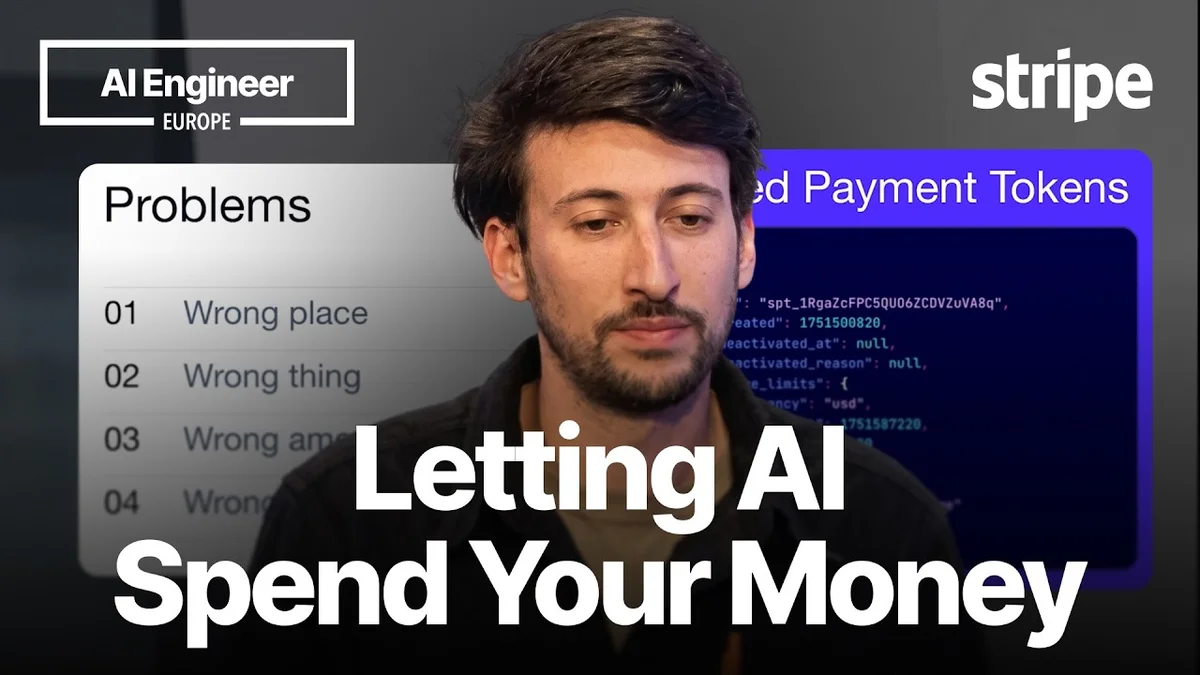
Problems in Agent Transactions

Kaliski identified several potential failure points when AI agents interact with e-commerce and payment systems:

  • Wrong Place: Ensuring an agent interacts with the correct, legitimate domain to prevent phishing or fraudulent transactions.
  • Wrong Thing: AI agents might select incorrect items or miss crucial add-ons due to the complexity of navigating websites.
  • Wrong Amount: Fluctuations in pricing, currency conversions, taxes, and miscalculations can lead to incorrect payment amounts.
  • Wrong Credential: While credit card details can sometimes be pasted, other payment methods are much harder for agents to input, posing a significant hurdle.

Stripe's Approach: Shared Payment Tokens and Protocols

To address these challenges, Stripe has been developing several key components. Kaliski introduced Shared Payment Tokens (SPT), a mechanism that allows an agent to collect a payment credential and share it securely across multiple payment methods and sellers. This tokenization approach helps mitigate risks by limiting the exposure of sensitive payment information.

Furthermore, Stripe is pioneering the Machine Payments Protocol (MPP). Kaliski described MPP as essentially an API call with money attached, designed to bundle payments directly into deterministic flows. This protocol aims to provide a standardized way for AI agents to initiate and manage payments, ensuring that the correct amount is paid to the correct recipient.

The protocol also focuses on Agentic Commerce Protocol (ACP), which enables more nuanced communication between agents and sellers. This allows agents to express their purchasing intent and receive structured data about product details, pricing, shipping options, and tax information, thereby reducing errors and increasing the reliability of transactions.

Demoing the Solutions

Kaliski then provided a practical demonstration of these concepts. He showed how Stripe's API can be used to create a payment intent for an agent, specifying parameters like the amount, currency, and importantly, setting usage limits and an expiration date for the payment credential. This allows for fine-grained control over how the agent can spend funds.

The demonstration highlighted how agents can leverage these tools to securely acquire and use payment credentials, even across different payment methods. The key was to ensure that while agents could discover and interact with products, the actual payment and checkout processes remained deterministic and secure, with sellers retaining control over the transaction parameters.

The Future of AI Payments

Kaliski concluded by summarizing the core principles for building a safe autonomous economy: for sellers, applications need to be 'agent-friendly,' providing structured data and clear APIs. For agents, the focus should be on leveraging tools like SPTs and wallets to manage credentials safely and securely. By bridging the gap between discovery and deterministic transactions, Stripe aims to pave the way for a more robust and trustworthy autonomous economy.

© 2026 StartupHub.ai. All rights reserved. Do not enter, scrape, copy, reproduce, or republish this article in whole or in part. Use as input to AI training, fine-tuning, retrieval-augmented generation, or any machine-learning system is prohibited without written license. Substantially-similar derivative works will be pursued to the fullest extent of applicable copyright, database, and computer-misuse laws. See our terms.