


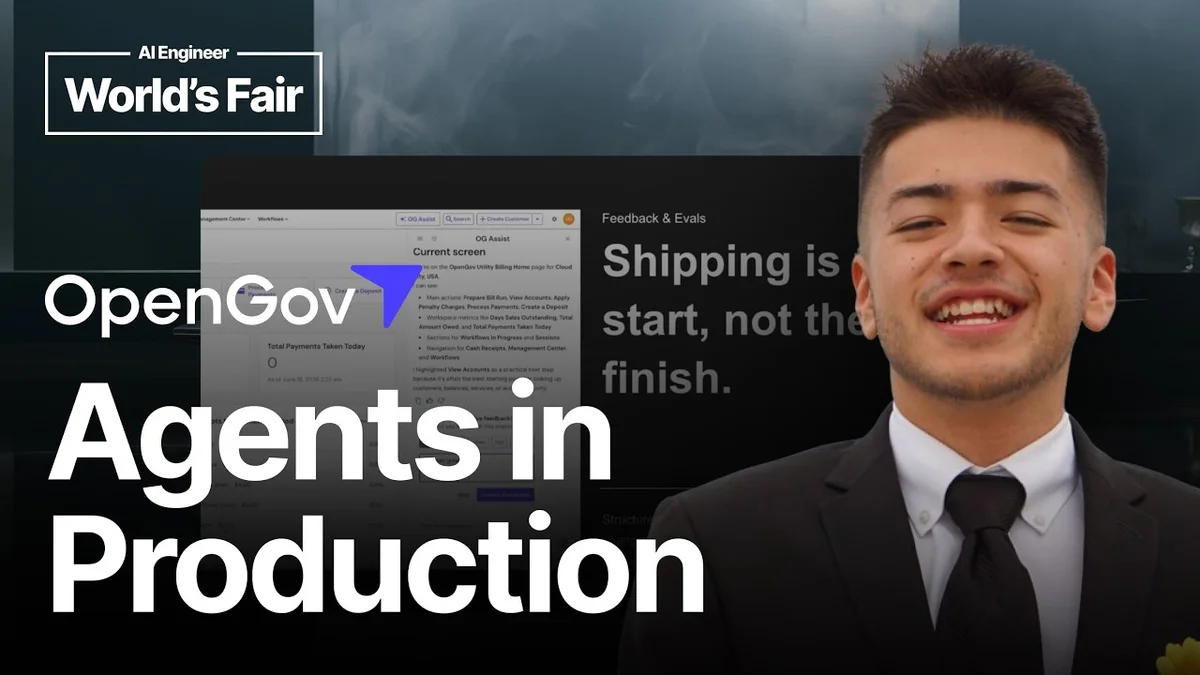
Gabe De Mesa, an engineer at OpenGov, shared insights into the company's journey of building and scaling their AI agent, OG Assist, in a presentation titled "Agents in Production: How OpenGov Built and Scaled OG Assist." The presentation offered a comprehensive look at the technical decisions, challenges, and strategies employed by OpenGov to bring AI agents into a production environment.
The Origin and Vision of OG Assist
De Mesa explained that the initiative began with a principal engineer spinning up a team focused on AI agents, which he was invited to join. OG Assist grew from this foundation, with the goal of integrating AI deeply into OpenGov's existing product suite. This integration was approached through both frontend and backend tools, aiming to enhance the user experience and operational efficiency.
Leveraging the Effect Framework and A2A Protocol
A significant portion of the presentation focused on the technical underpinnings of OG Assist. De Mesa highlighted the use of the Effect framework for building the agent's core loop, emphasizing its benefits in terms of type-native control flow, structured concurrency, and resource safety. He also detailed the adoption of the Agent-to-Agent (A2A) protocol, which was developed by Google, as the foundation for OG Assist's ability to interact with supported specifications. This protocol allows agents to discover and utilize other agents or tools, creating a more dynamic and capable AI system.
Key Features and Capabilities
De Mesa showcased several key capabilities of OG Assist. The agent can be integrated into the UI of OpenGov's products, providing contextual help and enabling users to perform tasks through natural language prompts. For instance, he demonstrated how a user could ask the agent to perform actions like creating a PDF or retrieving specific data, with the agent responding by generating the necessary output or providing options. The ability to handle long contexts was also emphasized, allowing the AI to maintain coherence and recall information across extended conversations.
Ensuring Safety and Scalability
Crucially, OpenGov focused on safety and scalability throughout the development process. De Mesa explained the use of sandboxing, where agent code runs in isolated environments, allowing them to take real actions without jeopardizing production systems or customer data. He also touched upon the importance of observability, stating, "You can't scale what you can't see." Every agent run is traced end-to-end, providing visibility for debugging, measurement, and tuning. Furthermore, maintaining "Humans in the Loop" was highlighted as a critical safety measure, with tool calls being gated behind UI requiring manual intervention and explicit user permission before execution.


