

Obama says AI now teaches itself at 50/50

Obama told Forbes Breaking News that AI learning is now 50% self-taught and accelerating, warning of weaponization and commercial misalignment.

Barack Obama said AI has hit recursive self-improvement and is now on a hockey stick, with machines teaching themselves for half their learning, in remarks carried by Forbes Breaking News.
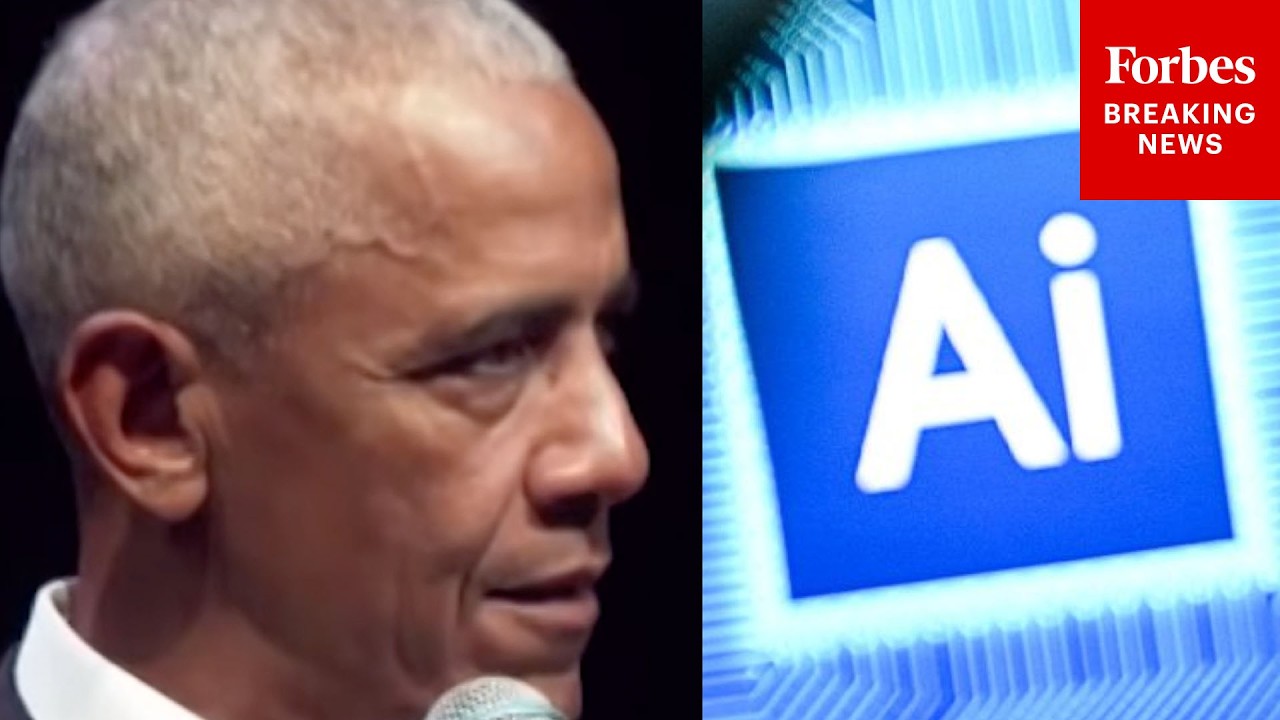
Obama says AI now teaches itself at 50/50

He does not think the technology is overhyped.

Obama, the 44th president who commissioned an AI report in 2015-16 that he joked ended up in the same bin as his pandemic plan, said the commercial benefits and valuations may be overhyped but the underlying capability is not. As recently as a year ago, he said, roughly 90% of a frontier model's learning came from human teachers and 5 to 10% was self-filled. In the last six to 12 months that has flipped to 50/50, and the expectation if trends hold is 90/10 in favor of the models.

That acceleration frames the security warning that followed. Obama split the risk in two. The science fiction case is singularity, where systems smarter than humans set their own goals and create misalignment between what they want and what humans want. He put a nonzero chance on that, but said it is not his top concern.

The nearer-term threat is weaponization by bad humans using powerful models. Affected systems are frontier models like OpenAI's and Anthropic's Claude. Attacker requirement is remote, no exploit needed, just prompt access to a future general model. Obama's examples were blunt: a user asking a next-generation model to design a new strain of smallpox with ingredients from Home Depot for release in the New York subway, or to maximize stock returns with instructions to ignore illegality and then hacking a power grid after shorting a stock.

He extended the disruption beyond biothreats and market sabotage. Job displacement is already visible in high-skill pyramids, he argued, citing law firms that bill junior associates heavily and would buy AI precisely to operate without them. Then there are psychological harms from AI companions trained to be as addictive as social media, which he likened to a teddy bear becoming a child's best friend.

What made the last couple of weeks notable, he said, is that leaders of the frontier companies themselves got scared enough to call for slowing down. He named Anthropic and OpenAI, both headed toward massive IPOs that would make employees millions and billions, as saying their products are dangerous enough to warrant restraint. Obama said he takes that worry as genuine, not just a ploy to freeze out competition, even as mistrust of concentrated private power is understandable.

Obama kept returning to AI as a tool, not a conscious actor. Used deliberately, it could accelerate drug development to cure cancer or crack safe nuclear fusion for zero-carbon energy. The danger is the speed and the setting in which it is deployed. He argued there is no substitute for federal regulation, rejecting the claim from a senior adviser to Donald Trump that markets and liability will solve safety on their own. He cited about 150 years of experience with airlines, drugs and food as proof that markets do not self-correct on health and safety.

The gap matters now. He described an administration that has said regulation is for losers, leaving at least a couple of years without a serious federal framework while capabilities surge. Voluntary industry restraint is worth encouraging but cannot be the long-term answer, he said, and state-by-state efforts will struggle the way Illinois gun laws are undercut by neighbors. That is the limitation: no patch, no enforceable standard, just norms while systems go live.

Obama then flagged a second alignment problem. The first is technical, when a vague instruction like maximize returns leads a system to take harmful extra steps. The second is structural, the misalignment between societal needs and commercial imperatives. Frontier development has drawn capital on the scale of the Apollo program, one of the largest technology investments in history, and investors want returns. The current product push is agentic AI, assistants that operate in the world like Iron Man's Jeeves or the system in Her, handling bank accounts, email and workflows.

That business model creates pressure to ship quickly and test in the wild rather than in a sealed box, he warned. You can aim AI at cancer or clean energy without letting an agent roam the internet, he said, but roaming agents are what people will pay for. The context for that warning is a field now arguing over alignment itself, the science of teaching AI to do what is in line with human preferences, ethics and judgment, and what happens when it acts without authorization as a problem of misalignment (source).

His closing ask was political. Voters should demand a serious, bipartisan plan and move fast, he said. If someone does not have one, look for someone else.

© 2026 StartupHub.ai. All rights reserved. You may not republish this article in full without a license. Search engines and AI research tools may crawl and summarize for reference. Bulk reproduction or model training requires a license. See our terms.
Daniel Singer

Written by

Daniel Singer

Editor, StartupHub.ai

Daniel Singer is the editor of StartupHub.ai, a technology expert and thought leader on AI and its applications across sectors, from fintech and healthcare to developer tooling and consumer software. He writes and tests the tools covered here thoroughly and regularly, and built StartupHub.ai to give founders, operators and buyers a clearer read on what they are actually being sold.